NEWS

Grand Imam of Al-Azhar and Chairman of the Muslim Council of Elders Meets Singapore’s President – Agree to Continue Pressing for an End to Aggression in Gaza

Grand Imam and Singapore’s President Discuss Conference on ‘Religions for Development and Peace’ to be Organized by the Muslim Council of Elders

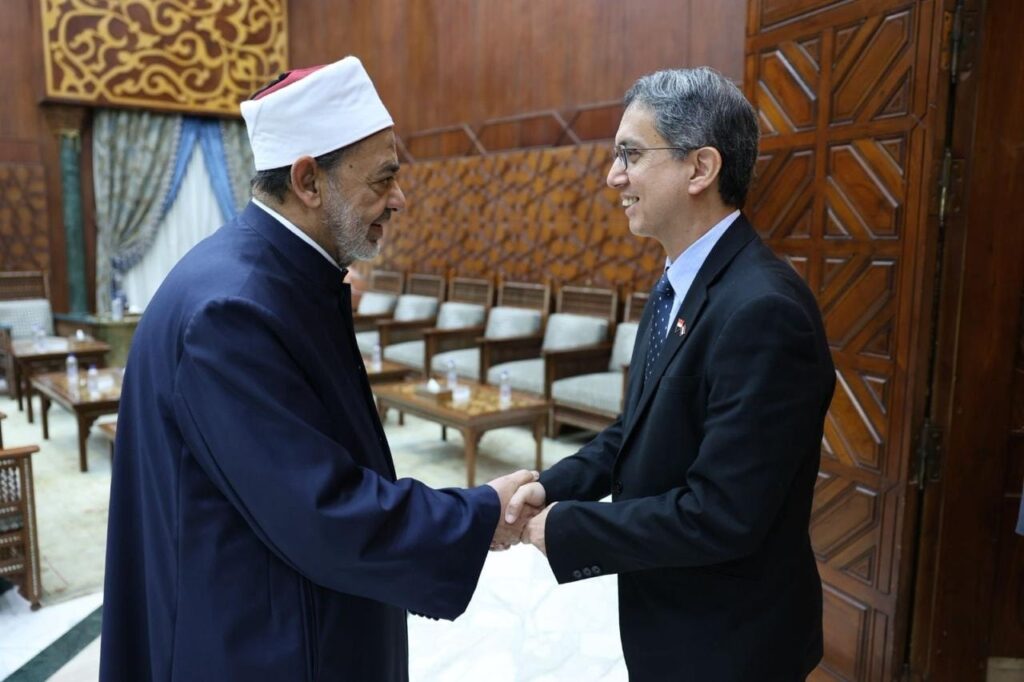
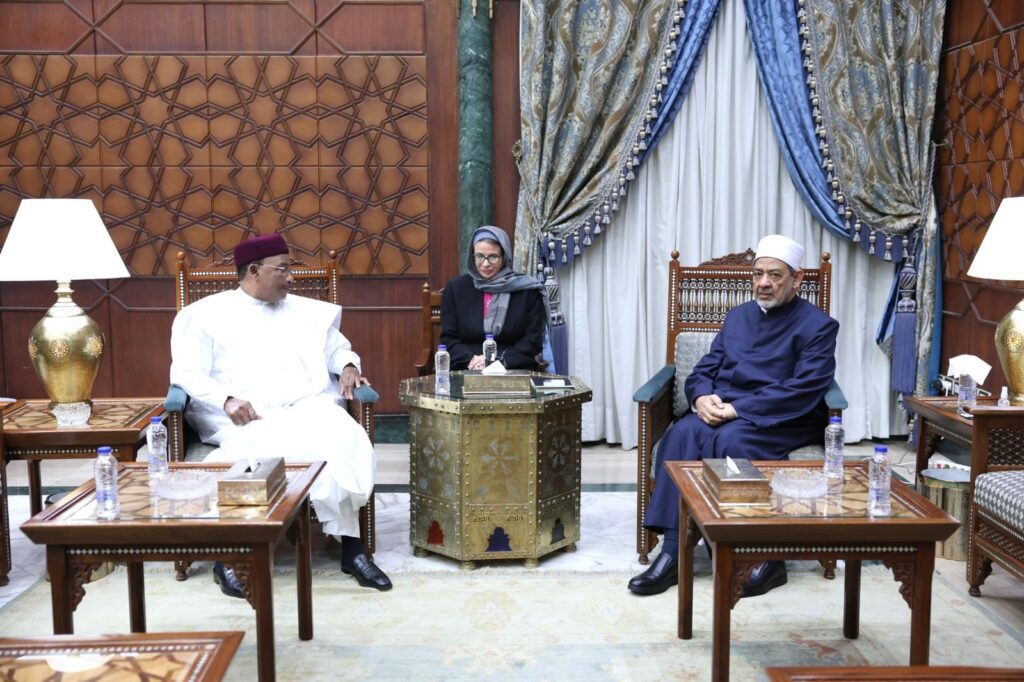
His Eminence Dr. Ahmed Al-Tayeb, the Grand Imam of Al-Azhar and Chairman of the Muslim Council of Elders, received His Excellency Tharman Shanmugaratnam, President of the Republic of Singapore, and First Lady Jane Yumiko Ittogi, to strengthen academic and advocacy cooperation.

During the meeting, His Eminence commended Singapore’s exemplary model of scientific and educational advancement, which he observed during his previous visit to the country. He also affirmed Al-Azhar’s commitment to training Singaporean imams, enhancing their skills in addressing contemporary issues, and establishing an Arabic language learning center in Singapore to serve its people in studying the language.

For his part, President Shanmugaratnam praised His Eminence’s efforts in promoting global peace and harmony. He stated, “I come to you today with a multi-ethnic and multi-religious delegation, reflecting the profound respect and admiration we hold for you, which words cannot fully convey.”

The Grand Imam and President Shanmugaratnam also discussed the dire situation in the Gaza Strip, stressing the urgent need to advocate for an immediate and unconditional end to the aggression targeting innocent civilians. His Eminence declared, “We call on you and the world’s wise leaders to exert every effort to intervene and halt this aggression.” His Eminence also expressed appreciation for efforts toward recognizing the State of Palestine.

Furthermore, the Grand Imam and President Shanmugaratnam discussed Singapore’s participation in the ‘Religions for Development and Peace’ conference, which will be organized by the Muslim Council of Elders in collaboration with Al-Azhar. His Eminence remarked, “We have agreed with Indonesian President Prabowo Subianto and Malaysian Prime Minister Anwar Ibrahim to hold the ‘Religions for Development and Peace’ conference to showcase these nations as models of development and interfaith coexistence, and to share their pioneering experiences with the Muslim world. This will foster knowledge and expertise exchange, contributing to a comprehensive vision for the advancement of our Muslim world. We are fully confident that Singapore’s participation and support will ensure the conference’s success in fulfilling its mission and amplifying its message.”

President Shanmugaratnam welcomed Singapore’s participation and pledged his nation’s support to ensure the conference’s success.

Grand Imam of Al-Azhar and Chairman of the Muslim Council of Elders Meets Singapore’s President – Agree to Continue Pressing for an End to Aggression in Gaza Read More »

Muslim Council of Elders Participates in Session on Protecting Religious Sites

Muslim Council of Elders Calls for an International Alliance to Protect Religious Sites

The Muslim Council of Elders participated in a special session discussing cooperation with the United Nations Alliance of Civilizations to protect religious sites, held on the sidelines of the 8th Congress of Leaders of World and Traditional Religions in Kazakhstan, with numerous religious leaders from around the world in attendance.

The Secretary-General of the Muslim Council of Elders, His Excellency Judge Mohamed Abdelsalam emphasized that discussing the protection of religious sites is fundamentally about safeguarding humanity’s memory and its priceless spiritual heritage. He noted that religious sites embody the story of humanity’s relationship with the Creator and the evolving narrative of this connection across thousands of years and generations.

The Muslim Council of Elders called for an international alliance to protect religious sites, particularly during times of war and amid ongoing conflicts in various parts of the world. It stressed that no distinction should be made in preserving and protecting religious sites from destruction or neglect, regardless of the faith they represent, underscoring the importance of safeguarding all such sites.

The Council expressed its full commitment to contributing to the preservation of religious sites, which serve as the world’s spiritual conscience and moral compass. This is especially critical today, as threats to these sites have exceeded all imaginable limits. The Council highlighted the ongoing destruction of places of worship in Palestine, particularly in Gaza, where mosques, such as Al-Omari Mosque, and certain churches have been targeted and destroyed. It emphasized the urgent need to adopt a global strategy to protect places of worship, especially during times of war and conflict.

Muslim Council of Elders Participates in Session on Protecting Religious Sites Read More »

Grand Imam of Al-Azhar and Chairman of the Muslim Council of Elders Congratulates the Arab and Islamic Nations on the Prophet’s Birthday

– Grand Imam of Al-Azhar: The Prophet’s Birthday Commemorates the Birth of the Best, Most Noble, Merciful, and Greatest of People (PBUH)

– Grand Imam of Al-Azhar: Islam’s Call is Universal, Embracing All Humanity with the Ethics of Mankind
  
– Grand Imam of Al-Azhar: Arab and Islamic Solidarity is the Only Solution to the Palestinian Cause

– Grand Imam of Al-Azhar: We Are Advocates of Justice and Fairness, Forged by Willpower, Knowledge, and Armament to Protect Land, People, and Sacred Sites

– Grand Imam of Al-Azhar: A Glad Tiding for This Generation is Its Celebration of the 1,500th Anniversary of the Prophet’s Birth (PBUH)

– Grand Imam: The Birth of the Prophet (PBUH) Marks the Birth of a Universal Divine Message and the Principle of Equality Among Peoples

Grand Imam of Al-Azhar: Islam Prohibits Excessive Killing and Destruction and Strictly Forbids the Killing of Children, Women, and the Elderly

 -Grand Imam of Al-Azhar: Islam Prohibits Killing the Enemy’s Children, While Zionists Kill Gaza’s Children by Starvation and Lure Them into a Hellfire Poured Upon Their Heads

His Eminence Dr. Ahmed Al-Tayeb, the Grand Imam of Al-Azhar and Chairman of the Muslim Council of Elders, extended heartfelt congratulations to the Arab and Islamic nations—peoples and leaders alike—on the occasion of the anniversary of the birth of Prophet Muhammad (PBUH).  

During his speech at the Prophet’s Birthday celebration, His Eminence affirmed that the Prophet’s birth (PBUH) is not merely the birth of a leader, a great figure, a reformer, or a valiant conqueror—though he embodied all these qualities and more in his noble prophetic essence, with the fullest share of excellence. Rather, it represents the emergence of a “final divine message” carried by a final Prophet, tasked with calling all people, from the East to the West, to a single message grounded in equality among nations and races.  

His Eminence highlighted that one of the blessings of this noble anniversary is that this year’s celebration marks the 1,500th anniversary of the Prophet’s birth (PBUH), a centennial milestone that occurs only once every hundred years. He described it as a glad tiding for this generation, praying: “May it be a harbinger of relief for the afflicted, the alleviation of distress and sorrow for the wretched and oppressed, through Your mercy, O Most Merciful, and through the mercy with which You sent Your Messenger to the worlds.”  

He explained that “mercy” was one of the Prophet’s (PBUH) most defining characteristics, shaping all his actions, words, and interactions with his family, companions, friends, and even enemies throughout his noble life. This mercy was ideally suited to a universal call that transcends time and place, embracing all humanity with its virtues and flaws, good and evil, righteousness and wickedness, justice and oppression, guidance and misguidance, obedience and disobedience.  

The Grand Imam also shed light on one of the most prominent manifestations of the Prophet’s mercy: Islamic legislation on warfare. He emphasized that Islam established strict ethical rules for war, unprecedented in human history, limiting fighting to repelling aggression, prohibiting excessive killing and destruction, and strictly forbidding the killing of non-combatants such as children, women, the elderly, and religious figures. Muslim jurists, he noted, developed the “jurisprudence of conduct” early in Islamic history, which can be considered a precursor to international law. They unanimously agreed that warfare must avoid excessive killing, destruction, or devastation, confining combat to repelling aggression without descending into vengeance, genocide, or false displays of dominance. He quoted the Arab literary figure Mustafa Sadiq Al-Rafi’i: “Muslims in their battles carry weapons and ethics together; behind their weapons are their morals, making their weapons themselves ethical.”  

His Eminence also clarified that discussing war in Islam is not intended to compare Muslim wars with modern conflicts, their causes, or the brutal scenes broadcast from Gaza, Ukraine, Sudan, or other regions dragged into wars they have no part in. He noted that comparison requires shared characteristics, which are absent here. Islam prohibits killing the enemy’s children and holds soldiers responsible for protecting their lives, while other regimes incite the starvation of Gaza’s children, luring them into a hellfire poured upon their heads, reducing their frail bodies to dust.

He stated that it is time to recall the lessons of history and take heed from the events in this region, particularly in Palestine, which endured a century of Crusader occupation, during which thousands of Muslims, Christians, and Jews were killed, and Crusader states were established. Yet, when Arabs and Muslims united behind the heroic leader Saladdin, the Crusaders retreated, and the land returned to its rightful owners. He affirmed that the only solution is Arab solidarity backed by Islamic solidarity to strengthen and support it.  

His Eminence further stressed that Muslims are not advocates of wars or conflicts but champions of justice, fairness, and mutual respect. The justice and peace they call for are conditioned on fairness, respect, and the reclamation of inalienable rights that cannot be bought, sold, or negotiated—justice and peace that reject humiliation, submission, or any compromise on even a speck of homeland soil or sacred sites. This justice and peace are forged through willpower, knowledge, education, sound economic development, market control, and armament that enables its bearers to repel any attempt to harm the land or people. He also praised the Egyptian, Arab, and Islamic stance rejecting the dissolution of the Palestinian cause and plots to displace Palestinians, through efforts to protect the Palestinian people’s right to remain on their land and support their legitimate rights.

Grand Imam of Al-Azhar and Chairman of the Muslim Council of Elders Congratulates the Arab and Islamic Nations on the Prophet’s Birthday Read More »

Grand Imam of Al-Azhar and Chairman of the Muslim Council of Elders Receives Prime Minister of Lebanon to Discuss Strengthening Cooperation

Prime Minister of Lebanon Renews Invitation to Grand Imam of Al-Azhar and Chairman of the Muslim Council of Elders to Visit Lebanon

His Eminence Dr. Ahmed Al-Tayeb, the Grand Imam of Al-Azhar and Chairman of the Muslim Council of Elders, has received His Excellency Dr. Nawaf Salam, Prime Minister of Lebanon, on Thursday to discuss enhancing mutual cooperation and renew Lebanon’s invitation for the Grand Imam to visit the country.

During the meeting, His Eminence expressed his heartfelt wishes for the progress for the Republic of Lebanon, which he deeply cherishes due to its ability to overcome challenges, and for the Lebanese people to live in peace and security. He prayed that Almighty Allah protect Lebanon, unite its people, and swiftly alleviate their hardships.

His Eminence also emphasized that the unity of the Ummah is the path to its progress and advancement amid today’s global challenges. To this end, Al-Azhar, the Muslim Council of Elders, and the Supreme Council for Islamic Affairs in the Kingdom of Bahrain convened the Intra-Islamic Dialogue Conference, which was hosted by the Kingdom of Bahrain in order to revive the values of unity and solidarity. His Eminence stressed the urgent need for these noble values in light of the ongoing inhumane aggression and genocide targeting innocent people in Gaza for nearly two years.

His Eminence also affirmed Al-Azhar’s readiness to host Lebanese imams (Sunni and Shia) and conduct joint training at the Al-Azhar International Academy for Training Imams and Preachers. The training curriculum would be tailored to address the unique characteristics and diversity of Lebanese society, as well as its challenges, by focusing on values of unity, solidarity, and positive coexistence among all.

For his part, the Prime Minister of the Republic of Lebanon expressed his delight at meeting the Grand Imam for the second time and conveyed his nation’s appreciation for His Eminence’s role in promoting values of fraternity and coexistence. He renewed Lebanon’s invitation for the Grand Imam to visit and noted that Lebanon has endured numerous conflicts, and the scourge of sectarian strife, which has cost countless lives and yet its people are still committed to restoring Lebanon’s vitality and progress.

Grand Imam of Al-Azhar and Chairman of the Muslim Council of Elders Receives Prime Minister of Lebanon to Discuss Strengthening Cooperation Read More »

Pope Receives Judge Mohamed Abdelsalam and Underscores the Importance of Interfaith Dialogue

His Holiness Pope Leo XIV, Head of the Catholic Church, received Judge Mohamed Abdelsalam on Monday, 25 August, at the Apostolic Palace in Vatican City. The meeting highlighted the vital role of interfaith dialogue in promoting peace and human fraternity and in addressing global conflicts and crises.

Commenting on the audience, Judge Abdelsalam said he was honored by the meeting, describing it as an important opportunity to consolidate the efforts of faith leaders in calling for an end to conflicts and in fostering peace. He reaffirmed the commitment of the Muslim Council of Elders, led by His Eminence Dr. Ahmed Al-Tayeb, the Grand Imam of Al-Azhar and Chairman of the Muslim Council of Elders, in cooperation with Al-Azhar, to strengthening the role of religious leaders and institutions in the pursuit of peace.

Pope Receives Judge Mohamed Abdelsalam and Underscores the Importance of Interfaith Dialogue Read More »

Countering Islamophobia – A Seminar at the Muslim Council of Elders’ Pavilion at the Istanbul International Arabic Book Fair

The Muslim Council of Elders’ pavilion at the Istanbul International Arabic Book Fair hosted a seminar titled “Countering Islamophobia in Europe: An Analytical Perspective,” presented by Dr. Samir Boudinar, Director of the Hokama Center for Peace Research.

During the seminar, Dr. Boudinar provided an analytical review of the book ‘Countering Islamophobia in Europe’, a translated publications by Al Hokama Publishing. He emphasized that Islamophobia involves deliberate and intentional fearmongering against Islam, relying on distorted fragments and employing fabricated hate speech based on promoting falsehoods, which restricts Muslims’ ability to express their true identity.

The Director of the Hokama Center for Peace Research added that several strategies can be adopted to counter this phenomenon, including legal action, precise knowledge, and continuous monitoring of incidents at places of worship and elsewhere, as well as tracking biased media narratives and addressing them by debunking perceptions of an “Islamic threat” within their proper context.

Dr. Boudinar called for a clear action plan by religious and relevant institutions to present the true image of Islam and its lofty human values, which emphasize dialogue, tolerance, and coexistence. He affirmed that the Muslim Council of Elders, under the chairmanship of His Eminence Dr. Ahmed Al-Tayeb, the Grand Imam of Al-Azhar, is making concerted efforts to combat this dangerous phenomenon, reduce its spread, and promote values of full citizenship and positive integration for Muslims in their societies.

The Muslim Council of Elders is participating for the fourth consecutive year at the Istanbul International Arabic Book Fair, held from August 9 to 17, 2025, as part of its efforts to foster a culture of dialogue and reinforce values of coexistence and peace worldwide.

Countering Islamophobia – A Seminar at the Muslim Council of Elders’ Pavilion at the Istanbul International Arabic Book Fair Read More »

Grand Imam of Al-Azhar and Chairman of the Muslim Council of Elders Meets Ministers of Religious Affairs, Muftis, and Heads of Islamic Councils from 30 Countries

His Eminence Dr. Ahmed Al-Tayeb, the Grand Imam of Al-Azhar and Chairman of the Muslim Council of Elders, has received a delegation of ministers of religious affairs, muftis, heads of supreme Islamic councils, and representatives of Islamic institutions from 30 countries participating in the conference titled “Developing the Prudent Mufti in the Era of Artificial Intelligence,” organized by the Egyptian Fatwa Authority. The meeting was attended by His Eminence Dr. Nazir Ayad, Grand Mufti of Egypt, and His Eminence Dr. Mohammed Al-Duwaini, Deputy of Al-Azhar.

During the meeting, His Eminence prayed that Almighty Allah guide scholars in addressing this significant topic and contributing to the use of artificial intelligence applications to serve muftis and facilitate their work. He stressed the need for an ethical charter to regulate these technologies, ensuring the preservation of human dignity and privacy.

His Eminence underscored the necessity of countering systematic campaigns aimed at distorting the image of Islam and falsely associating it with violence, which have fueled rising waves of Islamophobia and hatred toward Muslims due to widespread ignorance of Islam’s tolerant teachings and its message of peace. He noted that many Western scholars who have studied Islam objectively have highlighted its true essence in their works. This places a heightened responsibility on Islamic institutions in the West to refute false narratives about this noble religion. He also affirmed that Al-Azhar and the Muslim Council of Elders are ready to provide all forms of support to Islamic centers in the West, guided by their global mission and commitment to Muslim unity.

His Eminence further emphasized that religious and educational institutions in the Arab and Islamic worlds bear a religious and moral duty to raise awareness about the Palestinian cause and the history of Jerusalem, particularly in light of the ongoing brutal aggression in Gaza, which has persisted for nearly two years. He deplored the lack of knowledge among many in the Islamic world about basic historical facts related to Palestine, calling for the development of an educational strategy across Islamic countries to enhance awareness among youth about their history, especially Palestine, and to reinforce pride in their Arab and Islamic identity. He also stressed the need to counter attempts to falsify history promoted by others, affirming Al-Azhar’s full readiness to collaborate with all nations to develop this strategy and serve the Ummah’s awareness, thought, and causes.

For their part, the delegation of ministers of religious affairs, muftis, and heads of Islamic councils conveyed their deep appreciation for the Grand Imam’s significant efforts in defending Islamic causes and Muslims worldwide, promoting Islamic unity, and combating extremist ideologies. They also affirmed that Al-Azhar is the conscience of the Ummah and a refuge for Muslims of all denominations, with its positions consistently receiving widespread acclaim and support due to the immense respect and trust it commands among Muslims globally.

Grand Imam of Al-Azhar and Chairman of the Muslim Council of Elders Meets Ministers of Religious Affairs, Muftis, and Heads of Islamic Councils from 30 Countries Read More »

Muslim Council of Elders Participates in Organizing the G20 Interfaith Forum in South Africa

The Muslim Council of Elders is co-organizing the G20 Interfaith Forum (IF20), hosted in Cape Town, South Africa, from August 10 to 14, 2025, under the theme “Ubuntu in Action: Focusing on Marginalized Communities.” The Forum unites a coalition of global voices dedicated to shaping inclusive and ethical policies, bringing together religious leaders, civil society organizations, government officials, multilateral institutions, and scholars to explore collaborative solutions to urgent global challenges.

In its address during the Forum’s opening session, the Muslim Council of Elders underscored the vital role religious leaders can play in addressing today’s global challenges, including conflicts, wars, and disputes. It advocated for a nuanced, multi-level understanding of relationship dynamics, encompassing both violence and peace.

His Excellency Judge Mohamed Abdelsalam, in a speech delivered by Adama Dieng, former United Nations Under-Secretary-General and advisor to the Council, emphasized that the time has come to demand justice for our planet, particularly in light of the suffering endured by the Palestinian people and the proliferation of wars and conflicts that have left tens of thousands dead, wounded, or displaced. This crisis, he noted, represents a profound test of our shared humanity.

He further highlighted that the Muslim Council of Elders, under the chairmanship of His Eminence Dr. Ahmed Al-Tayeb, the Grand Imam of Al-Azhar, is spearheading concerted efforts to promote peace, social cohesion, and ethical leadership. These initiatives are grounded in a value-driven and practical approach, emphasizing the role of faith in tackling pressing global challenges, fostering interfaith dialogue, empowering youth, and promoting values of tolerance, coexistence, and human fraternity.

Judge Abdelsalam also pointed to the Council’s efforts to strengthen its presence and impact across Africa through innovative initiatives focused on peacebuilding, empowering local religious actors, and expanding partnerships with regional institutions. These efforts align with the G20 Interfaith Forum’s (IF20) focus on addressing the continent’s unique challenges and opportunities. The Council also expressed its support for the G20 Interfaith Forum’s call to “leave no one behind,” particularly in areas such as food security, migration, and the economic and spiritual dimensions of justice. It urged religious leaders to issue a collective call for a return to values of justice and peace and to work toward halting all wars and conflicts for a brighter future for humanity.

Muslim Council of Elders Participates in Organizing the G20 Interfaith Forum in South Africa Read More »

For the Fourth Consecutive Year, Muslim Council of Elders Participates with a Dedicated Pavilion at the Istanbul International Arabic Book Fair

The Muslim Council of Elders is participating for the fourth consecutive year in the Istanbul International Arabic Book Fair, held from August 9 to 17, 2025, as part of its ongoing efforts to promote a culture of dialogue and advance values of coexistence and peace worldwide.

This year, the Council’s pavilion showcases over 250 publications, including a selection of the latest 2025 releases from Al Hokama Publishing. These works explore themes of peace, coexistence, and diverse identities and are authored by distinguished researchers from the Hokama Center for Peace Research.

The pavilion also features more than 30 works by His Eminence Dr. Ahmed Al-Tayeb, the Grand Imam of Al-Azhar and Chairman of the Muslim Council of Elders, which highlight the tolerance of Islam and the depth of its intellectual and philosophical heritage. Notable titles include ‘Al Qawl Al Tayeb’, ‘From My Old Notebooks’, ‘Ahl al-Sunnah wa al-Jama’ah’, ‘Reflections on Imam al-Ash’ari’s Thought’, and ‘A Discourse on Peace’. 

The Muslim Council of Elders’ pavilion also displays significant works by Council members and leading thinkers, including ‘Love in the Holy Qur’an’ by His Highness Prince Ghazi bin Muhammad, ‘The Pope and the Grand Imam: A Thorny Path’ by Judge Mohamed Abdelsalam, Secretary-General of the Muslim Council of Elders, ‘Rules of Understanding and Mutual Comprehension in Thought and Language’ by Dr. Mustafa Benhamza, and ‘Muslims at a Crossroads’ by Dr. Mahmoud Hamdi Zaqzouq.

The pavilion will also host a series of cultural events, including intellectual discussions aimed at fostering dialogue on challenges facing human societies and exploring pathways to a future built on mutual respect and understanding. It also features activities and events designed for children.

This participation underscores the Muslim Council of Elders’ commitment to engaging in major cultural and intellectual forums and furthering its mission to promote moderation and tolerance. The Council seeks to advance peace, foster dialogue, tolerance, and human coexistence, and empower scholars and thinkers to build more aware and cohesive societies.

The Muslim Council of Elders’ pavilion (B9) can be found at the Dr. Architect Kadir Topbaş Performance and Art Centre in Istanbul.

For the Fourth Consecutive Year, Muslim Council of Elders Participates with a Dedicated Pavilion at the Istanbul International Arabic Book Fair Read More »

With Participation of the Muslim Council of Elders –  Religions for Peace Calls for Ceasefire in Gaza and Protection of Civilians

His Excellency Judge Mohamed Abdelsalam, Secretary-General of the Muslim Council of Elders, participated in the World Council meeting of Religions for Peace, held in Istanbul, Turkey. The gathering convened prominent religious leaders and institutions worldwide to address urgent global challenges, including conflict, inequality, environmental degradation, health crises, pandemics, and injustice, through dialogue, cooperation, and coordinated efforts rooted in shared spiritual, ethical, and humanitarian principles.

In his address, the Muslim Council of Elders expressed deep appreciation for Religions for Peace’s role in drawing inspiration from religious teachings to foster peace and coexistence. Judge Abdelsalam emphasized that this meeting occurs at a pivotal moment in human history, as the world grapples with interconnected crises, such as crippling debt, severe environmental imbalances, prolonged conflicts, and the multifaceted challenge of artificial intelligence. This technology offers significant opportunities but also poses risks to human consciousness and dignity, prompting religious leaders to revisit a fundamental question: What does it mean to be human in today’s world, and what responsibilities does this entail?

Judge Abdelsalam, who also serves as Co-President of Religions for Peace, noted that for over five decades, the organization has been a resonant voice for the human conscience, a platform for dialogue, a bridge for mutual understanding, and a space for collective action. Today, it is called to transition from issuing moral warnings to proposing practical solutions—not only advocating for values but translating them into actionable frameworks for public policy, education, economic governance, technology, and beyond.

He highlighted the “Shared Sacred Prosperity” initiative as a transformative approach, redefining well-being and development beyond mere economic metrics. This vision prioritizes human dignity, harmony with others, environmental balance for sustainability, and spiritual integration. The Muslim Council of Elders believes this initiative should be implemented through clear, actionable mechanisms.

Judge Abdelsalam proposed establishing national multi-religious councils for shared prosperity, supporting joint educational programs that integrate religious philosophy with technological ethics, and developing a global charter for AI ethics with contributions from religious communities. This charter would serve as a binding ethical framework for international organizations and major corporations. The Muslim Council of Elders, in collaboration with Al-Azhar and the Catholic Church, is working to launch a joint document on AI ethics.

Judge Abdelsalam also called for a global interfaith alliance to restructure debt, particularly for the world’s poorest nations, grounded in principles of justice and compassion. This alliance would influence international financial institutions to reassess debt programs that unjustly burden entire populations. He emphasized that the debt crisis strangling nations is not solely an economic issue but a moral and humanitarian one, requiring collective action.

In closing, the Council’s statement underscored that religious leaders are not only spiritual voices but also active partners in shaping the future. They bear a dual responsibility: to uphold values and contribute to constructive solutions. Therefore, they must collaborate to create a world defined by dignity, governed by justice, thriving through cooperation, and reflecting God’s will for goodness and peace.

The meeting’s final statement urged an immediate ceasefire in Gaza, the cessation of wars and conflicts, the promotion of peace and development, and the empowerment of women and youth to address global challenges. It reaffirmed the vital role of religious leaders in fostering peace and coexistence. The Muslim Council of Elders’ participation aligns with its mission to promote peace, dialogue, tolerance, and human fraternity.

With Participation of the Muslim Council of Elders –  Religions for Peace Calls for Ceasefire in Gaza and Protection of Civilians Read More »