
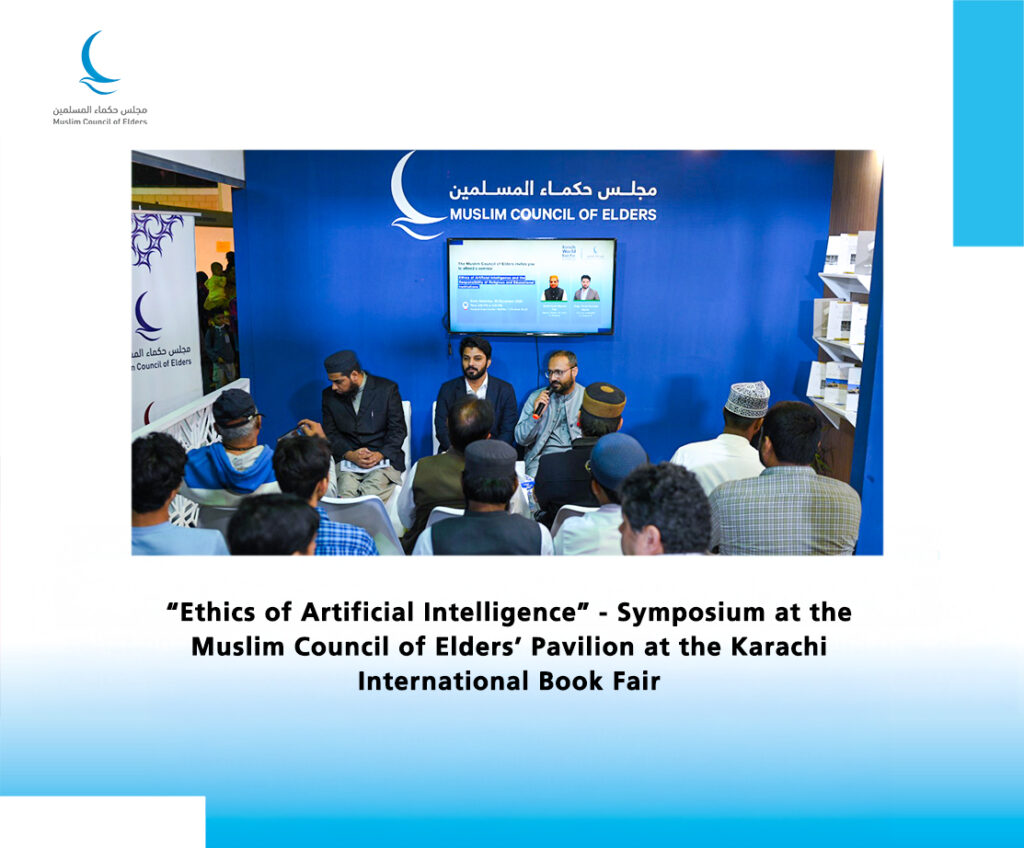
As part of its participation in the Karachi International Book Fair 2025, the Muslim Council of Elders organized its second symposium titled: “Ethics of Artificial Intelligence and the Responsibility of Religious and Educational Institutions.” The session featured Mufti Abdul Munim Faiz, Media Director at Al-Rasheed University – Karachi, and Engineer Faraz Hussain Borrero, Founder of “PakGPT” and Co-Chairman of “Pro Global AI,” and was moderated by Muhammad Adeel Al-Azhari, Translation Officer at the Muslim Council of Elders’ Pakistan office.
The symposium opened by emphasizing that the growing presence of artificial intelligence technologies in the lives of individuals and societies imposes clear responsibilities on religious and educational institutions—not only in transferring knowledge to youth and future generations but also in defining the ethical and human framework for using these technologies. This ensures that AI serves human values, preserves human dignity, and promotes social responsibility in the digital age.
Participants praised the Muslim Council of Elders’ commitment to promoting the ethical use of artificial intelligence as an intellectual and humanitarian issue requiring responsible approaches. They noted that the Council, in collaboration with various partners, is working to develop reference frameworks and standards to guide AI development and usage, preventing it from encroaching on values, violating rights, or creating informational confusion among the public—especially in highly sensitive areas.
In his remarks, Engineer Faraz Hussain Borrero provided a simplified explanation of how AI systems generate responses, noting that outputs are directly linked to the nature of the data they receive and the way questions are formulated. He explained that this affects the accuracy and quality of results and their usability in daily life, given the growing reliance on these technologies across multiple fields.
For his part, Mufti Abdul Munim Faiz stressed that the prudent use of AI by students and the public should remain within the framework of referencing sources and supporting researchers, rather than turning into complete dependence on ready-made answers taken without review or verification. He warned that validation is a critical condition before issuing any rulings, especially on religious matters and fatwas, explaining that AI-generated answers may vary depending on question phrasing, user context, and language. This, he said, requires critical awareness and reinforces the need for trusted scholarly references.
The symposium featured an interactive discussion and active participation, with numerous questions raised about addressing ethical challenges related to AI applications and ways to minimize cognitive errors and risks associated with circulating inaccurate or unverified information. Speakers emphasized that collaboration between AI developers and religious and educational institutions is essential to provide accurate data for models and to develop precise standards for handling content.
Students and researchers from various religious and educational institutions in Pakistan attended the symposium and expressed their appreciation for the opportunity to gain direct insights into AI and its ethical dimensions within an organized knowledge framework. They commended the Muslim Council of Elders’ initiatives and efforts to open serious discussions on contemporary issues affecting people’s lives and to develop ethical frameworks that guide the development and use of modern technologies in harmony with human values.
The Council’s pavilion at the Karachi International Book Fair is located in Hall 1, Pavilion 45 at the Karachi Expo Center and is open December 18 to 22, 2025.