NEWS

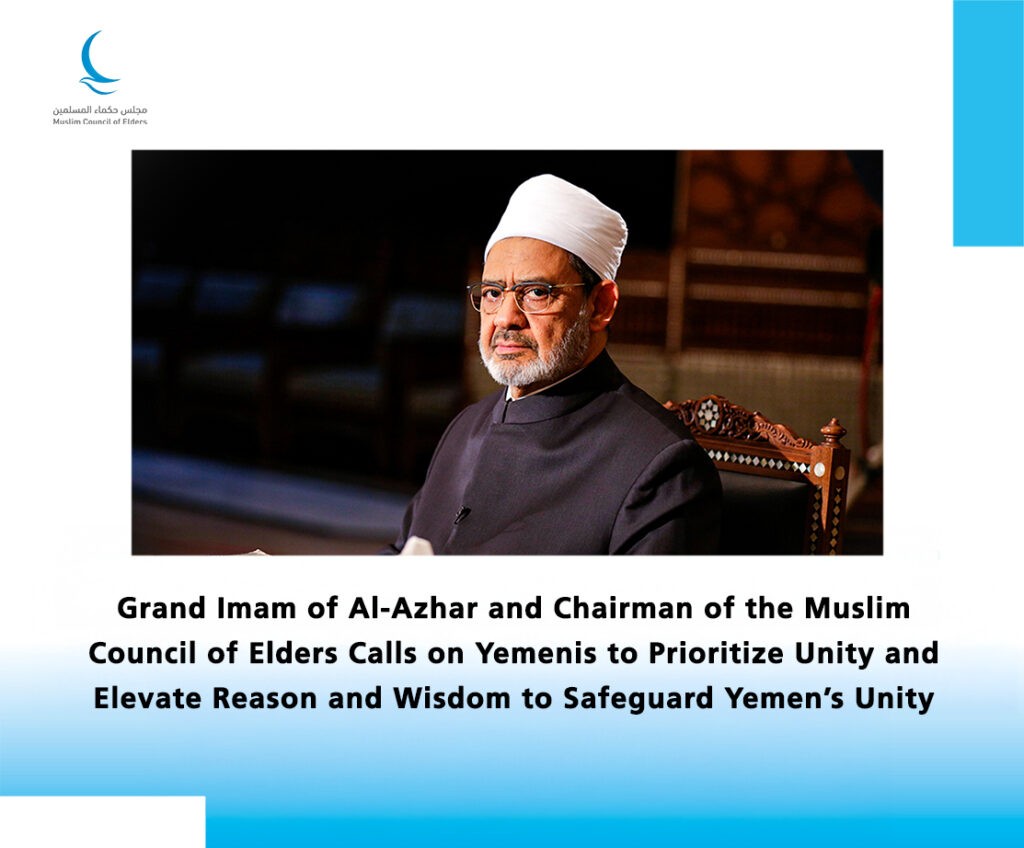
Grand Imam of Al-Azhar and Chairman of the Muslim Council of Elders Receives 2026 Zayed Award for Human Fraternity Judging Committee

His Eminence Ahmed Al-Tayeb, Grand Imam of Al-Azhar and Chairman of the Muslim Council of Elders received members of the Zayed Award for Human Fraternity’s 2026 judging committee at Al-Azhar headquarters in Cairo on Tuesday. The visiting delegation of the independent global award included head of the Administration of the President of the Republic of Uzbekistan Her Excellency Saida Mirziyoyeva; former President of the European Council His Excellency Charles Michel; Zayed Award for Human Fraternity Secretary-General His Excellency Judge Mohamed Abdelsalam; and former Chairperson of the African Union Commission His Excellency Moussa Faki Mahamat.

During the meeting, Grand Imam Al-Tayeb welcomed the jury members and stressed that this first visit of the committee to Egypt represents an extension of the journey of human fraternity that began in Cairo in 2017 and culminated in His Eminence’s signing of the Document on Human Fraternity alongside the late His Holiness Pope Francis, in Abu Dhabi, United Arab Emirates, in 2019.

Grand Imam Al-Tayeb added that the award named after the ‘Wise Man of the Arabs’ – the late Sheikh Zayed bin Sultan Al Nahyan, founder of the United Arab Emirates – stands as a continuation of his noble legacy in serving humanity and supporting the weak and vulnerable and extended his gratitude to His Highness Sheikh Mohamed bin Zayed Al Nahyan, President of the United Arab Emirates, who stands as the foremost supporter of the path of human fraternity

His Eminence said: “You are now sitting in a place [Al-Azhar] that for more than a thousand years has been spreading peace, moderation, and human fraternity in Egypt and across the world. Egypt is the cradle of tolerance and coexistence; it offers the world a unique and unparalleled model in advancing peaceful coexistence, human fraternity, and tolerance. 

He added that all religions uphold the values of peace, fraternity, and coexistence — universal human values that humanity is now in utmost need of strengthening in societies, especially as today’s world is plagued by wars and conflicts. 

The Grand Imam of Al-Azhar expressed his confidence in the sincere efforts undertaken by the members of the Zayed Award for Human Fraternity judging committee to achieve the goals of the Document on Human Fraternity, for which the award was established. He noted that history is a guide to help lay the foundations of peace and fraternity in the world, stressing that the Zayed Award for Human Fraternity has today become one of the most important independent global platforms honoring genuine humanitarian efforts and initiatives. His Eminence called on the jury members to shoulder their historic responsibility in selecting individuals and initiatives that embody the spirit of human fraternity in its highest form, and that present to the world inspiring models that demonstrate peace and understanding are possible – no matter how great the challenges and how diverse cultures may be.

For their part, the members of the Zayed Award for Human Fraternity judging committee affirmed their commitment to select honorees following in the footsteps of honorary recipients Grand Imam Al-Tayeb and the late Pope Francis, for the award’s seventh edition.

Zayed Award for Human Fraternity Secretary-General His Excellency Judge Mohamed Abdelsalam said: “The judging committee’s inaugural visit to the Arab Republic of Egypt reflects our deep appreciation for this ancient country’s pioneering role in human progress, dialogue, and civilization. Our meeting with His Eminence Grand Imam Al-Tayeb – the foremost moral and spiritual authority in the Islamic world and a founding figure of the human fraternity mission – constitutes a central pillar and a fundamental source of support for the award’s efforts to highlight models and initiatives that embody the values of human fraternity.”

Her Excellency Saida Mirziyoyeva, head of the Administration of the President of the Republic of Uzbekistan and 2026 jury member, said: “It was truly a privilege for us as a jury to meet with His Eminence Al-Tayeb at Al-Azhar – one of humanity’s oldest and most esteemed centers of knowledge and dialogue – and to discuss our collective efforts advancing human fraternity and making the world a better place, with a figure who has committed his life to coexistence and service of others.”
 
His Excellency Charles Michel, former President of the European Council and 2026 jury member, said: “As an international jury visiting Egypt, a civilizational crossroads, Al-Azhar, a global beacon of learning, and our discussion with the Grand Imam of Al-Azhar, we are reminded of the Zayed Award for Human Fraternity’s core purpose – to strengthen humanity and civilization by promoting human development, dialogue, and education.” 

His Excellency Moussa Faki Mahamat, former Chairperson of the African Union Commission and 2026 jury member, said: “This meeting with His Eminence Al-Tayeb has underlined how essential religious and moral leadership is in promoting peaceful coexistence, especially in regions facing conflict. We are encouraged to select this year’s honorees guided by a sense of the importance of reconciliation, protection of vulnerable communities, and empowerment of future generations.” 

Advisors to the 2026 judging committee – former Secretary-General of the Commonwealth the Right Honorable Patricia Scotland KC and Adama Dieng, African Union Special Envoy on the Prevention of Genocide and Other Mass Atrocities and former United Nations Special Advisor on the Prevention of Genocide – were also present for the meeting and shared their perspectives.


The meeting with Grand Imam of Al-Azhar Ahmed Al-Tayeb is the first part of the judging committee’s visit to Egypt, which includes a visit to Al-Azhar Mosque, the Grand Egyptian Museum, and several other religious and cultural institutions in Cairo. 

Named in honor of the late Sheikh Zayed bin Sultan Al Nahyan, founder of the United Arab Emirates, the Zayed Award for Human Fraternity recognizes individuals and organizations – of all backgrounds, anywhere in the world – working selflessly and tirelessly to advance human fraternity and create breakthroughs towards peaceful coexistence.

The award has so far recognized 16 recipients from 15 countries including the Grand Imam of Al-Azhar and world-renowned cardiac surgeon Professor Sir Magdi Yacoub – since its establishment in 2019, following the historic meeting in Abu Dhabi between the late His Holiness Pope Francis, 266th head of the Catholic Church, and His Eminence Ahmed Al-Tayeb, Grand Imam of Al-Azhar, during which the two religious figures co-signed the Document on Human Fraternity.

Grand Imam of Al-Azhar and Chairman of the Muslim Council of Elders Receives 2026 Zayed Award for Human Fraternity Judging Committee Read More »

Islamic Dialogue: Unity in Diversity and the Responsibility of Joint Construction – at a Seminar by the Muslim Council of Elders on the Main Stage of the Iraq International Book Fair

Amid a large attendance of religious, literary, and academic figures, the Muslim Council of Elders organized a seminar on the main stage of the Iraq International Book Fair, under the title: “Islamic Dialogue: Unity in Diversity and the Responsibility of Joint Construction”, with the participation of Prof. Amer Shaker Al-Janabi, President of the Sunni Endowment Office in the Republic of Iraq. The session was moderated by Dr. Samir Boudinar, Director of the Al Hokama Center for Peace Research.

Dr. Boudinar opened the session with welcoming remarks that expressed appreciation for the attendees and the intellectual value of this meeting, stressing: “In this great cultural festival, in the land of civilizations and scholars, we renew the discussion about dialogue and Iraq’s exceptional experience in managing differences—a model worth studying and highlighting.” He pointed out that dialogue is not a rhetorical slogan but a civilizational necessity to ensure societies remain capable of creativity and progress despite the diversity of perspectives and jurisprudential and theological schools.

For his part, Dr. Amer Al-Janabi expressed his gratitude and appreciation to the Muslim Council of Elders, chaired by His Eminence the Grand Imam Prof. Ahmed Al-Tayeb, Sheikh of Al-Azhar, affirming that the Council’s presence in an open cultural space like the Iraq International Book Fair represents a shift in dialogue from elites to the public. He said: “I am delighted to be in this vast space that turns the Iraq International Book Fair into a platform for wisdom, not just for books. The topic of this symposium is not an intellectual luxury; it comes after this nation has been overwhelmed by conflicts, crises, and challenges.”

Al-Janabi highlighted the Qur’anic roots of dialogue, affirming that dialogue is a deeply rooted principle in the history of divine messages, which is not negated by differences among schools and sects but rather embraced and guided. He noted that the history of the Islamic nation witnessed interaction among schools of jurisprudence, theology, and philosophy, and that diversity was a driver of knowledge, not a cause of division. He stressed the need to turn this diversity into a source of strength through scholars and religious institutions tasked with building awareness and managing differences.

He added that the foundation of the nation’s unity lies in agreement on fundamentals, while leaving wide room for interpretation in secondary matters—a historical tradition established by imams who differed in thought but agreed in heart. He emphasized that scholars are responsible for bringing ideas closer, expanding common ground, and involving youth to build a generation that believes difference is a mercy, not a flaw.

The President of the Sunni Endowment Office explained that demand for religious education is witnessing significant growth, and that developing curricula and re-reading heritage with a collective spirit is the best path to mature awareness. He added: “Religious education today is not the ‘yellow books’ as portrayed, but a system evolving with curricula and tools. We have hundreds of schools welcoming students from diverse backgrounds, and every year the demand grows remarkably.”

Al-Janabi concluded by affirming that Iraq has overcome ordeals that nearly tore it apart but rose thanks to scholars, intellectuals, and bearers of awareness, offering the world a lesson in the possibility of rebuilding after division.

He also made sure to visit the Muslim Council of Elders’ pavilion at the Iraq International Book Fair, praising its excellent organization and the variety of intellectual and cultural publications it offers, calling on students, professors, scholars, and intellectuals to visit the pavilion and benefit from its rich content.

The Muslim Council of Elders is participating in the Iraq International Book Fair as part of its mission to promote peace, entrench values of dialogue and tolerance, and build bridges of cooperation among people of different races and beliefs. The Council’s pavilion is located at Baghdad International Fairgrounds, Pavilion No. 16 – H6.

Islamic Dialogue: Unity in Diversity and the Responsibility of Joint Construction – at a Seminar by the Muslim Council of Elders on the Main Stage of the Iraq International Book Fair Read More »

Muslim Council of Elders Celebrates Women as Part of the Iraq International Book Fair 2025

In conjunction with the Iraq International Book Fair’s celebration of Iraqi women—held under the theme “100 Iraqi Noons”—the Muslim Council of Elders pavilion hosted a seminar entitled “Women in the Project of Intra-Islamic Dialogue: Roles and Contributions”. The session featured Dr. Amira Ibrahim Hussein Al-Samarrai, Head of the Women’s Section at the Iraq Fiqh Academy, and Nasiba Sabah Al-Dahiri, Guide at the Mosque of Imam Abu Hanifa Al-Nu‘man. The discussion was moderated by Dr. Mohammed Gamal, researcher at the Al-Azhar Heritage Revival Office.

Dr. Mohammed Gamal opened the seminar by affirming that Islam, from the very dawn of its call, granted women both status and responsibility, and that a glance at Islamic civilization’s history reveals that women were never excluded from active participation and contribution.

For her part, Dr. Amira Al-Samarrai began by reaffirming the exalted status Islam accorded to women, noting that the Holy Qur’an spoke of women’s role and elevated their position as mothers, sisters, wives, and daughters—shapers of generations. She added that Islamic history has preserved the names of many women who had a prominent presence in the fields of knowledge and da‘wah, actively participating in building Islamic history and civilization across the ages.

Nasiba Al-Dahiri offered an analytical reading of social history that helped clarify the role women play within the Islamic framework. She stressed that the mother is the first link in forming awareness, making her role in intra-Islamic dialogue decisive, for she creates the primary cultural and moral mediator in human consciousness.

The Muslim Council of Elders is participating at the Iraq International Book Fair, in keeping with its mission to promote peace, entrench values of dialogue and tolerance, and build bridges of cooperation among humankind regardless of race or creed. The Council’s pavilion is located at the Baghdad International Fairground, Pavilion 16 – H6.

Muslim Council of Elders Celebrates Women as Part of the Iraq International Book Fair 2025 Read More »

Grand Imam of Al-Azhar and Chairman of the Muslim Council of Elders Receives Saida Mirziyoyeva, Head of the Presidential Administration of the Republic of Uzbekistan – Pair Agree to Strengthen Efforts to Preserve Islamic Heritage

His Eminence Dr. Ahmed Al-Tayeb, Grand Imam of Al-Azhar and Chairman of the Muslim Council of Elders, received Her Excellency Saida Mirziyoyeva, Head of the Presidential Administration of the Republic of Uzbekistan and member of the Zayed Award for Human Fraternity judging committee, to explore ways of enhancing scientific and da‘wah cooperation between the two parties.

During the meeting, His Eminence extended his heartfelt greetings to His Excellency President Shavkat Mirziyoyev of Uzbekistan, whose generous hospitality he still fondly recalls from his visits to Uzbekistan in 2018 and 2020. He affirmed that the Islamic intellect, in its most brilliant intellectual and scholarly manifestations, holds Uzbekistan—dear to every Muslim—in the highest esteem and respect for the profound imprint left by its early scholars on Islamic thought and heritage. Among them are Imam Al-Maturidi, Al-Tirmidhi, Al-Zamakhshari, Al-Farabi, Al-Khwarizmi, and many others who emerged from this blessed land and whose influence reached the entire world. Their contributions were not limited to Islamic culture; humanity as a whole has benefited from them.

His Eminence also expressed his delight at seeing Muslim women such as Saida Mirziyoyeva assuming the highest positions in their countries—positions from which women had long been deprived due to ignorant customs and traditions that have no basis in Islamic law. He further commended her efforts in defending human rights and women’s rights, protecting children, promoting education and culture, and her initiatives to preserve Islamic heritage.

For her part, Saida Mirziyoyeva expressed her immense pride in meeting His Eminence the Grand Imam and conveyed her nation’s deep appreciation for his tangible global efforts in spreading values of fraternity and positive coexistence, preserving Islamic heritage, and confronting extremist thought. She highlighted her pride in the honorary doctorate conferred upon His Eminence by the Islamic Academy of Uzbekistan in 2018, her close following of his speeches and writings, and her admiration for his supportive stances on preserving women’s status and rights. She also conveyed the greetings of President Shavkat Mirziyoyev to His Eminence, along with his wishes for continued health and well-being, and prayers that Allah bless His Eminence’s endeavours aimed at unifying and strengthening the Ummah.

Her Excellency affirmed her nation’s desire to enhance cooperation and coordination with Al-Azhar and the Muslim Council of Elders through joint educational initiatives, exchange of researchers and students, and the implementation of collaborative scholarly projects between Al-Azhar University and the Islamic Academy of Uzbekistan. These include digitizing and publishing over 100,000 Islamic manuscripts, disseminating the scholarly heritage of Imam Al-Maturidi, benefiting from Al-Azhar’s expertise and Uzbekistan’s capabilities, and coordinating between the Al-Azhar Observatory and Uzbekistan’s Ministry of Religious Affairs and Committee on Religious Education to rehabilitate those influenced by extremist ideas and reintegrate them into society once their thinking has been corrected.

His Eminence confirmed Al-Azhar’s readiness to cooperate with Uzbekistan in implementing these proposals, directing the formation of a joint committee to study them and begin execution as soon as possible.

At the conclusion of the meeting, the Head of the Presidential Administration of Uzbekistan extended an official invitation to the Grand Imam of Al-Azhar and Chairman of the Muslim Council of Elders to visit the country and participate in the inauguration of the Islamic Civilization Center—the largest such centre in Central Asia. His Eminence warmly welcomed this generous invitation and congratulated the Uzbek people on this significant civilizational landmark, which represents a continuation of the illustrious history of the scholars of Transoxiana in serving Islamic civilization.

Grand Imam of Al-Azhar and Chairman of the Muslim Council of Elders Receives Saida Mirziyoyeva, Head of the Presidential Administration of the Republic of Uzbekistan – Pair Agree to Strengthen Efforts to Preserve Islamic Heritage Read More »

Religious Education and the Imperative of Intra-Islamic Dialogue – Seminar at the Muslim Council of Elders Pavilion – Iraq International Book Fair

The Muslim Council of Elders pavilion at the Iraq International Book Fair hosted a seminar entitled “Religious Education and the Imperative of Intra-Islamic Dialogue: Toward an Awareness that Unites the Ummah Rather than Divides It” featuring Dr. Salahuddin Al-Samarrai, Dean of the Faculty of Imam Al-A’zam University, and Dr. Samir Boudinar, Director of Al Hokama Center for Peace Research.

Dr. Samir Boudinar opened by stating that this event is part of a series of intellectual activities aimed at addressing one of the most critical issues facing the Ummah today: Muslim unity and confronting manifestations of intellectual and sectarian estrangement. He emphasized that religious education is not merely a knowledge curriculum but roots that extend deep into identity and shape how generations understand their heritage.

For his part, Dr. Salahuddin Al-Samarrai expressed appreciation for the efforts of the Muslim Council of Elders, under the chairmanship of His Eminence Prof. Dr. Ahmed Al-Tayeb, Grand Imam of Al-Azhar in strengthening dialogue among the components of the Islamic Ummah. He noted that education constitutes a primary pillar both in raising awareness of its importance and in combating discourses of division, hatred, and fanaticism.

He added that religious education and legitimate institutions form a fundamental axis in building the awareness of the Ummah’s children—not only at the level of academic specialization for scholars and students, but also for society as a whole, which needs an open religious vision. Religious education carries a great mission yet can be highly dangerous if poorly presented or superficially understood. Legal texts are vast, interpretive approaches are numerous, and educational institutions must therefore offer precise curricula that present religion in a rigorous scholarly language.

Dr. Al-Samarrai further explained that when proper understanding of texts is absent, knowledge can become a gateway to closed-mindedness or extremism. It is therefore essential to develop balanced, conscious curricula that encompass both religious sciences and contemporary knowledge. He praised the Al-Azhar model, which teaches natural sciences and astronomy alongside fiqh, the Qur’an, and Hadith, stressing that the religious scholar must be acquainted with the laws of the universe addressed by religion. He also pointed out that the Qur’an itself establishes the principle of natural and divinely ordained human difference, and that multiplicity in understanding and ijtihad is not evidence of contradiction but a space for enrichment when managed wisely. The Ummah was never built upon a single opinion but upon diverse views. 

The Muslim Council of Elders is participating in the Iraq International Book Fair as part of its mission to promote peace, entrench the values of dialogue and tolerance, and build bridges of cooperation among humankind regardless of all races and creeds. The Council’s pavilion is located at the Baghdad International Fairground, Pavilion 16 – H6.

Religious Education and the Imperative of Intra-Islamic Dialogue – Seminar at the Muslim Council of Elders Pavilion – Iraq International Book Fair Read More »

“Shared Heritage Among Islamic Schools of Thought” Seminar at the Muslim Council of Elders Pavilion in the Iraq International Book Fair

On the fourth day of the Iraq International Book Fair, the Muslim Council of Elders organized a seminar entitled “Shared Heritage Among Islamic Schools of Thought: A Reading of Unifying Texts”. The session featured Prof. Dr. Saadi Al-Jumaili, Professor of Principles of Jurisprudence and former Dean of the Faculty of Sharia at the Iraqi University – Baghdad, and Prof. Dr. Ammar Aboudi Nassar, Professor of History and Islamic Thought at the Faculty of Arts, University of Kufa. The discussion was moderated by Dr. Mohammed Gamal, researcher at the Al-Azhar Heritage Renewal Department.

Dr. Mohammed Gamal opened by emphasizing that Islamic heritage is not merely texts and narrations but a vast intellectual space where concepts intertwine and objectives complement one another. He noted that the ethics of disagreement serve as the bridge capable of transforming dialogue into a point of convergence rather than a cause of division, and that reviving these ethics is essential for rebuilding Islamic consciousness on the foundation of moderation.

For his part, Dr. Saadi Al-Jumaili began by affirming that the question of heritage is an ancient one addressed by scholars across the ages, yet current circumstances make its re-examination more urgent amid attempts to sow division among Muslims by exaggerating differences. He explained that heritage, in its broadest sense, encompasses everything left by the righteous predecessors since the era of the Companions and their successors, yet it comprises both immutable religious constants and jurisprudential legacies that evolve with time and the efforts of jurists. He pointed out that diversity of opinion even within a single school of thought is evidence of vitality and strength, not weakness—for an Ummah that reflects, debates, and seeks knowledge is a living Ummah capable of renewal.

Dr. Ammar Nassar stressed that strengthening Islamic identity begins with entrenching mutual understanding rather than magnifying differences. He highlighted the need for such seminars, especially as some selectively exploit heritage texts to foster division rather than unity of ranks—a unity the Ummah desperately needs today. He noted that the majority of doctrinal and jurisprudential principles among Muslims are shared, and portraying disagreement as fundamental conflict is merely the result of narrow interpretations and distortion of sources.

Participants praised the call of His Eminence Prof. Dr. Ahmed Al-Tayeb, Grand Imam of Al-Azhar, for reuniting the Ummah and enhancing understanding among all its components. They affirmed that His Eminence’s positions lay the foundation for a new phase of intra-Islamic dialogue rooted in Islamic fraternity and mutual respect, clarifying that Islamic heritage has never been a cause of division but has always, at its core, served as a bridge for Muslim unity. Re-reading it through the lens of commonalities rather than differences is capable of rebuilding the collective consciousness of the Ummah.

The Muslim Council of Elders is participating in the Iraq International Book Fair as part of its mission to promote peace, entrench the values of dialogue and tolerance, and build bridges of cooperation among humankind regardless of race or creed. The Council’s pavilion is located at the Baghdad International Fairground, Pavilion 16 – H6.

“Shared Heritage Among Islamic Schools of Thought” Seminar at the Muslim Council of Elders Pavilion in the Iraq International Book Fair Read More »

Muslim Council of Elders Organizes Seminar on “Religious Platforms and the Responsibility of Muslim Unity” at the 2025 Iraq International Book Fair

Dr. Samir Boudinar: Inter-Islamic dialogue is a cornerstone of the Muslim world today

Dr. Ismail Al-Alwani: The pulpit is a vital tool for raising public awareness and strengthening the Muslim Ummah’s collective identity

Dr. Jassim Juayiz: Unity is a process of mutual acceptance rooted in social harmony, diversity, and pluralism


On the third day of the Iraq International Book Fair, the Muslim Council of Elders hosted an intellectual seminar titled “Religious Platforms and the Responsibility of Muslim Unity.” The session featured Prof. Dr. Ismail Khalil Al-Alwani, Assistant Dean of Al-Imam Al-Azam University College, and Dr. Jasim Juayiz Mankhi, Assistant Dean of Al-Imam Al-Kadhim University College, and was moderated by Dr. Samir Boudinar, Director of Al-Hokama Center for Peace Research. 

Opening the discussion, Dr. Samir Boudinar underscored that inter-Islamic dialogue is a fundamental pillar of contemporary Muslim society. It is deeply intertwined with questions of identity, belonging, and the role of scholars in engaging communities through religious and media platforms. He noted that Iraq stands out as an exemplary model in this regard, given its long history, rich sectarian and intellectual diversity, and profound civilizational and religious heritage—all of which make dialogues of this kind both necessary and impactful.

Prof. Dr. Ismail Al-Alwani emphasized that the pulpit serves as a central means of educating the public and reinforcing the Muslim Ummah’s shared identity. More than a medium for sermons, it is a bridge between scholars and society—a tool capable of deepening understanding and nurturing unity when used responsibly, or fuelling division when misused. He highlighted that throughout Islamic history, scholars played an essential role in safeguarding faith and preserving communal cohesion, and that the Islamic tradition offers many examples of scholars who united rather than divided. This, he said, places a significant moral and intellectual responsibility on today’s scholars to continue this mission.

Dr. Jassim Juayiz stated that inter-Islamic dialogue must be rooted in the values of understanding, mutual recognition, and the rejection of discord. He stressed that societies today are in urgent need of a thoughtful, evidence-based religious discourse. He added that the three influential societal institutions—religious, social, and academic—must work in harmony to correct misconceptions, promote a culture of dialogue, and affirm that unity does not mean eliminating difference, but rather embracing one another in a spirit of social peace, diversity, and pluralism.

The seminar concluded by reaffirming that the role of scholars today extends well beyond the traditional pulpit. It is a purposeful, long-term effort to strengthen Muslim unity, shield societies from extremism, and build trust among different schools of thought through a balanced discourse grounded in evidence, shared history, and respect for difference.

The Muslim Council of Elders is participating in the Iraq International Book Fair as part of its mission to promote peace, foster dialogue and tolerance, and build bridges among people of all backgrounds and beliefs. The Council’s pavilion is located at the Baghdad International Fairgrounds, Pavilion No. 16 – H6.

Muslim Council of Elders Organizes Seminar on “Religious Platforms and the Responsibility of Muslim Unity” at the 2025 Iraq International Book Fair Read More »

“The Future of Muslim Unity: Between Shared Objectives and the Ethics of Differences” – Seminar at the Muslim Council of Elders Pavilion at the Iraq International Book Fair

The Muslim Council of Elders organized a seminar at the Iraq International Book Fair titled “The Future of Muslim Unity: Between Shared Objectives and the Ethics of Differences” which featured His Eminence Dr. Hussein Ghazi, member of the Supreme Council of the Iraq Fiqh Academy, and was moderated by Dr. Mohammed Gamal, researcher at the Al-Azhar Heritage Renewal Department.

Sheikh Hussein Ghazi emphasized that the exchange of ideas and communication among societies is the path to bridging viewpoints and closing intellectual gaps. He explained that the Qur’anic approach is founded upon forbearance and magnanimity in dialogue, calling for the adoption of a discourse that rejects extremism and preserves homelands.

He further discussed the foundations upon which the unity of the Ummah rests, pointing out that such unity cannot be achieved through slogans alone but must be grounded in scholarly and methodological ethics that precede emotional reactions. Foremost among these principles are good faith toward others and the exercise of sound reason that curbs whims and reins in impulses. He warned that stirring sectarian and communal strife paralyzes the march of life, spreads resentment, and obscures enlightened minds that could otherwise serve as building blocks for awareness and progress.

Sheikh Ghazi added that difference is a natural human phenomenon that must be managed with wisdom and patience, citing the example of the Rightly Guided Caliphs and Qur’anic verses that underscore the importance of tolerance and moderation in dialogue. He urged youth to channel their energies toward reading and verification, cautioning against being swept away by rumors and misinformation circulated by some on social media platforms.

The member of the Supreme Council of the Iraq Fiqh Academy praised the efforts of the Muslim Council of Elders, under the chairmanship of His Eminence Dr. Ahmed Al-Tayeb, the Grand Imam of Al-Azhar and Chairman of the Muslim Council of Elders, in working to strengthen dialogue, mutual understanding, and respect among the various components of the Islamic Ummah. He highlighted the Council’s organization of the first Intra-Islamic Dialogue Conference, held in the Kingdom of Bahrain last February, which produced the “Ahlul-Qiblah” charter—a call to unify the Ummah’s word, reunite its ranks, and stand together in the face of contemporary challenges.

The Muslim Council of Elders is participating in the Iraq International Book Fair as part of its mission to promote peace, entrench the values of dialogue and tolerance, and build bridges of cooperation among humanity regardless of race or creed. The Council’s pavilion is located at the Baghdad International Fairground, Pavilion 16 – H6.

“The Future of Muslim Unity: Between Shared Objectives and the Ethics of Differences” – Seminar at the Muslim Council of Elders Pavilion at the Iraq International Book Fair Read More »

Muslim Council of Elders and India’s Siraj-ul-Huda University Explore Strengthening Cooperation in Education, Dialogue, and Coexistence

A high-level delegation from India’s Siraj-ul-Huda University, led by its founder and president, Sheikh Abdulrahman Saquafi, visited the headquarters of the Muslim Council of Elders in Abu Dhabi to discuss prospects for joint collaboration in education, the advancement of dialogue, and the consolidation of coexistence.

During the meeting, His Excellency Judge Mohamed Abdelsalam highlighted the Council’s wide range of programs designed to empower youth and the younger generation to play an active role in building peace, entrenching the principles of moderation and balance, and combating all forms of hatred, extremism, racism, and discrimination. He underscored the vital importance of equipping a new generation capable of promoting dialogue and tolerance while harnessing modern technologies to foster bridges of communication, mutual understanding, and respect among diverse cultures and peoples.

For their part, members of the Siraj-ul-Huda University delegation expressed profound appreciation for the tireless efforts of the Muslim Council of Elders—under the leadership of His Eminence Dr. Ahmed Al-Tayeb, the Grand Imam of Al-Azhar—in fostering global understanding, advancing the values of human fraternity, and enabling educational institutions to nurture an enlightened generation dedicated to peacebuilding and intra-Islamic dialogue.

At the conclusion of the meeting, both parties agreed to deepen joint cooperation through a series of academic and technological projects and to launch targeted initiatives for youth and researchers that will reinforce the values of dialogue and peace, promote intellectual development, and ensure the ethical application of artificial intelligence.

Muslim Council of Elders and India’s Siraj-ul-Huda University Explore Strengthening Cooperation in Education, Dialogue, and Coexistence Read More »

President of the Court of Cassation of Iraq Visits the Muslim Council of Elders Pavilion and Praises Its Efforts and Publications in Promoting Dialogue, Coexistence, and Peace

His Excellency Judge Faiq Zaidan, President of the Court of Cassation of Iraq, visited the Muslim Council of Elders pavilion during the inauguration of the sixth edition of the Iraq International Book Fair. The fair, held under the theme “100 Iraqi Noons,” opened on Wednesday, at the Baghdad International Fairground and will run from 3 to 13 December 2025.

Judge Zaidan reviewed the most prominent publications from Al-Hokama Publishing at the Council’s pavilion and commended the Council’s participation, affirming that the Muslim Council of Elders represents a credible voice of knowledge that significantly contributes to raising societal awareness and spreading moderation, tolerance, coexistence, and peace.

He further highlighted the pioneering role of the Muslim Council of Elders, under the chairmanship of His Eminence Dr. Ahmed Al-Tayeb, Grand Imam of Al-Azhar in supporting cultural and intellectual initiatives that serve humanity and advance civil peace and social harmony.

The Muslim Council of Elders is participating at the sixth Iraq International Book Fair, showcasing a wide range of books and studies addressing moderation, human fraternity, combating extremism, contemporary intellectual approaches to peacebuilding, and strengthening intra-Islamic dialogue.

President of the Court of Cassation of Iraq Visits the Muslim Council of Elders Pavilion and Praises Its Efforts and Publications in Promoting Dialogue, Coexistence, and Peace Read More »