ALL

Grand Imam of Al-Azhar and Chairman of the Muslim Council of Elders Meets Prime Minister Serbia to Discuss Strengthening Academic and Religious Cooperation for Serbia’s Muslim Community

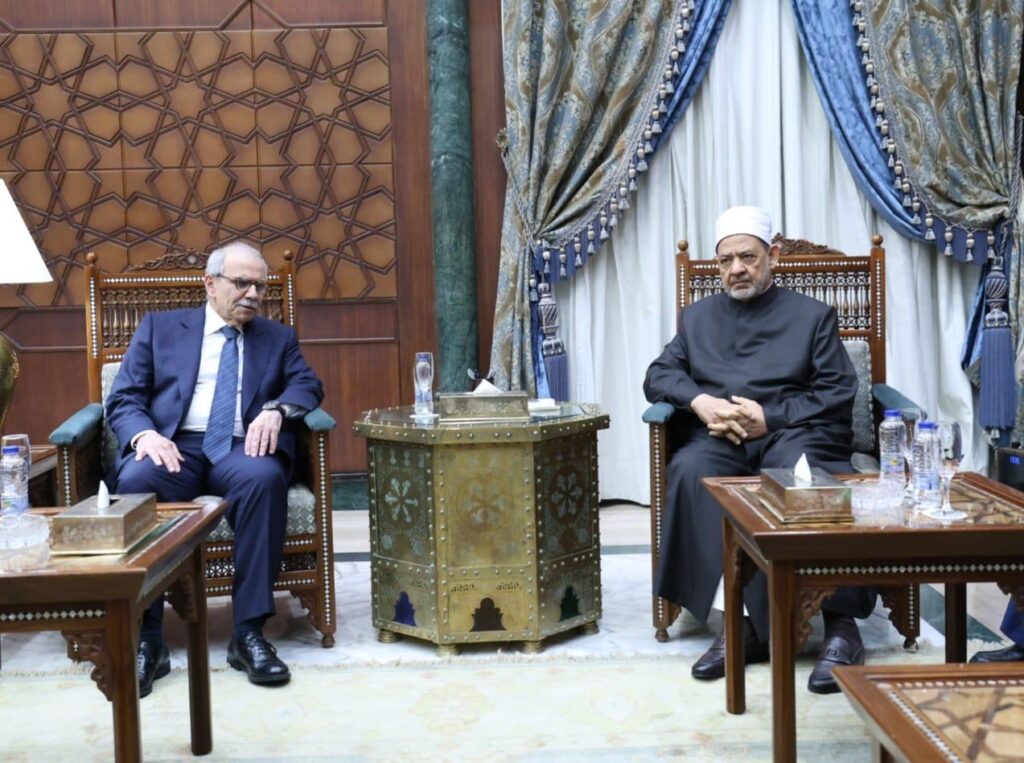
His Eminence Dr. Ahmed Al-Tayeb, Grand Imam of Al-Azhar and Chairman of the Muslim Council of Elders has met with Dr. Đuro Macut, Prime Minister of Serbia, to discuss ways to enhance academic and religious cooperation in support of Serbia’s Muslim community.

His Eminence affirmed Al-Azhar’s commitment to addressing the needs of Serbian Muslims by training imams and preachers, equipping them to tackle contemporary intellectual and religious challenges. These efforts focus on promoting human fraternity, fostering positive coexistence, facilitating the integration of Muslims into Western societies, clarifying women’s rights in Islam, countering extremist ideologies with reason and logic, and establishing an Arabic language center in Serbia to serve the Muslim community and teach the language of the Holy Qur’an.

His Eminence also emphasized that peace and mutual understanding should serve as the foundation for coexistence among all people. He further urged for efforts to instill patriotism in youth and to embrace diversity and differences, which he described as a divinely ordained universal principle essential for humanity’s continuity.

For his part, the Prime Minister of Serbia expressed his pleasure at meeting His Eminence, highlighting Serbia’s dedication to strengthening ties with Islamic countries and institutions. He also commended the Grand Imam of Al-Azhar and Chairman of the Muslim Council of Elders for his efforts in promoting dialogue, tolerance, peaceful coexistence, and human fraternity.

Grand Imam of Al-Azhar and Chairman of the Muslim Council of Elders Meets Prime Minister Serbia to Discuss Strengthening Academic and Religious Cooperation for Serbia’s Muslim Community Read More »

On the International Day for Countering Hate Speech, the Muslim Council of Elders calls for confronting hate, intolerance, and discrimination and for upholding the values of coexistence and mutual respect

The Muslim Council of Elders, chaired by His Eminence Prof. Dr. Ahmed Al-Tayeb, Grand Imam of Al-Azhar, affirms that combating hate speech, racism, intolerance, and discrimination is a moral, religious, and humanitarian imperative—especially in light of the growing global rise in violence, incitement, and social polarization, all of which pose a serious threat to communal harmony and human coexistence.

In a statement issued on the occasion of the International Day for Countering Hate Speech, observed annually on June 18, the Council warned of the dangers of turning a blind eye to verbal incitement, racist practices, and exclusionary rhetoric—particularly within digital and media spaces—which fuel hatred and resentment and create fertile ground for extremism and violence. The Council stressed the urgent need to enact binding legislation to curb such harmful discourse.

The statement emphasized that Islamic law forbids anything that incites division, hatred, or discord. As the Qur’an states: “And tell My ˹believing˺ servants to say what is best” [Qur’an 17:53], and as the Prophet Muhammad (peace be upon him) taught: “A kind word is charity.” Islam calls on its followers to uphold the values of compassion, mutual respect, and tolerance; to embrace diversity and pluralism; and to strengthen the principles of human fraternity—values that form the true foundation of peace and stability in societies and nations.

The Muslim Council of Elders continues to lead efforts to promote dialogue, peaceful coexistence, and mutual respect through several pioneering initiatives, including East-West Dialogue, Intra-Islamic Dialogue, the International Peace Convoys, and the Emerging Peacemakers Forum, among others. The Document on Human Fraternity, signed in Abu Dhabi in 2019 by His Eminence Prof. Dr. Ahmed Al-Tayeb, Grand Imam of Al-Azhar and Chairman of the Muslim Council of Elders, and the late Pope Francis of the Catholic Church, clearly states that religions have never been a source of war, conflict, hatred, or extremism. Instead, it calls for an end to the misuse of religion to incite hatred, violence, extremism, and blind fanaticism, and urges all people of faith and goodwill to work together in spreading the values of tolerance, coexistence, and peace.

On the International Day for Countering Hate Speech, the Muslim Council of Elders calls for confronting hate, intolerance, and discrimination and for upholding the values of coexistence and mutual respect Read More »

For the fourth consecutive year, the Muslim Council of Elders showcases its latest intellectual and cultural publications at a dedicated pavilion in the Jakarta Islamic Book Fair

The Muslim Council of Elders is taking part in the 23rd Jakarta Islamic Book Fair, held at the Jakarta Convention Center (JCC) from June 18 to 22, 2025. Marking its fourth consecutive year of participation, the Council is showcasing its work through a dedicated and prominent pavilion—one of the fair’s key attractions. This presence reflects the Council’s ongoing commitment to promoting a culture of peace and coexistence, advancing the principles of moderate Islam, and deepening its cultural footprint in Southeast Asia.

This year, the Council is presenting over 250 intellectual and cultural titles, including a selection of its latest 2025 releases by Al Hokama Publishing. The publications explore key issues such as peacebuilding, coexistence, and identity pluralism, with notable titles including: “Religion and the Nations of Greater Asia: Managing Religious and Ethnic Pluralism in China and India,” “Peace in Africa: Studies and Perspectives on Enhancing Stability and Development,” “The Making of International Peace: Drawing from Shared Contexts,” and “International Peace: Shared Values and Institutional Concepts,” authored by a group of researchers from the Al Hokama Center for Peace Research. 
 
 The pavilion further highlights over 30 works by His Eminence Prof. Dr. Ahmed Al-Tayeb, Grand Imam of Al-Azhar and Chairman of the Muslim Council of Elders. These works aim to present the true spirit of Islam and its rich intellectual and philosophical heritage. Titles include “Al-Qawl al-Tayyib,” “From My Old Notebooks,” “Ahl al-Sunnah wa al-Jama’ah,” “Insights into the Thought of Imam Al-Ash‘ari,” and “A Discussion on Peace.” Additionally, the book “Islam and the West: An Approach to the Causes of Confrontation and a Survey of the Conditions for Intercultural Exchange” by Dr. Mohamed Elbenayadi, “The Quran’s Discourse on Humanity” by Sheikh Ali Mohamed Hassan Al-Amari, “Imam al-Haramayn and His Influence on the Development of the Ash’ari School” by Dr. Ali Mohamed Jaber, and “Islamic Principles on Family Planning” by Abu Al-Wafa Al-Maraghi will also be featured.

 The Council is also showcasing a selection of significant works by its members and prominent intellectuals. Among the highlights are: “Love in the Holy Qur’an” by His Royal Highness Prince Ghazi bin Muhammad, “The Grand Imam and the Pope: A Thorny Path – A Testimony on the Birth of the Document on Human Fraternity” by Judge Mohamed Abdelsalam, Secretary-General of the Muslim Council of Elders, “Principles of Understanding and Mutual Comprehension in Thought and Language” by Dr. Mostafa Benhamza, “Muslims at a Crossroads” by Dr. Mahmoud Hamdi Zakzouk, “Dimensions of Mutual Knowledge in Morocco and Al-Andalus” by Dr. Jaafar bin Al-Hajj Al-Salami, and “Studies in Thematic Parallels in Qur’anic Narratives: A Comparative and Analytical Approach” by Dr. Abdelghani Al-Rajihi.

As part of its commitment to expanding its cultural impact and reaching Indonesian audiences, the Council is offering a collection of publications translated into Bahasa Indonesia. Notable titles include: “Al Qawl Al-Tayeb,” “From My Old Notebooks,” “Reflections on the Thought of Imam Al-Ash’ari,” Ahl al-Sunnah wal-Jama‘ah: Who Are We?,” “The Essentials of Islam,” “and Social Ethics in Islam” by Sheikh Abu Al-Wafa Al-Maraghi, as well as “Correcting Misconceptions” by Sheikh Muhammad Abu Zahra. In addition, the Council is presenting several works translated from other languages, such as: “The Voice of Change,” “Shared Global Values and the Making of International Peace,” “Confronting Islamophobia in Europe,” “Islam and Good Governance” by Prof. Muqtedar Khan, and “Islam, the West, and Tolerance: Conceiving Coexistence” by Dr. Aaron Tyler.


The Council’s participation in this year’s fair extends to a series of high-level intellectual seminars featuring a distinguished group of scholars and thinkers. Among the highlights is a seminar titled “Promoting Dialogue Among the Components of the Muslim Ummah,” featuring Dr. Muhammad Zainul Majdi, member of the Council’s Executive Committee; Prof. Dr. Syafiq Mughni, Vice President of the Muhammadiyah; and Ms. Alissa Wahid, Coordinator of the Gusdurian Network Indonesia (GNI). Another seminar, titled “The Importance of Strengthening Digital Sovereignty and the Ethics of Artificial Intelligence in the Indonesian Context,” will feature Prof. Dr. Muhammad Quraish Shihab, member of the Muslim Council of Elders and former Indonesian Minister of Religious Affairs; Prof. Dr. Pratikno, Minister of Human Development and Culture; and Dr. Rezzy Eko Caraka, researcher at BRIN and visiting professor in Taiwan.

In its commitment to engaging diverse segments of society, the Council is also hosting a variety of interactive workshops at its pavilion. These include “AI and Coexistence for Children” and a screenwriting workshop on “Human Fraternity and Coexistence,” designed for young creators and content developers.

The Council’s pavilion has been awarded “Best Pavilion” at the Jakarta Islamic Book Fair for three consecutive years—an acknowledgment of the richness of its content, the diversity of its programs, and the high level of visitor engagement. The Muslim Council of Elders warmly invites the public to visit its pavilion in Halls A & B at the Jakarta Convention Center to explore its latest publications and take part in its diverse activities, all of which reflect its mission to promote peace, mutual understanding, and dialogue among nations and cultures.

For the fourth consecutive year, the Muslim Council of Elders showcases its latest intellectual and cultural publications at a dedicated pavilion in the Jakarta Islamic Book Fair Read More »

On World Elder Abuse Awareness Day: Muslim Council of Elders Calls for Upholding the Dignity, Protection, and Care of Senior Citizens as a Religious, Humanitarian, and Societal Duty

The Muslim Council of Elders, under the chairmanship of His Eminence Professor Dr. Ahmed Al-Tayeb, Grand Imam of Al-Azhar, affirms that caring for the elderly and protecting them from all forms of neglect, physical abuse, psychological harm, or social marginalization is a moral and religious obligation that must not be overlooked. It represents one of the highest forms of righteousness advocated by Islam and emphasized by the Prophet of Mercy, Muhammad (PBUH), who said: “He is not one of us who does not show reverence to our elders.”

In a statement issued to mark World Elder Abuse Awareness Day, observed annually on June 15, the Council stated that the true measure of a civilized society lies in the care and appreciation it shows toward its elderly. This generation represents sacrifice, wisdom, and experience—those who paved the way for the present. It is therefore our collective duty to ensure they enjoy a life of dignity, supported by comprehensive health, social, and psychological care that reflects their inherent human and moral status. The statement further stressed that acts of kindness and loyalty to elders should not diminish with age, but rather deepen and strengthen. Preserving a person’s dignity in old age is among the sincerest forms of compassion and solidarity that must be cultivated and upheld.

The Muslim Council of Elders places strong emphasis on the protection and care of senior citizens and actively works to raise awareness of their rights and dignity. In this context, the Council partnered with the Pontifical Academy for Life at the Vatican and the American Association of Retired Persons (AARP) to launch an international declaration in support of the elderly—the first official initiative of the Vatican under the leadership of His Holiness Pope Leo XIV. This declaration recognizes older persons as the custodians of collective memory and identity, bearers of wisdom and experience whose transmission to younger generations strengthens societal resilience in the face of crises and lays the groundwork for a more balanced and stable future.

The Muslim Council of Elders calls on all communities, individuals, institutions, and international organizations to fulfill their ethical and humanitarian responsibilities toward senior citizens. This includes enacting and enforcing protective legislation, implementing care and awareness programs, upholding their rights, and combating all forms of age-based discrimination. Such efforts are vital to enhancing the status of older persons and ensuring their right to a safe, dignified, and fulfilling life.

On World Elder Abuse Awareness Day: Muslim Council of Elders Calls for Upholding the Dignity, Protection, and Care of Senior Citizens as a Religious, Humanitarian, and Societal Duty Read More »

Muslim Council of Elders Condemns Israeli Military Strike on Iran

The Muslim Council of Elders, under the chairmanship of His Eminence Professor Dr. Ahmed Al-Tayeb, Grand Imam of Al-Azhar, condemns the Israeli military strike on the Islamic Republic of Iran and warns of its serious repercussions for regional and global security and stability.

The Council calls on the international community to take the necessary measures to de-escalate the situation, prevent the expansion of the conflict, and support diplomatic efforts aimed at fostering international peace and security.

Muslim Council of Elders Condemns Israeli Military Strike on Iran Read More »

Muslim Council of Elders Extends Condolences to India over Victims of Plane Crash near Ahmedabad Airport

The Muslim Council of Elders, under the chairmanship of His Eminence Professor Dr. Ahmed Al-Tayeb, Grand Imam of Al-Azhar, extends its sincere condolences to the Republic of India following the tragic crash of an Air India aircraft near Ahmedabad Airport, which resulted in the loss of dozens of lives.

The Council expresses its deepest sympathy and solidarity with the families and loved ones of the victims of this tragic incident.

Muslim Council of Elders Extends Condolences to India over Victims of Plane Crash near Ahmedabad Airport Read More »

On the World Day Against Child Labour – Muslim Council of Elders: Protecting Children and Preserving Their Childhood from Exploitation and Suffering Is a Religious, Moral, and Humanitarian Duty

The Muslim Council of Elders, under the chairmanship of His Eminence Dr. Ahmed Al-Tayeb, Grand Imam of Al-Azhar, affirms that safeguarding children and preserving their childhood from exploitation and suffering is a religious, moral, and profound humanitarian obligation shared by societies, institutions, and individuals alike.

On the World Day Against Child Labour, observed annually on June 12, the Council declares that addressing child exploitation and forced labor is a collective responsibility and demands unified efforts to develop sound policies, enact stringent laws, ensure social protection and quality education, foster a culture of societal responsibility toward children, and intensify initiatives to combat poverty and ignorance, which rank among the leading causes of child labor. The Council praises the programs and initiatives by various nation states and institutions that empower families and promote education, thereby helping curb this grave issue and fostering a safe environment for every child’s healthy development.

The Council’s statement also emphasizes that in Islam, a child is a dignified being entitled to care, education, protection, and growth in a secure and nurturing environment. Which is proven by the Prophetic Hadith, “Each of you is a shepherd, and each is responsible for their flock” (narrated by Al-Bukhari), which powerfully highlights adults’ duty to nurture children, shield them from harm, and protect them from the burdens of poverty or deprivation, ensuring their rightful childhood remains intact. Furthermore, the Council underscores the critical role of religious, educational, and media institutions in raising awareness and educating communities to combat this issue, actively shaping a collective consciousness that prioritizes child protection which is especially vital in today’s world, where wars and conflicts intensify the suffering of countless innocent children.

The Document on Human Fraternity, which was co-signed in 2019 in Abu Dhabi by His Eminence the Grand Imam of Al-Azhar, Chairman of the Muslim Council of Elders, alongside the late Pope Francis, Pontiff of the Catholic Church at the time, asserts that children’s fundamental rights to family upbringing, nutrition, education, and care constitute a moral duty and responsibility for families and society. These rights must be upheld, defended, and guaranteed for every child worldwide, without exception. Additionally, any practice that undermines their dignity or violates their rights must be condemned, and vigilance is required to address the risks and violations they face in any form.

On the World Day Against Child Labour – Muslim Council of Elders: Protecting Children and Preserving Their Childhood from Exploitation and Suffering Is a Religious, Moral, and Humanitarian Duty Read More »

Muslim Council of Elders Participates in Egypt’s Local Conference of Youth on Climate Change

The Muslim Council of Elders participated in the Local Conference of Youth on Climate Change (LCOY Egypt 2025), organized by the Mediterranean Youth Foundation and hosted at the Bibliotheca Alexandrina. The event drew active participation from numerous institutions, as well as official, academic, and religious figures.
 
In a recorded address broadcast during the opening session of the conference, His Excellency Judge Mohamed Abdelsalam, Secretary-General of the Muslim Council of Elders, emphasized that climate change is a fundamental and existential issue that is closely linked to achieving social justice. He noted that it is also a humanitarian concern that threatens humanity and the shared planet we all inhabit. He explained that the Muslim Council of Elders has embraced this cause on multiple fronts, including its participation in several United Nations Climate Change Conferences, most recently COP28 in Dubai and COP29 in Azerbaijan. At these conferences, the Council launched a landmark initiative—the Faith Pavilion—which aimed to strengthen the role of religious leaders and figures in addressing the climate challenge.

Judge Abdelsalam further noted that the Council also organized the Global Summit of Religious Leaders for Climate, which resulted in the issuance of the document titled The Call of Conscience: The Abu Dhabi Joint Declaration on Climate.” This statement was signed by 30 of the world’s most prominent religious leaders, including His Eminence Professor Dr. Ahmed Al-Tayeb, Grand Imam of Al-Azhar, and the late Pope Francis, former Pontiff of the Catholic Church. He also highlighted that, in recognition of the importance of youth engagement, the Council organized a climate-themed youth competition that attracted more than 50 participants from 11 countries around the world, aimed at involving youth in this global challenge.

The Secretary-General commended the LCOY Egypt 2025 initiative, particularly as it was launched by Egyptian civil society. He expressed his confidence that such efforts would contribute positively to empowering youth to play a greater role in confronting climate change. He reaffirmed the Muslim Council of Elders’ support for the initiative, stemming from its firm belief in the vital role of youth in addressing contemporary challenges and in promoting peace, coexistence, and human fraternity.

It is worth noting that LCOY Egypt 2025 is being organized for the first time under the leadership of Egyptian civil society, across 11 governorates from May to November 2025, and concurrently in 110 countries around the world. The conference will culminate in a policy paper, which will be submitted annually in November to the Secretary-General of the United Nations. Recorded remarks at the opening session were delivered by H.E. Ambassador Dr. Badr Abdelatty, Egypt’s Minister of Foreign Affairs and Immigration; Dr. Alaa Farouk, Minister of Agriculture and Land Reclamation; Dr. Mahmoud Seddiq, Vice President of Al-Azhar University; Dr. Heba Labib, Vice President of Nile University for Innovation and Entrepreneurship; and Dr. Ne’ma Sa’eed, Representative of the World Health Organization in Egypt. The opening session also featured in-person participation from a large number of prominent figures from official, academic, religious, and youth leaders.

Muslim Council of Elders Participates in Egypt’s Local Conference of Youth on Climate Change Read More »

Muslim Council of Elders Congratulates the Kingdom of Saudi Arabia on the Successful Hajj Season

The Muslim Council of Elders, under the chairmanship of His Eminence Professor Dr. Ahmed Al-Tayeb, Grand Imam of Al-Azhar, extends its heartfelt congratulations to the Custodian of the Two Holy Mosques, His Majesty King Salman bin Abdulaziz Al Saud, and to His Royal Highness Prince Mohammed bin Salman bin Abdulaziz Al Saud, Crown Prince and Prime Minister, on the successful completion of this year’s Hajj season. The Council commends the tremendous efforts exerted by the Kingdom of Saudi Arabia in serving the pilgrims.

The Council expresses its appreciation for the Kingdom’s leading role in the sustainable development of the Hajj system, its mobilization of extensive resources, comprehensive services, and integrated facilities. These efforts are aligned with an advanced vision and innovative programs aimed at ensuring the comfort of pilgrims, enabling them to perform their rites in peace and safety, and providing them with care and support to complete their pilgrimage with ease and reassurance.

The Muslim Council of Elders also conveys its gratitude to the leadership, government, and people of the Kingdom of Saudi Arabia for their remarkable efforts in hosting over 1.6 million pilgrims this year. The Council commends  the exceptional organization and the mobilization of all necessary capacities to guarantee a secure and seamless Hajj experience. It further lauds the efforts of the Saudi Ministry of Islamic Affairs in educating and guiding the pilgrims, facilitating their journey, and enabling them to perform their rites with smoothness, clarity, and ease.

Muslim Council of Elders Congratulates the Kingdom of Saudi Arabia on the Successful Hajj Season Read More »

Muslim Council of Elders Congratulates the Kingdom of Bahrain on Election to the UN Security Council

The Muslim Council of Elders, chaired by His Eminence Prof. Dr. Ahmed Al-Tayeb, Grand Imam of Al-Azhar, extends its heartfelt congratulations to the Kingdom of Bahrain—led by His Majesty King Hamad bin Isa Al Khalifa—along with its government and noble people, on being elected as a non-permanent member of the United Nations Security Council for the 2026–2027 term, having secured broad international support with over 186 votes.

The Council affirms that Bahrain’s election to the Security Council is a testament to its significant efforts in promoting global peace and advancing the values of dialogue, tolerance, coexistence, and peace. This selection comes at a time when the world is in dire need of voices of wisdom amidst escalating challenges, wars, and conflicts.

The Muslim Council of Elders expresses its strong confidence that Bahrain’s election as a non-permanent member of the UN Security Council will help amplify the Arab and Islamic stance on key global issues, particularly the Palestinian cause, and will serve as a sincere voice for the Ummah in addressing the challenges of our time.

Muslim Council of Elders Congratulates the Kingdom of Bahrain on Election to the UN Security Council Read More »