ALL

Muslim Council of Elders Strongly Condemns Israeli Government’s Decision to Occupy the Gaza Strip

Muslim Council of Elders Urges the Global Conscience for Urgent Action to Halt Aggression in Gaza and Protect Innocent Civilians

The Muslim Council of Elders, under the chairmanship of His Eminence Dr. Ahmed Al-Tayeb, the Grand Imam of Al-Azhar, strongly condemns the Israeli government’s ministerial council decision to occupy the Gaza Strip. The Council asserts that such actions constitute a flagrant violation of the Palestinian people’s rights and undermine efforts to achieve peace and a just, comprehensive resolution to the Palestinian issue.

The Council emphasizes that the Israeli occupation’s ongoing provocations and grave violations against the Palestinian people—including continued killings, starvation policies, and attempts at forced displacement—which threaten dire consequences for peace and security in the region and beyond.

The Muslim Council of Elders renews its urgent appeal to the global conscience to act swiftly to stop the aggression on the Gaza Strip and protect innocent civilians. It calls on the international community to uphold its legal, moral, and humanitarian responsibilities to end the Palestinian people’s suffering, which has endured for over seven decades, and to affirm their legitimate right to establish an independent state with Jerusalem as its capital.

Muslim Council of Elders Strongly Condemns Israeli Government’s Decision to Occupy the Gaza Strip Read More »

For the Fourth Consecutive Year, Muslim Council of Elders Participates with a Dedicated Pavilion at the Istanbul International Arabic Book Fair

The Muslim Council of Elders is participating for the fourth consecutive year in the Istanbul International Arabic Book Fair, held from August 9 to 17, 2025, as part of its ongoing efforts to promote a culture of dialogue and advance values of coexistence and peace worldwide.

This year, the Council’s pavilion showcases over 250 publications, including a selection of the latest 2025 releases from Al Hokama Publishing. These works explore themes of peace, coexistence, and diverse identities and are authored by distinguished researchers from the Hokama Center for Peace Research.

The pavilion also features more than 30 works by His Eminence Dr. Ahmed Al-Tayeb, the Grand Imam of Al-Azhar and Chairman of the Muslim Council of Elders, which highlight the tolerance of Islam and the depth of its intellectual and philosophical heritage. Notable titles include ‘Al Qawl Al Tayeb’, ‘From My Old Notebooks’, ‘Ahl al-Sunnah wa al-Jama’ah’, ‘Reflections on Imam al-Ash’ari’s Thought’, and ‘A Discourse on Peace’. 

The Muslim Council of Elders’ pavilion also displays significant works by Council members and leading thinkers, including ‘Love in the Holy Qur’an’ by His Highness Prince Ghazi bin Muhammad, ‘The Pope and the Grand Imam: A Thorny Path’ by Judge Mohamed Abdelsalam, Secretary-General of the Muslim Council of Elders, ‘Rules of Understanding and Mutual Comprehension in Thought and Language’ by Dr. Mustafa Benhamza, and ‘Muslims at a Crossroads’ by Dr. Mahmoud Hamdi Zaqzouq.

The pavilion will also host a series of cultural events, including intellectual discussions aimed at fostering dialogue on challenges facing human societies and exploring pathways to a future built on mutual respect and understanding. It also features activities and events designed for children.

This participation underscores the Muslim Council of Elders’ commitment to engaging in major cultural and intellectual forums and furthering its mission to promote moderation and tolerance. The Council seeks to advance peace, foster dialogue, tolerance, and human coexistence, and empower scholars and thinkers to build more aware and cohesive societies.

The Muslim Council of Elders’ pavilion (B9) can be found at the Dr. Architect Kadir Topbaş Performance and Art Centre in Istanbul.

For the Fourth Consecutive Year, Muslim Council of Elders Participates with a Dedicated Pavilion at the Istanbul International Arabic Book Fair Read More »

Muslim Council of Elders Strongly Condemns Israeli Minister’s Incursion into Al-Aqsa Mosque and Calls for a Just, Comprehensive Resolution to the Palestinian Issue

The Muslim Council of Elders, under the chairmanship of His Eminence Dr. Ahmed Al-Tayeb, the Grand Imam of Al-Azhar, strongly condemns the incursion into the courtyards of the Al-Aqsa Mosque by Itamar Ben-Gvir, Israel’s National Security Minister, accompanied by settlers under the protection of Israeli occupation police.

The Council categorically rejects such extremist acts of provocation, which are a flagrant violation of international laws and conventions. Likewise, the Council demands an immediate cessation of these repeated campaigns of incitement, hatred and violence whilst calling for accountability for those responsible. The Council also urges robust protection for religious sanctities and an end to the ongoing violations against the Al-Aqsa Mosque.

The Muslim Council of Elders renews its call to the international community to take urgent action to halt these violations and all forms of aggression against the Palestinian people. It calls for a just and comprehensive resolution to the Palestinian issue, ending the seven-decade suffering endured by the Palestinian people, and affirming their legitimate right to establish an independent state with Jerusalem as its capital.

Muslim Council of Elders Strongly Condemns Israeli Minister’s Incursion into Al-Aqsa Mosque and Calls for a Just, Comprehensive Resolution to the Palestinian Issue Read More »

With Participation of the Muslim Council of Elders –  Religions for Peace Calls for Ceasefire in Gaza and Protection of Civilians

His Excellency Judge Mohamed Abdelsalam, Secretary-General of the Muslim Council of Elders, participated in the World Council meeting of Religions for Peace, held in Istanbul, Turkey. The gathering convened prominent religious leaders and institutions worldwide to address urgent global challenges, including conflict, inequality, environmental degradation, health crises, pandemics, and injustice, through dialogue, cooperation, and coordinated efforts rooted in shared spiritual, ethical, and humanitarian principles.

In his address, the Muslim Council of Elders expressed deep appreciation for Religions for Peace’s role in drawing inspiration from religious teachings to foster peace and coexistence. Judge Abdelsalam emphasized that this meeting occurs at a pivotal moment in human history, as the world grapples with interconnected crises, such as crippling debt, severe environmental imbalances, prolonged conflicts, and the multifaceted challenge of artificial intelligence. This technology offers significant opportunities but also poses risks to human consciousness and dignity, prompting religious leaders to revisit a fundamental question: What does it mean to be human in today’s world, and what responsibilities does this entail?

Judge Abdelsalam, who also serves as Co-President of Religions for Peace, noted that for over five decades, the organization has been a resonant voice for the human conscience, a platform for dialogue, a bridge for mutual understanding, and a space for collective action. Today, it is called to transition from issuing moral warnings to proposing practical solutions—not only advocating for values but translating them into actionable frameworks for public policy, education, economic governance, technology, and beyond.

He highlighted the “Shared Sacred Prosperity” initiative as a transformative approach, redefining well-being and development beyond mere economic metrics. This vision prioritizes human dignity, harmony with others, environmental balance for sustainability, and spiritual integration. The Muslim Council of Elders believes this initiative should be implemented through clear, actionable mechanisms.

Judge Abdelsalam proposed establishing national multi-religious councils for shared prosperity, supporting joint educational programs that integrate religious philosophy with technological ethics, and developing a global charter for AI ethics with contributions from religious communities. This charter would serve as a binding ethical framework for international organizations and major corporations. The Muslim Council of Elders, in collaboration with Al-Azhar and the Catholic Church, is working to launch a joint document on AI ethics.

Judge Abdelsalam also called for a global interfaith alliance to restructure debt, particularly for the world’s poorest nations, grounded in principles of justice and compassion. This alliance would influence international financial institutions to reassess debt programs that unjustly burden entire populations. He emphasized that the debt crisis strangling nations is not solely an economic issue but a moral and humanitarian one, requiring collective action.

In closing, the Council’s statement underscored that religious leaders are not only spiritual voices but also active partners in shaping the future. They bear a dual responsibility: to uphold values and contribute to constructive solutions. Therefore, they must collaborate to create a world defined by dignity, governed by justice, thriving through cooperation, and reflecting God’s will for goodness and peace.

The meeting’s final statement urged an immediate ceasefire in Gaza, the cessation of wars and conflicts, the promotion of peace and development, and the empowerment of women and youth to address global challenges. It reaffirmed the vital role of religious leaders in fostering peace and coexistence. The Muslim Council of Elders’ participation aligns with its mission to promote peace, dialogue, tolerance, and human fraternity.

With Participation of the Muslim Council of Elders –  Religions for Peace Calls for Ceasefire in Gaza and Protection of Civilians Read More »

Grand Imam of Al-Azhar and Chairman of the Muslim Council of Elders Meets Pakistan’s Chairman Joint Chiefs of Staff, Emphasizing the Urgent Need for Islamic Unity

Pakistan’s Chairman Joint Chiefs of Staff Invites Grand Imam of Al-Azhar to Visit Pakistan

Pakistan’s Chairman Joint Chiefs of Staff: The Grand Imam of Al-Azhar Is a Symbol of Islamic Moderation, Inspiring Hope Among Muslims Worldwide with His Courageous Stances

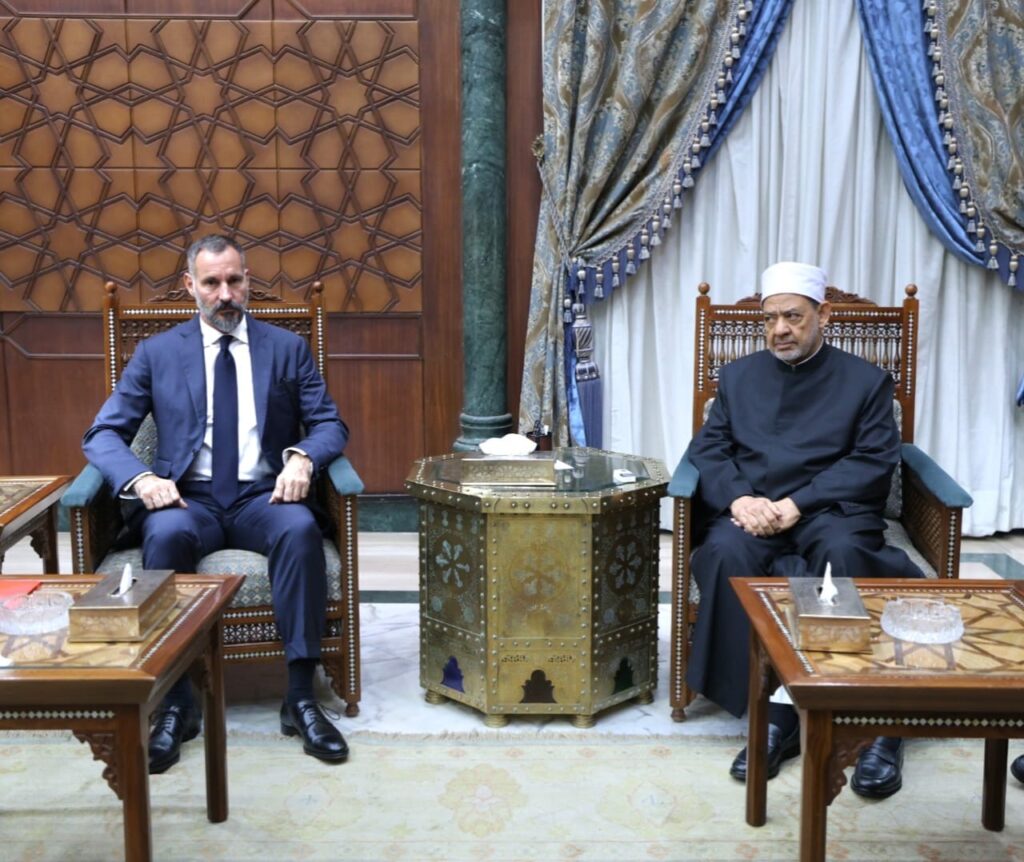
His Eminence Dr. Ahmed Al-Tayeb, the Grand Imam of Al-Azhar and Chairman of the Muslim Council of Elders, welcomed General Sahir Shamshad Mirza, Chairman of the Joint Chiefs of Staff Committee of the Islamic Republic of Pakistan.

During the meeting, His Eminence highlighted the deep ties with the Islamic Republic of Pakistan, noting that Pakistan exemplifies the progress and strength of Islamic intellectual thought. He expressed a commitment to strengthening academic and cultural cooperation with Pakistan through initiatives such as establishing centers to teach the Arabic language, enabling Pakistan people to learn the language of the Holy Qur’an, increasing scholarship opportunities, and training Pakistani imams.

His Eminence emphasized that the time has come for the Islamic world to unite and rally around the Palestinian cause, which has become a global concern. He stated, “There can be no stability in the Middle East, or indeed the world, without a just resolution to the Palestinian issue that ensures the Palestinian people’s full rights to establish an independent state with Jerusalem as its capital.”

General Sahir Shamshad Mirza expressed his delight at meeting His Eminence, conveying the appreciation of Pakistan’s leadership and people for the Grand Imam. He remarked, “Meeting you is a great honor, as you are a symbol of Islamic moderation, inspiring hope among Muslims worldwide with your courageous stances.” He added that the people of Pakistan trust Al-Azhar’s approach, closely follow its positions with deep respect, and support its vision on issues affecting the Islamic world.

At the conclusion of the meeting, the Chairman of the Joint Chiefs of Staff extended an official invitation to His Eminence Dr. Ahmed Al-Tayeb to visit Pakistan, emphasizing the people of Pakistan’s eager anticipation of this visit. His Eminence warmly welcomed the invitation, expressing his intent to accept it at the earliest opportunity.

Grand Imam of Al-Azhar and Chairman of the Muslim Council of Elders Meets Pakistan’s Chairman Joint Chiefs of Staff, Emphasizing the Urgent Need for Islamic Unity Read More »

Muslim Council of Elders Welcomes the Intent by Several Nations to Recognize the State of Palestine and Urges Global Affirmation of the Palestinian People’s Right to an Independent State

Muslim Council of Elders: The Series of Announcements by Nations Intending to Recognize the State of Palestine Represents a Historic and Vital Step Toward Justice for the Palestinian People

The Muslim Council of Elders, under the chairmanship of His Eminence Dr. Ahmed Al-Tayeb, the Grand Imam of Al-Azhar welcomes the announcements by Malta, Canada, Australia, Andorra, Finland, Iceland, Luxembourg, New Zealand, Portugal, and San Marino of their intent to recognize the State of Palestine.

The Council affirms that the increasing number of nations supporting the Palestinian people’s rights marks a historic and significant step toward achieving justice, ending their decades-long suffering, and affirming their legitimate right to establish an independent state with Jerusalem as its capital.

The Muslim Council of Elders expresses its full support for all Arab and international efforts aimed at securing a just and comprehensive resolution to the Palestinian issue. It also reiterates its call to the international community to take decisive action in order to halt the aggression in the Gaza Strip, protect innocent civilians, ensure the unimpeded delivery of humanitarian and relief aid, and end displacement plans and starvation policies targeting the oppressed Palestinian people.

Muslim Council of Elders Welcomes the Intent by Several Nations to Recognize the State of Palestine and Urges Global Affirmation of the Palestinian People’s Right to an Independent State Read More »

Muslim Council of Elders Strongly Condemns Terrorist Attack on Church in the Democratic Republic of Congo

The Muslim Council of Elders, led by His Eminence Dr. Ahmed Al-Tayeb, Grand Imam of Al-Azhar, strongly condemns the terrorist attack on a Catholic Church in Kumanda, northeastern Democratic Republic of Congo, which claimed the lives of dozens of innocent civilians and injured others.

The Council categorically rejects such terrorist acts, which contravene the teachings of Islam, all divine religions, international laws, conventions, and universal human and ethical values that prohibit attacks on places of worship and mandate their protection, preservation, and respect.

The Muslim Council of Elders underscores that targeting places of worship constitutes a flagrant assault on the sanctity of human life and sacred sites, representing an indefensible crime under any pretext. It reaffirms its unwavering stance against all forms of violence and terrorism, urging resolute action to counter extremist groups that aim to sow destruction, chaos, and instability.

The Council extends its heartfelt condolences to the Democratic Republic of Congo—its leadership and people—and to the families of the innocent victims, praying that Almighty Allah grants them patience and solace, and a swift recovery to those injured.

Muslim Council of Elders Strongly Condemns Terrorist Attack on Church in the Democratic Republic of Congo Read More »

Muslim Council of Elders Welcomes France’s Intent to Recognize the State of Palestine

The Muslim Council of Elders, under the chairmanship of His Eminence Dr. Ahmed Al-Tayeb, Grand Imam of Al-Azhar, welcomes the announcement by French President Emmanuel Macron regarding France’s intention to recognize the State of Palestine.

The Council expresses its appreciation for this decision, which is poised to bolster international efforts toward achieving a just and comprehensive resolution to the Palestinian issue. It supports the legitimate rights of the Palestinian people, foremost among them the establishment of an independent state with Jerusalem as its capital, in accordance with international resolutions.

The Muslim Council of Elders reiterates its call to the international community to fulfill its responsibilities and act immediately to halt the aggression in the Gaza Strip, ensure the unimpeded delivery of humanitarian and relief aid, and support all Arab and international efforts to end the Palestinian people’s suffering, which has persisted for over seven decades. These efforts aim to promote peace and stability in the region and around the world.

Muslim Council of Elders Welcomes France’s Intent to Recognize the State of Palestine Read More »

Muslim Council of Elders Praises Egypt’s Efforts in Supporting the Palestinian Cause and Working to End Aggression in Gaza

The Muslim Council of Elders, under thebchairmanship of His Eminence Dr. Ahmed Al-Tayeb, the Grand Imam of Al-Azhar, commends the historic and pivotal role of the Arab Republic of Egypt—its leadership and people—in championing the Palestinian cause. The Council strongly denounces baseless propaganda and unfounded accusations aimed at undermining Egypt’s defense of the Palestinian cause and its support for the Palestinian people.

The Council expresses profound appreciation for Egypt’s unwavering commitment to advocating for Palestinian rights across regional and international forums. Egypt has tirelessly provided political, diplomatic, humanitarian, and relief support to the people of Gaza and the broader Palestinian population, reflecting a deep-rooted dedication to the Arab and Islamic nation’s issues. This serves as an exemplary model of fraternal solidarity and historical responsibility toward the Palestinian cause, which remains central to the Arab and Islamic conscience.

The Council highly praises Egypt’s continuous efforts to achieve Palestinian national reconciliation and unify Palestinian ranks to address current and future challenges. It also emphasizes that Egypt has been, and will remain, a steadfast supporter of the Palestinian people in their legitimate struggle to reclaim their rights and establish an independent state with Jerusalem as its capital.

Furthermore, the Council applauds the diplomatic and relief efforts by Arab nations to support the Palestinian people and the oppressed residents of Gaza. It urges the international community and all influential actors to support Egypt’s and other Arab nations’ initiatives to secure a just and comprehensive resolution to the Palestinian issue, ensuring the Palestinian people’s inalienable rights and promoting security and stability in the region and beyond.

Muslim Council of Elders Praises Egypt’s Efforts in Supporting the Palestinian Cause and Working to End Aggression in Gaza Read More »

Muslim Council of Elders Strongly Condemns Israeli Occupation’s Attack on Holy Family Church in Gaza and Demands Protection for Places of Worship and Innocent Civilians

The Muslim Council of Elders, under the chairmanship of His Eminence Dr. Ahmed Al-Tayeb, the Grand Imam of Al-Azhar, unequivocally condemns the Israeli occupation’s attack on the Holy Family Church in the Gaza Strip, which resulted in multiple deaths and injuries.

The Council firmly rejects such attacks, which represent a flagrant violation of international laws, conventions, and norms prohibiting assaults on places of worship and the targeting of innocent civilians. It warns of the escalating humanitarian crisis in Gaza due to the ongoing aggression against the besieged territory and the obstruction of humanitarian and relief aid.

The Muslim Council of Elders renews its call to the international community to uphold its responsibility to protect religious sanctities and civilian institutions, urgently work to end the aggression in the Gaza Strip, and affirm the Palestinian people’s legitimate right to establish an independent state with Jerusalem as its capital.

Muslim Council of Elders Strongly Condemns Israeli Occupation’s Attack on Holy Family Church in Gaza and Demands Protection for Places of Worship and Innocent Civilians Read More »