
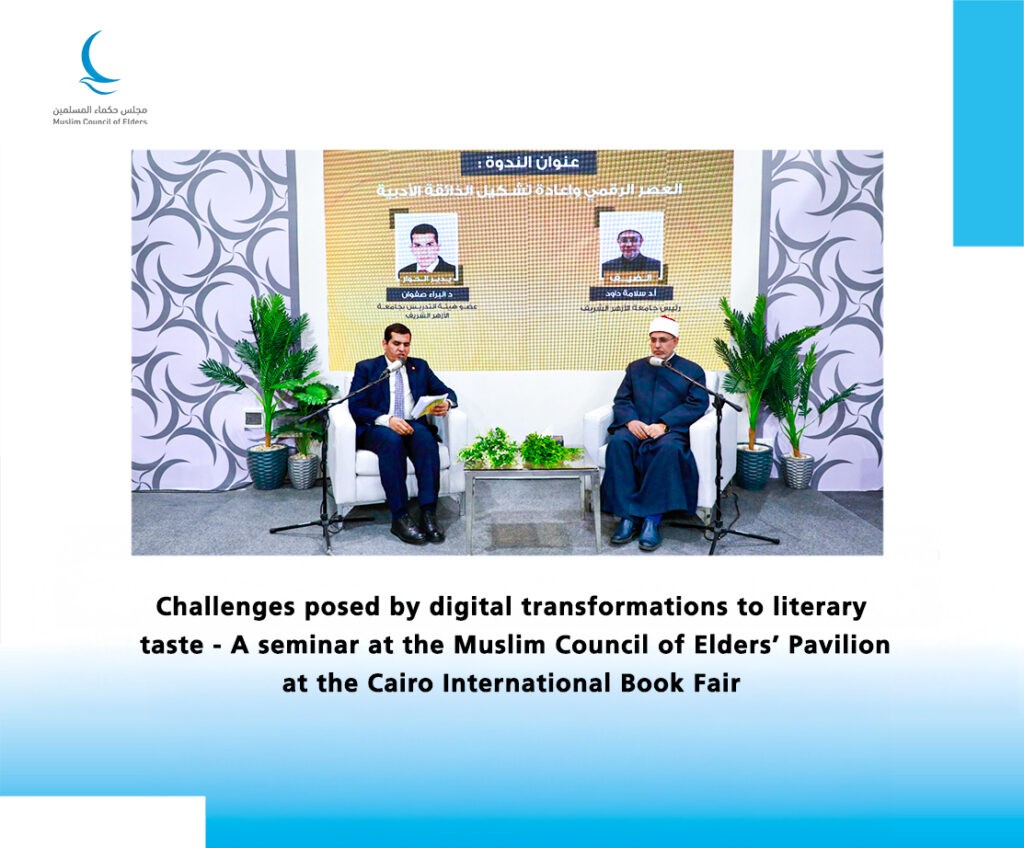
The pavilion of the Muslim Council of Elders at the Cairo International Book Fair held its sixth cultural seminar, titled “The Digital Age and the Reshaping of Literary Taste,” with the participation of Professor Dr. Salama Dawood, President of Al‑Azhar University, in the presence of a distinguished audience of intellectuals, researchers, and students.
The seminar shed light on the challenges that digital transformations impose on literary taste, and how literary creativity can endure amid modern technology, with a focus on balancing authenticity and contemporary approaches in the reception of knowledge.
Dr. Salama Dawood emphasized that nurturing talent and refining literary taste are the result of a cumulative journey that begins with extensive reading, structured memorization, and exposure to elevated examples drawn from the finest classical texts and eloquent poetry. This, combined with training the mind to balance and compare different styles and texts, develops within the reader a “rhetorical faculty” that enables distinguishing between what is refined and what is inferior.
The President of Al‑Azhar University warned against being swept away by the language used by some on social media platforms, which has had a negative impact on the literary taste of the current generation. He pointed out that a person is shaped by what they read and hear; if one regularly hears articulate and elevated speech, a refined sense of language develops, whereas habitual exposure to crude language corrupts one’s linguistic and literary faculty.
In an important remark, Dr. Dawood also stressed that cultivating literary taste is not merely an “intellectual luxury” but a necessity. He explained that an inability to appreciate literature or distinguish between what is fine and what is coarse leads inevitably to an inability to sense the rhetorical miracle of the Qur’an and to recognize the superiority of Allah’s words over human speech.
Dr. Salama Dawood concluded his remarks by linking the success of educational institutions—schools, institutes, and universities—to their ability to cultivate this “rhetorical faculty” in students. He affirmed that the capacity to appreciate what is spoken and heard is the true measure of success within the educational process.
The Muslim Council of Elders is participating at the 57th Cairo International Book Fair, held from 21 January to 3 February 2026 with a wide range of the Council’s publications, alongside a series of seminars, activities, and events focused on promoting the values of peace and peaceful coexistence among all people.
The pavilion of the Muslim Council of Elders is located next to the Al‑Azhar Pavilion in Heritage Hall No. 4 at the Egypt International Exhibition and Convention Center in the Fifth Settlement.