
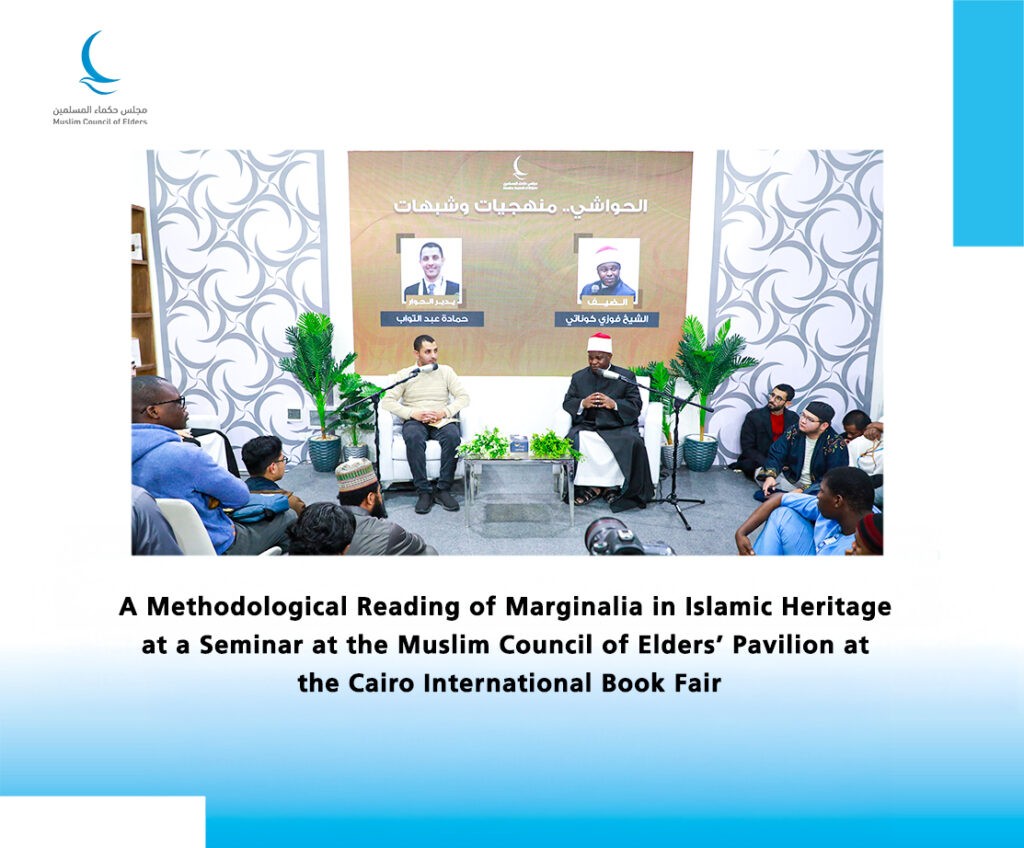
The Muslim Council of Elders held its eighth cultural seminar at the 57th Cairo International Book Fair, titled “Marginalia: Methods and Misconceptions,” with the participation of Sheikh Fawzi Konaté.
The seminar aimed to offer a methodological and scholarly examination of “marginalia” (ḥawāshī) in Islamic heritage, highlighting how they should be approached and addressing the academic concerns raised about them—ensuring that the Islamic intellectual tradition is both preserved and critically assessed through rigorous scholarly standards.
During the seminar, Sheikh Fawzi Konaté explained that linguistically the term “ḥāshiya” refers to the edge or margin of something, and over time it became a conventional term for what is written on the margins of a manuscript. He clarified that marginalia fall into two types: marginal notes on commentaries and marginal notes on primary texts. He noted that before the 10th century AH, most marginalia were written on primary texts, while after the 10th century AH, marginalia increasingly appeared on commentaries.
Regarding the origins and development of marginalia, Konaté highlighted that marginal notes often first appear on a student’s personal copy of a book, reflecting what he received from his teacher during the reading of the text. He explained that marginalia became available to the wider scholarly community in several ways: either the scholar compiles them himself, others compile them during his lifetime, or his students collect them after his passing.
Konaté also explained that scholars who wrote marginalia aimed to supplement what the commentator may have overlooked, clarify points that were obscure or concealed in the author’s intent, or correct errors and lapses. He summarized the purposes of marginalia into three principal functions: clarifications, verifications, and critical refinements.
The Muslim Council of Elders is participating at the 57th Cairo International Book Fair, held from 21 January to 3 February 2026 with a large selection of the Council’s distinguished publications, along with a series of seminars, activities, and events focused on promoting the values of peace and peaceful coexistence among all people.
The pavilion of the Muslim Council of Elders is located next to the Al‑Azhar Pavilion in Heritage Hall No. 4 at the Egypt International Exhibition and Convention Center in the Fifth Settlement.