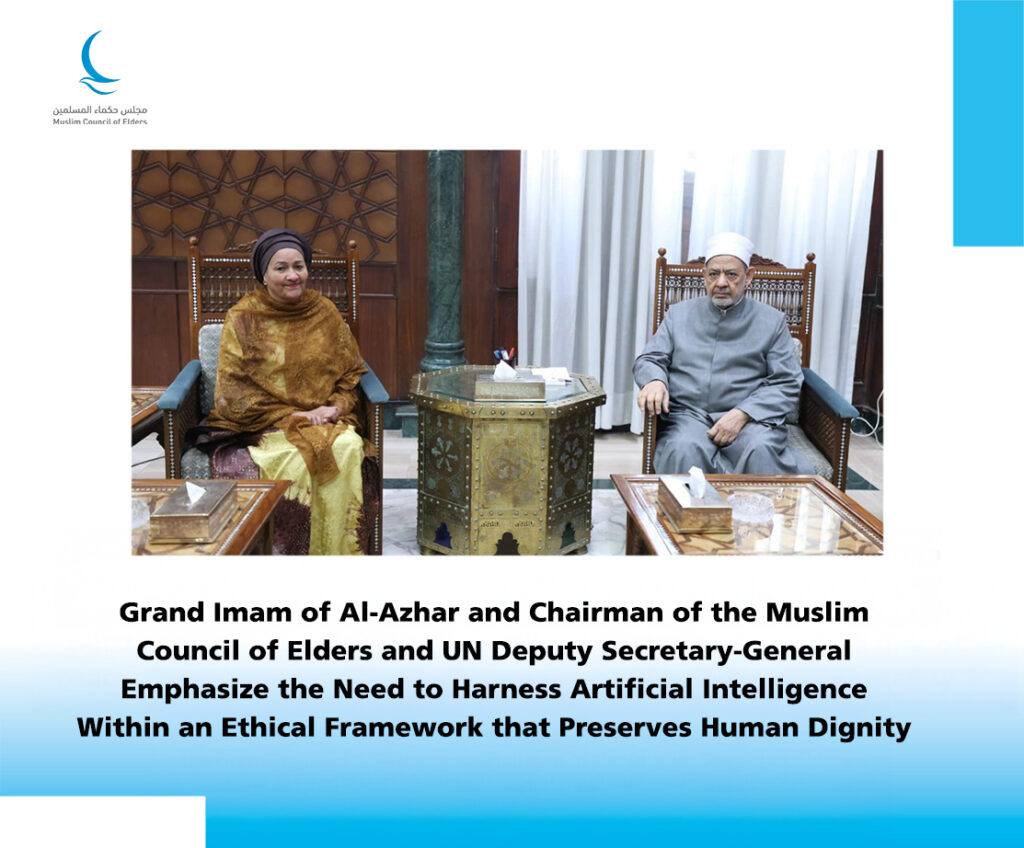
Grand Imam of Al-Azhar and Chairman of the Muslim Council of Elders and UN Deputy Secretary-General Emphasize the Need to Harness Artificial Intelligence Within an Ethical Framework that Preserves Human Dignity
His Eminence Dr. Ahmed Al-Tayeb, Grand Imam of Al-Azhar and Chairman of the Muslim Council of Elders, received Her Excellency Amina Mohammed, Deputy Secretary-General of the United Nations, along with her accompanying delegation. During the meeting, His Eminence emphasized that artificial intelligence, without ethical safeguards, risks undermining human values, and that no scientific advancement can truly benefit humanity if it is detached from these values.
His Eminence explained that the rapid development of artificial intelligence technologies raises genuine concerns about their impact on moral and human values. He noted that excessive reliance on such tools is already negatively affecting critical thinking and creativity, and has become a means of reinforcing certain negative behaviors, circumventing ethical standards, and appropriating the work of others. He warned that the absence of a governing ethical framework for artificial intelligence could lead to a future in which human dignity declines and the principles upheld by divine religions are eroded.
His Eminence further raised concerns about the future of humanity if such technologies were to be controlled by a limited few capable of influencing the fate of nations, development trajectories, and the broader future of humanity. He stressed that while scientific progress is essential and beneficial, it must not come at the expense of moral values. He stated: “The question that should concern the world today is not how far technology and artificial intelligence will advance, but rather who will regulate this advancement, on what system of values and ethics it will be based, and who will be held accountable. If ethics are absent, scientific progress itself becomes a source of danger to humanity.”
The Grand Imam also expressed his appreciation for the role played by the United Nations, under the leadership of Secretary-General António Guterres, in upholding international law, promoting justice, and confronting injustice. He affirmed Al-Azhar’s and the Muslim Council of Elders’ readiness to join any international effort aimed at ensuring that artificial intelligence is used to serve humanity rather than control it.
For her part, Her Excellency Amina Mohammed expressed her appreciation for the Grans Imam’s role in promoting the values of fraternity, coexistence, and global peace and also conveyed the greetings of the UN Secretary-General. She noted that, in recent years, the United Nations has launched extensive discussions on the governance of artificial intelligence, placing human dignity and ethical values at the center of this technology. She added that these dialogues are now being formally launched from Al-Azhar before expanding to major religious and cultural institutions around the world.
The UN Deputy Secretary-General commended the Grand Imam’s vision, which underscores the importance of preserving human dignity in the digital age. She emphasized that technology must remain a tool that serves humanity, not a means of controlling it, and that its responsible use should contribute to enhancing people’s well-being, promoting justice, and narrowing disparities between nations.
She also expressed her appreciation for the Document on Human Fraternity, signed in Abu Dhabi in 2019 by His Eminence Dr. Ahmed Al-Tayeb, Grand Imam of Al-Azhar, and the late Pope Francis, former Pontiff of the Catholic Church.