May 13, 2026

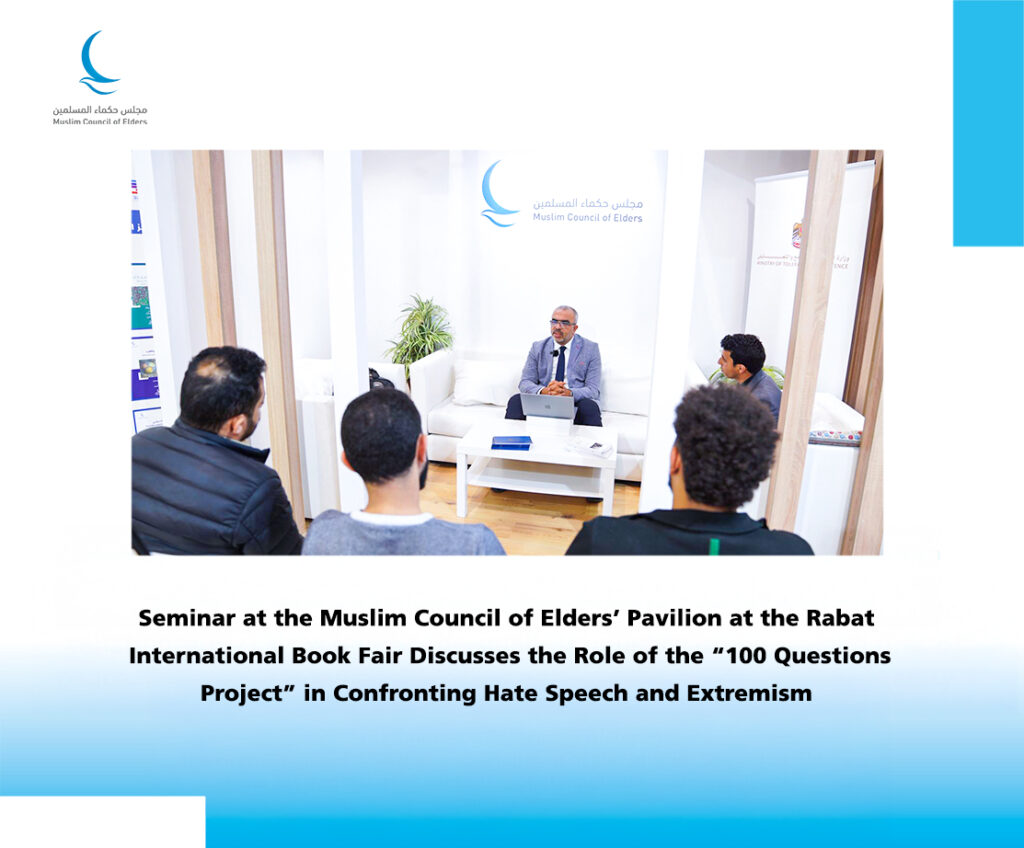
Seminar at the Muslim Council of Elders’ Pavilion at the Rabat International Book Fair Discusses the Role of the “100 Questions Project” in Confronting Hate Speech and Extremism

The Muslim Council of Elders’ pavilion at the Rabat International Publishing and Book Fair hosted a cultural seminar titled “The 100 Questions Project in Methodology, Creed, and Sharia,” by Dr. Samir Boudinar, Director of the Al-Hokama Center for Peace Research, in the presence of scholars, intellectuals, and individuals engaged in intellectual and religious affairs.

The seminar presented an intellectual and scholarly examination of the book “The 100 Questions Project in Methodology, Creed, and Sharia,” which represents the outcome of a collaborative academic effort between Al-Azhar and the Muslim Council of Elders. The work aims to provide well-grounded and balanced answers to a number of contemporary intellectual and theological questions and misconceptions raised within Muslim societies today, contributing to the promotion of sound religious awareness, the entrenchment of moderation and balance, and the confrontation of hate speech and extremist ideologies.

Dr. Samir Boudinar explained that the book draws upon a diverse range of scholarly and classical sources, including the Holy Qur’an and the Prophetic Sunnah, as well as works of theological debate, scholarly discourse, and refutation that have historically contributed to shaping doctrinal positions and reinforcing ethical and human values within Islamic civilization. He noted that the phenomena of misconceptions, extremism, hatred, and excess are not confined to Islamic culture alone, but rather constitute a global challenge affecting various cultures and societies.

The seminar also reviewed the book’s key themes, including methodological approaches to understanding religion, the relationship between reason and revelation, the principles governing legal opinions (fatwas) and the higher objectives of Sharia, and the role of creed in shaping human behavior. It further addressed issues such as excommunicatio, the concept of the caliphate, and other contemporary intellectual challenges, underscoring the importance of developing a balanced religious discourse that confronts extremism and promotes the values of peace and coexistence.

The Muslim Council of Elders, in cooperation with the Ministry of Tolerance and Coexistence of the United Arab Emirates, is participating at the 31st Rabat International Publishing and Book Fair, which runs until 10 May 2026. The pavilion showcases more than 275 publications in five languages, alongside a diverse program of seminars and cultural and intellectual events aimed at promoting the values of dialogue, tolerance, coexistence, and peace.

Seminar at the Muslim Council of Elders’ Pavilion at the Rabat International Book Fair Discusses the Role of the “100 Questions Project” in Confronting Hate Speech and Extremism Read More »

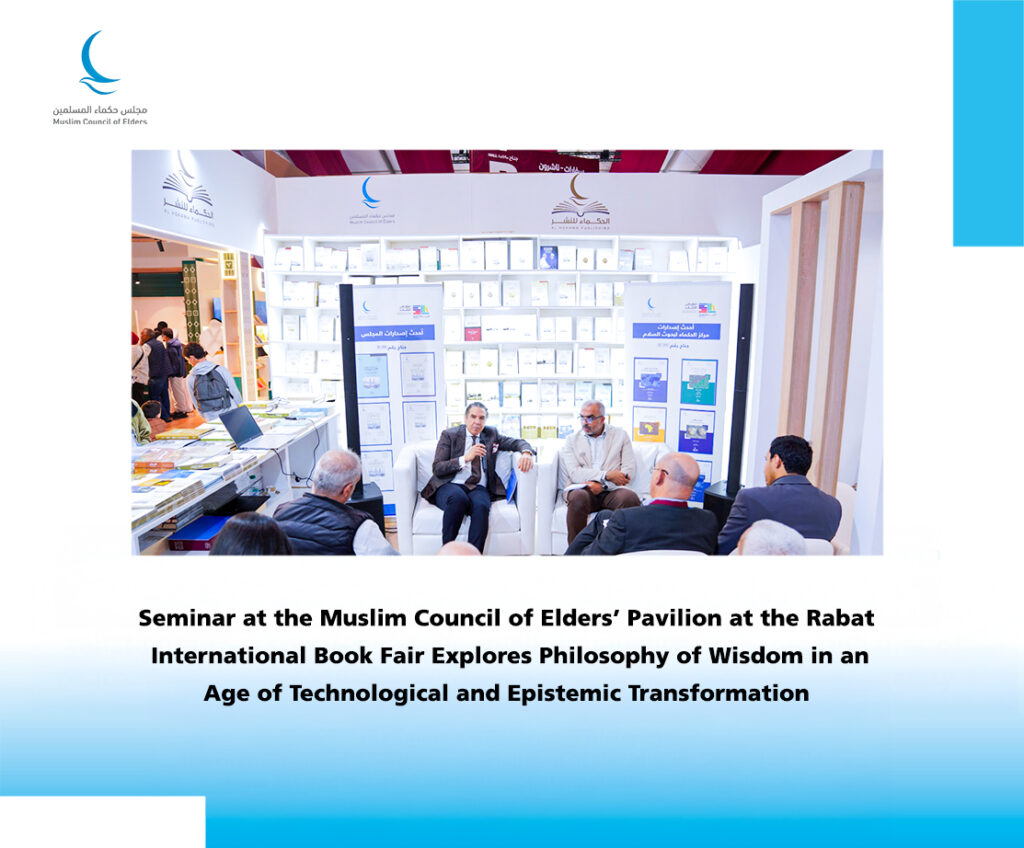
Seminar at the Muslim Council of Elders’ Pavilion at the Rabat International Book Fair Explores Philosophy of Wisdom in an Age of Technological and Epistemic Transformation

The Muslim Council of Elders’ pavilion at the Rabat International Book Fair hosted a seminar titled “Toward a Philosophy for the Age of Wisdom: Reflections on Science, Revelation, and Philosophy,” featuring Dr. Mustafa Hijazi and moderated by Dr. Samir Boudinar, Director of the Al-Hokama Center for Peace Research, and was attended by a group of intellectuals, academics, and media professionals.

The seminar offered an in-depth intellectual reading of Dr. Mustafa Hijazi’s book “Seizing the Wind: Reflections on Science, Revelation, and Philosophy,” one of the latest 2026 publications by Al-Hokama Publishing. The work presents a critical vision of the trajectory of human civilization and explores the possibility of founding a new era grounded in wisdom, regarded as the missing link in a world rapidly advancing toward material and technological superiority at the expense of meaning and humanity.

Dr. Mustafa Hijazi explained that the book serves as an intellectual testimony to the major transformations experienced by humanity across the ages. It traces the evolution of both cosmic and human concepts from prehistoric times through the agricultural, industrial, and information eras, and into the age of artificial intelligence. He cautioned against the erosion of human meaning and the loss of intellectual freedom amid the dominance of technology and the accelerating pace of epistemic change.

Hijazi also emphasized that overcoming the current civilizational crisis requires restoring centrality to the questions of meaning and truth, beginning anew with the fundamental question of “why.” Such a reorientation, he noted, would contribute to redefining the relationship between humanity and science, education, society, the economy, and the media. He stressed that building an “Age of Wisdom” can only be achieved through the integration of revelation, philosophy, and human knowledge—moving beyond the false dichotomy between reason and meaning.

The Muslim Council of Elders is participating at the 31st Rabat International Publishing and Book Fair, which runs until 10 May 2026. The pavilion showcases more than 275 publications in five languages, alongside a diverse program of seminars and cultural and intellectual events aimed at promoting the values of dialogue, tolerance, coexistence, and peace.
Seminar at the Muslim Council of Elders’ Pavilion at the Rabat International Book Fair Explores Philosophy of Wisdom in an Age of Technological and Epistemic Transformation Read More »