
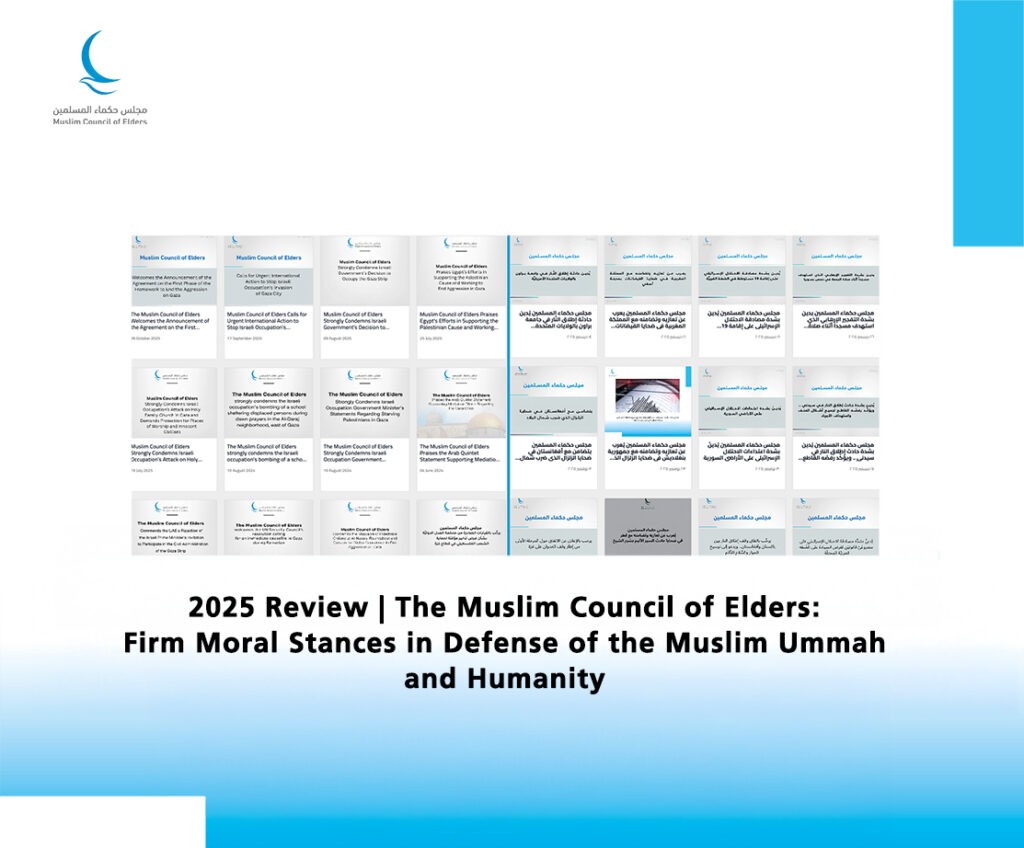
Throughout 2025, the Muslim Council of Elders demonstrated a consistent and principled moral stance in addressing the pressing issues facing the Muslim world and humanity at large. Through its positions and initiatives, the Council reaffirmed its unwavering commitment to promoting peace, fostering the values of dialogue, coexistence, tolerance, and mutual respect, and rejecting all forms of hatred, violence, extremism, terrorism, and Islamophobia.
During the year, the Council focused its efforts on countering extremist ideologies, fostering interfaith dialogue, and reinforcing the values of understanding and coexistence among diverse communities within the Muslim world. It emphasized that safeguarding human dignity is a shared moral and religious responsibility, and that defending the causes of the Muslim Ummah is inseparable from defending universal human values. The Council consistently called upon the international community to adopt a just and balanced discourse that contributes to global peace and stability.
Concerning the aggression against Gaza, the Muslim Council of Elders issued a series of statements firmly condemning the ongoing assault on the Gaza Strip. It called for an end to the suffering of the Palestinian people, which has persisted for more than seven decades, and reaffirmed the necessity of reaching a just and lasting solution to the Palestinian cause, including recognition of the legitimate right of the Palestinian people to establish an independent state with East Jerusalem as its capital. The Council also categorically rejected all attempts to forcibly displace Palestinians and expressed support for Arab, Islamic, and international positions defending the legitimate rights of the Palestinian people.
The Council further condemned the violations committed by the Israeli occupation in Jerusalem, including statements by the Israeli occupation prime minister regarding the so-called “Greater Israel” vision, the announcement of the construction of 3,400 new settlement units in the West Bank, the approval of two laws imposing Israeli sovereignty over the occupied West Bank, and plans to establish 19 new settlements. It also denounced attempts to seize control of the Ibrahimi Mosque, repeated incursions into Al-Aqsa Mosque, the decision to occupy the Gaza Strip, and extremist calls to destroy the blessed Al-Aqsa Mosque. The Council strongly condemned attacks targeting Christian communities in Jerusalem, including assaults on the Latin Monastery Church in Gaza. It welcomed the announcements by France, the United Kingdom, Canada, Australia, and Portugal recognizing the State of Palestine, and urged all countries to recognize the establishment of the State of Palestine.
As part of its efforts to advance peace globally, the Council condemned the Israeli military strike on the Qatari capital, Doha, as well as Israeli occupation attacks on Iran and Syrian territory. It called on India and Pakistan to exercise restraint and prioritize dialogue and understanding, welcomed the ceasefire between the two countries, and also welcomed the ceasefire agreement between Pakistan and Afghanistan. The Council further welcomed peace negotiations between Armenia and Azerbaijan aimed at reaching a comprehensive peace agreement, as well as the outcomes of the Arab Extraordinary Summit in Cairo and the Arab-Islamic Extraordinary Summit convened in response to the Israeli occupation’s attack on Doha.
With regard to rejecting violence and terrorism, the Muslim Council of Elders strongly condemned acts of violence in New Orleans and Las Vegas in the United States; the shooting at an educational institution in Sweden; the vehicle-ramming attack in Munich, Germany; the terrorist attack on a train in Balochistan, Pakistan; the attack on a church in the Democratic Republic of the Congo; the attack on a church in the U.S. state of Michigan; the shooting incident at Brown University; the kidnapping of more than 300 students and staff from a Catholic school in Nigeria; the terrorist attack in northeastern Nigeria; and the attack on a humanitarian convoy in North Darfur, Sudan. The Council reiterated the urgent need to intensify global efforts to promote dialogue, tolerance, coexistence, and the values of human fraternity.
In addressing Islamophobia, the Council condemned the killing of a worshipper inside a mosque in southern France, the murder of Algerian student Rahma Ayat in the German city of Hanover, attacks on a mosque in northern Nigeria and another in North Darfur, and called for the development of a comprehensive global strategy to combat all forms of racism, extremism, hatred, and Islamophobia. It further urged the enactment of binding legislation criminalizing such acts and the promotion of a culture of dialogue, tolerance, coexistence, mutual respect, and human fraternity.
Regarding humanitarian solidarity in times of natural disasters, the Council expressed solidarity with the people of Afghanistan following the devastating earthquake in the country’s east and north; with the victims of floods in the Kurdistan Region; with Bangladesh following a deadly earthquake; with Indonesia after floods and landslides; with Thailand and Myanmar after devastating earthquakes; with Türkiye following the Marmara Sea earthquake; with Qatar after the tragic traffic accident in Sharm El-Sheikh; with Morocco following floods in the city of Safi; with Iraq after the bridge collapse in Karbala; with Pakistan after deadly floods; with Sudan following a devastating landslide in the Darfur region; and with Algeria after the Oued El-Harrach accident.
The 2025 record of the Muslim Council of Elders reflects a principled and steadfast moral approach rooted in the defense of human dignity and the causes of the Muslim Ummah, and the promotion of peace and coexistence. In a world facing mounting challenges, the Council continues to stand as a voice of wisdom, conscience, and responsibility.