خبریں

“Interfaith Dialogue in the Spirit of the Document on Human Fraternity” – Seminar at the Muslim Council of Elders’ Pavilion at the New Delhi World Book Fair

The Muslim Council of Elders hosted its second seminar at the New Delhi World Book Fair under the theme “Interfaith Dialogue in the Spirit of the Document on Human Fraternity.” The session brought together leading scholars and peace advocates to discuss how the principles of the Document on Human Fraternity can guide societies toward deeper understanding, coexistence, and mutual respect. 

Giani Jaskirat Singh, Spiritual Researcher and Anti Extremism and Peace Activist, described the Document on Human Fraternity as a transformative initiative that reminds the world of the seriousness and responsibility required to build lasting peace. He stressed that genuine interfaith dialogue must begin by recognizing the fundamental truth that “as human beings, we are all equal.” He argued that peace emerges not from highlighting differences but from identifying the deep commonalities shared by all people. Singh reflected on the idea that inner conflict is often the source of outer chaos, and that true peace “beyond ideas, beliefs, culture, or tradition” comes from awakening to our shared humanity and becoming sensitive to the suffering of others. Interfaith encounters, he said, create the space for this rediscovery.

Prof. Dr. P. R. Kumaraswamy, Professor of International Studies at Jawaharlal Nehru University, described the Document on Human Fraternity as inclusive, timeless, and fundamentally anchored in the principle of equality rather than mere tolerance. He called it a “roadmap” that invites continual refinement and implementation, rather than a document that stands completed. Kumaraswamy also noted that genuine dialogue is grounded in equality, mutual respect, and a willingness to focus on shared values among religions to help manage inevitable differences. Even when deep disagreements exist, he argued, dialogue remains indispensable for reducing ignorance, prejudice, and extremism.

Prof. Dr. Rajesh Kumar, Professor of English Language and Literature at Indira Gandhi National Open University, described the Document on Human Fraternity as “the moral necessity of today.” Signed by leading Christian and Muslim figures to uphold the spirit of human fraternity, it aligns closely with the Indian Constitution’s emphasis on fraternity as a safeguard of dignity and freedom of religion. He emphasized that the essence of the document lies in seeing others as “a brother or a sister.”  He also highlighted how compassion transcends religious boundaries and how unconditional help is a universal moral calling. Professor Kumar also stressed that dialogues promoting human empathy and interfaith understanding are essential for peaceful societies.

Throughout the seminar, participants agreed that the Document on Human Fraternity offers a powerful framework for confronting modern challenges—whether extremism, polarization, or cultural fragmentation—by reinvigorating timeless values rooted in human dignity and shared responsibility. They called for interfaith and intercultural dialogue to become a continuous, active practice, enabling communities to move beyond stereotypes and toward genuine coexistence. Speakers also emphasized that the document—co-signed in 2019 by His Holiness Pope Francis and His Eminence the Grand Imam of Al Azhar and Chairman of the Muslim Council of Elders, His Eminence Dr. Ahmed Al Tayeb—remains one of the most important global calls for fraternity, compassion, and shared humanity in an era marked by polarization and conflict.

The Muslim Council of Elders’ participation in the New Delhi World Book Fair stems from its belief in the pivotal role of knowledge and culture as fundamental pillars for fostering understanding, countering division, reinforcing social cohesion, and affirming the importance of religious and intellectual institutions in addressing global issues and building bridges of communication and dialogue among societies.

The Council’s pavilion at the New Delhi World Book Fair is located at Bharat Mandapam, Hall No. 4, Pavilion H-06.

“Interfaith Dialogue in the Spirit of the Document on Human Fraternity” – Seminar at the Muslim Council of Elders’ Pavilion at the New Delhi World Book Fair Read More »

Muslim Council of Elders Extends Congratulations to the Arab and Islamic Nations on the Occasion of Isra and Mi’raj

The Muslim Council of Elders, under the chairmanship of His Eminence Dr. Ahmed Al-Tayeb, the Grand Imam of Al-Azhar, extends heartfelt congratulations to the Islamic nation on the occasion of Isra and Mi’raj—an esteemed event that embodies the highest meanings of faith, patience, and trust in Allah’s promise, while reaffirming the essential role of spiritual and moral values.

The Council emphasizes that the commemoration of Isra and Mi’raj represents a momentous spiritual milestone, carrying profound messages about the elevation of the soul, the virtue of unwavering conviction, the importance of upholding noble character and performing righteous deeds, and the need to deepen the values of mercy, tolerance, and mutual understanding among all people. The Council notes that the world today is in urgent need of values that unite rather than divide, and that build rather than destroy.

On this blessed occasion, the Muslim Council of Elders calls for drawing inspiration from the lessons of Isra and Mi’raj to reinforce peace, reject violence and hatred, promote wisdom and moderation, and advance joint efforts for the good of humanity and the preservation of its dignity—reflecting the noble Islamic principles that advocate for justice, compassion, and peaceful coexistence.

May Allah bless all humanity with security, peace, and stability, and make this occasion an opportunity to strengthen spiritual and human values, unite the Ummah, and inspire hope for a better future for all.

Muslim Council of Elders Extends Congratulations to the Arab and Islamic Nations on the Occasion of Isra and Mi’raj Read More »

Muslim Council of Elders Participates for the Fourth Consecutive Year in New Delhi World Book Fair 2026

For the fourth consecutive year, the Muslim Council of Elders is participating in the New Delhi World Book Fair, which will be held from January 10 to 18, 2026, at the Bharat Mandapam Convention Center in the Indian capital, New Delhi. The Council’s participation stems from its mission to promote peace, establish the values of dialogue and tolerance, and build bridges of cooperation and human coexistence.

Throughout the days of the fair, the Muslim Council of Elders’ pavilion will present over 270 publications, including a number of the latest releases from Al-Hokamah Publishing. These include over 20 works by His Eminence Dr. Ahmed Al-Tayeb, the Grand Imam of Al-Azhar and Chairman of the Muslim Council of Elders, aimed at introducing the tolerance of Islam and the richness of its intellectual and philosophical heritage. Among these works are: “Al-Qawl Al-Tayyib,” “From My Old Notebooks,” “A View on East-West Dialogue,” “An Introduction to the Study of Ancient Logic,” “A Discourse on Causes and Objectives,” “On Sufi Theological Terminology,” “Heritage and Renewal,” “For the Sake of Peace,” “Reflections on the Thought of Imam Al-Ash‘ari,” “Etiquette and Values,” “Towards Contemporary Jurisprudential Ijtihad,” and “Lady Aisha, Mother of the Believers,” among others.

The pavilion will also feature several important publications, including: “Love in the Holy Qur’an” by Prince Ghazi bin Muhammad, a member of the Muslim Council of Elders; “The Pope and the Grand Imam: A Thorny Path” by Judge Mohamed Abdel Salam, Secretary-General of the Muslim Council of Elders; “Rules of Understanding and Comprehension in Thought and Language” by Dr. Mustafa Benhamza, a member of the Muslim Council of Elders; and “Muslims at a Crossroads” by the late Dr. Mahmoud Hamdi Zakzouk, among others.

Recognizing the importance of translation as a bridge between civilizations, the Council will also showcase 25 books in Hindi, Urdu, and Malayalam, including: Al-Qawl Al-Tayyib, Care for Women’s Rights, Interpretation of Ibn Furak, A Discourse on Peace, Dialogue Between East and West, and  Freedom and Citizenship.

Additionally, the pavilion will present numerous translated works, such as “The Voice of Change,” “Shared Universal Values and Building International Peace” by a group of researchers, “Combating Islamophobia in Europe” by a group of researchers, “Islam and Good Governance” by Professor Dr. Muqtedar Khan, and “Islam, the West, and Tolerance: Conceiving Coexistence” by Aaron Tyler.

As part of its participation in this cultural event, the Muslim Council of Elders’ pavilion will organize a series of seminars aimed at fostering discussions that promote social cohesion and highlight the role of religions in addressing contemporary challenges. These seminars will cover several important topics, including: “AI for Humanity: Religious Perspectives on Ethical Artificial Intelligence”, “Interfaith Dialogue in the Spirit of the Document on Human Fraternity” and “Intra-Islamic Dialogue – A Reading of the Call for the People of Qiblah”.

The participation of the Muslim Council of Elders in the New Delhi World Book Fair reflects its ongoing efforts to build bridges of communication between cultures and affirm the importance of shared human values on the global stage. The Council’s pavilion (H6) is located in Hall 4 at the Bharat Mandapam Convention Center, Pragati Maidan, New Delhi.

Muslim Council of Elders Participates for the Fourth Consecutive Year in New Delhi World Book Fair 2026 Read More »

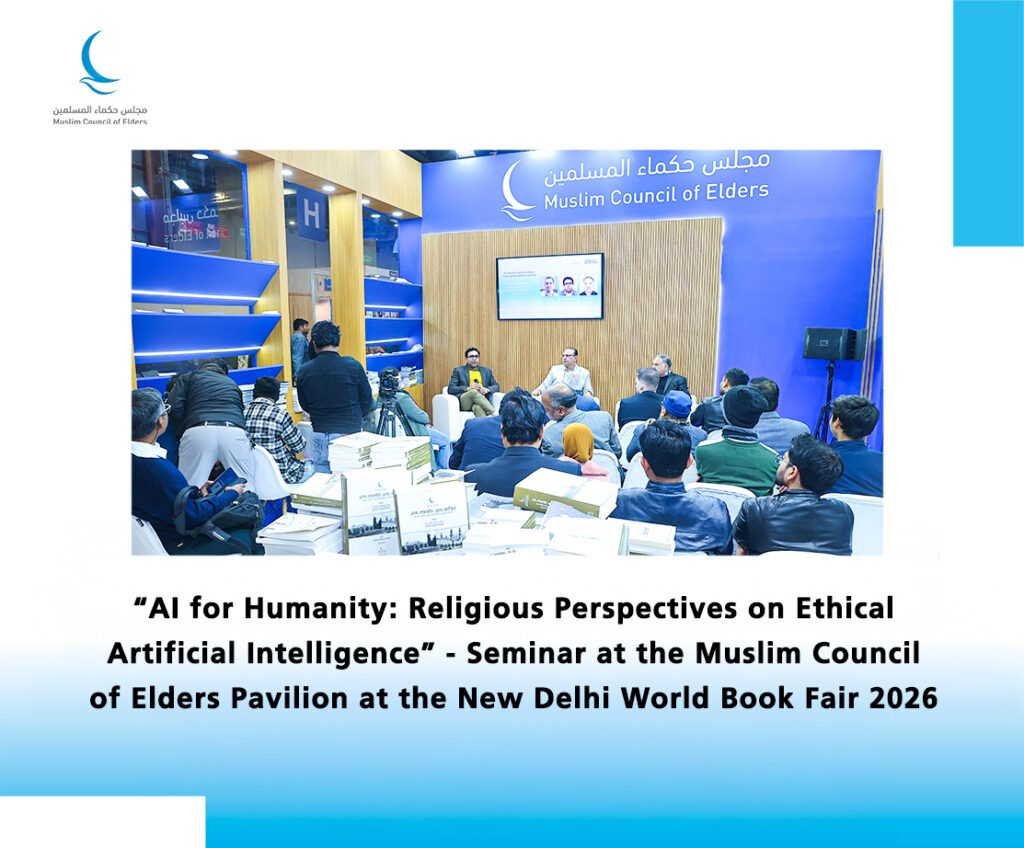
“AI for Humanity: Religious Perspectives on Ethical Artificial Intelligence” – Seminar at the Muslim Council of Elders Pavilion at the New Delhi World Book Fair

The Muslim Council of Elders hosted the first seminar at the New Delhi World Book Fair under the title “AI for Humanity: Religious Perspectives on Ethical Artificial Intelligence,” bringing together distinguished journalists and academics to examine AI’s transformative power through the lens of faith, ethics, and public interest. 

The discussion explored how interfaith dialogue can provide a shared moral vocabulary—rooted in truthfulness, justice, compassion, and human dignity—to guide the development and deployment of AI for the common good. 

Asad Mirza, Prominent Writer and Journalist emphasized that technologies which advance knowledge and benefit society are encouraged, provided they are used responsibly and transparently. He highlighted promising applications—such as traffic management, climate resilience, agricultural productivity, and weather forecasting—while warning against tools that could undermine justice. Mirza called for interfaith and interdisciplinary collaboration so that technologists, ethicists, and faith leaders can together define boundaries between beneficial use and morally ambiguous placing human judgment above automated outputs.

Prof. Dr. Mudassar Qamar, Associate Professor – Jawaharlal Nehru University, outlined three ethical pillars that should frame AI’s development across traditions and jurisdictions: ethical data generation that is free from bias and responsibly sourced; ethical processing that accounts for environmental costs such as energy and water use; and ethical usage secured by safeguards at the individual, societal, and governmental levels. He noted that these principles resonate across religious teachings and offer a practical foundation for cross faith cooperation, ensuring that AI remains equitable, sustainable, and aligned with human rights.

Sanjay Kapoor, President – Editors Guild of India, underscored the need for critical human oversight and distinct regulatory approaches for AI, given its capacity to produce convincing yet fabricated narratives. He pointed to emerging newsroom realities in which AI can rapidly generate sophisticated text but often lacks the human perspective and emotional nuance that readers trust. 

Kapoor urged media organizations to reinvest in original reporting and rigorous fact checking, arguing that values driven editorial standards—shaped by ethical and interfaith commitments to truth and responsibility—are indispensable in an age of algorithmic content.

Participants in the seminar also agreed that while still young, AI direct role in interfaith relations and dialogue remains nascent yet promising with careful human supervision, it can facilitate comparative study of religious messages, enhance translation and interpretation of texts, and promote global understanding by illuminating the universal ethics shared across traditions. Concluding the session, panelists also agreed that AI’s enormous potential must be matched by robust regulation, developer responsibility, organizational codes of conduct, and vigilant human oversight. Above all, they affirmed that interfaith dialogue provides a vital forum for aligning technological innovation with enduring moral principles—so that artificial intelligence advances the dignity, well being, and flourishing of all.

The Muslim Council of Elders’ participation in the New Delhi World Book Fair stems from its belief in the pivotal role of knowledge and culture as fundamental pillars for fostering understanding, countering division, reinforcing social cohesion, and affirming the importance of religious and intellectual institutions in addressing global issues and building bridges of communication and dialogue among societies.

The Council’s pavilion at the New Delhi World Book Fair is located at Bharat Mandapam, Hall No. 4, Pavilion H-06.
“AI for Humanity: Religious Perspectives on Ethical Artificial Intelligence” – Seminar at the Muslim Council of Elders Pavilion at the New Delhi World Book Fair Read More »

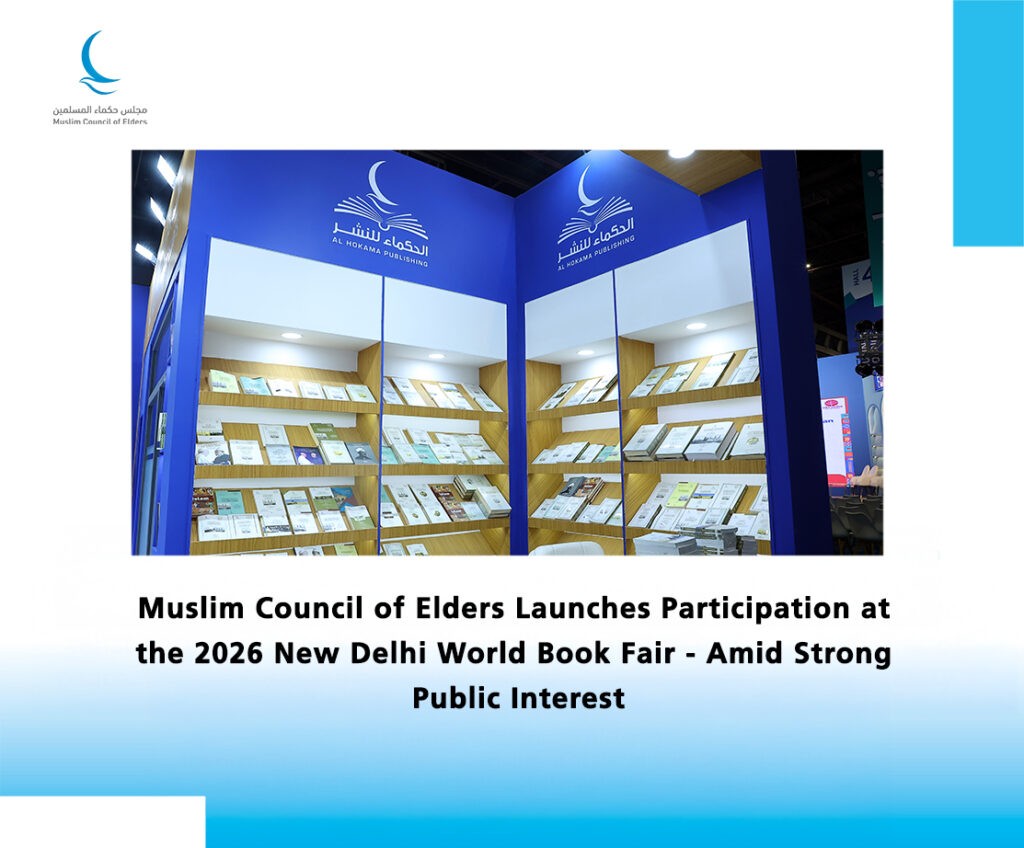
Muslim Council of Elders Launches Participation at the 2026 New Delhi World Book Fair – Amid Strong Public Interest

The Muslim Council of Elders has inaugrated its participation in the 2026 New Delhi World Book Fair through its pavilion, which showcases more than 270 publications in eight languages. The Council’s participation reflects its ongoing commitment to promoting dialogue, strengthening the values of peace, and upholding the principles of coexistence and mutual respect among peoples and cultures.

The opening day of the fair witnessed large engagement from visitors, intellectuals, researchers, and representatives of cultural and academic institutions. Attendees explored the Council’s publications and intellectual initiatives addressing critical issues such as peacebuilding, interfaith dialogue, intra-Islamic dialogue, and the role of religions in confronting contemporary ethical challenges.

The Council’s participation stems from its belief in the pivotal role of knowledge and culture as fundamental pillars for fostering understanding, countering division, reinforcing social cohesion, and affirming the importance of religious and intellectual institutions in addressing global issues and building bridges of communication and dialogue among societies.

Also as part of its participation, the Council will host a series of seminars focusing on contemporary humanitarian and philosophical issues. These include interfaith dialogue, intra-Islamic dialogue, and the ethical dimensions of artificial intelligence. Seminars will feature leading scholars, thinkers, and opinion leaders, reaffirming the Council’s commitment to the principles of the Document on Human Fraternity and its conviction that dialogue is a cornerstone for building cohesive societies founded on peace, understanding, and mutual respect.

The New Delhi World Book Fair is considered one of the most prominent cultural and publishing events globally, bringing together publishing houses, intellectuals, and cultural institutions from around the world. It provides a vital platform for dialogue, cultural exchange, and the promotion of reading and knowledge.

The Muslim Council of Elders’ pavilion at the New Delhi World Book Fair is located at Bharat Mandapam, Hall No. 4, Pavilion H-06.
Muslim Council of Elders Launches Participation at the 2026 New Delhi World Book Fair – Amid Strong Public Interest Read More »

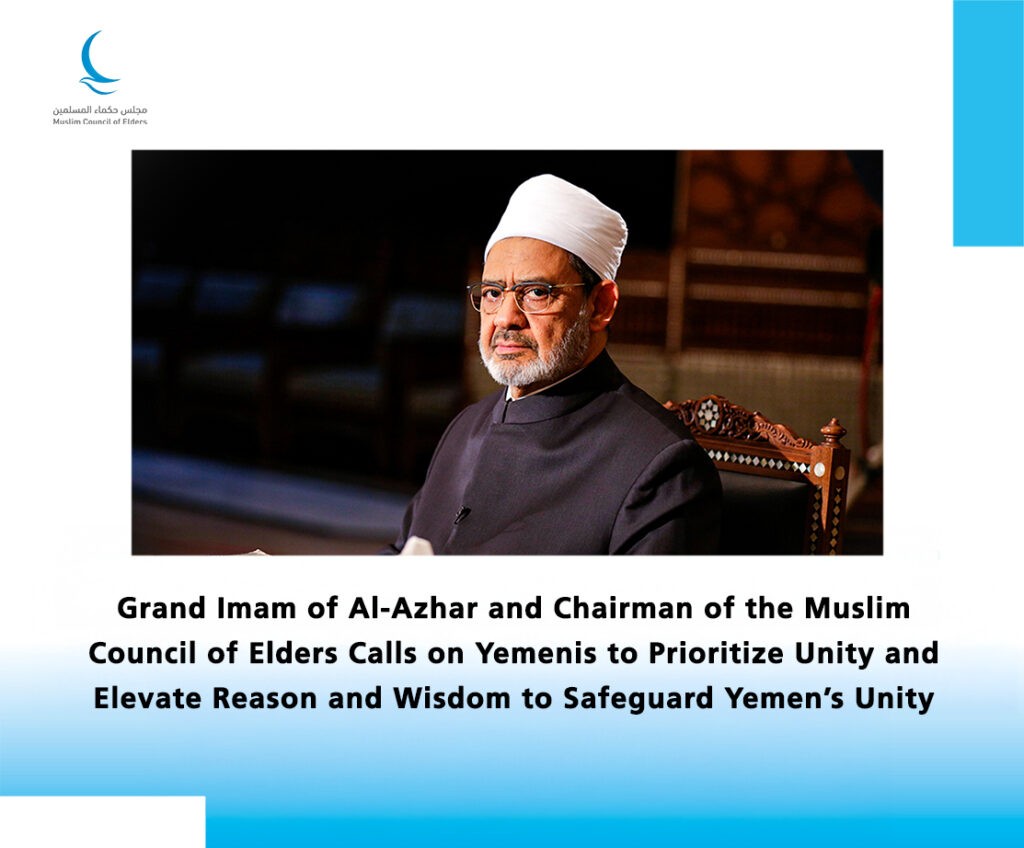
Grand Imam of Al-Azhar and Chairman of the Muslim Council of Elders Calls on Yemenis to Prioritize Unity and Elevate Reason and Wisdom to Safeguard Yemen’s Unity

His Eminence Prof. Dr. Ahmed Al-Tayeb, Grand Imam of Al-Azhar and Chairman of the Muslim Council of Elders, called upon the brotherly Yemeni people, in all their factions and components, to unite and to elevate the voice of reason, wisdom, and the spirit of fraternity to safeguard Yemen’s unity, stability, and territorial integrity.

In a post published on his official Facebook and X accounts, His Eminence wrote: “Our brothers and sisters in Yemen—this land so dear to every Arab and Muslim—we sincerely urge you to elevate the spirit of fraternity and the voice of reason and wisdom for which the people of Yemen have long been known. Our noble Messenger (peace be upon him) spoke of this when he said: ‘The people of Yemen have come to you and they are more gentle and soft-hearted. Belief is Yemenite and Wisdom is Yemenite.’ Hold fast to this wisdom, preserve the unity of your country, and turn toward peace through dialogue and consultation.”

The Grand Imam also called on Arab nations and the international community to intensify efforts to safeguard the stability of Yemen, warning against the grave risks of fragmentation and extremism. He recalled the Qur’anic verse: “And do not dispute with one another, or you would be discouraged and weakened” (The Qur’an, 8:46).

He concluded his message with a prayer for Yemen and the wider Arab and Muslim worlds, saying: “O Allah, protect the lands of the Arab and Muslim nations, and spare them from discord and strife, both manifest and hidden.”

Grand Imam of Al-Azhar and Chairman of the Muslim Council of Elders Calls on Yemenis to Prioritize Unity and Elevate Reason and Wisdom to Safeguard Yemen’s Unity Read More »

Muslim Council of Elders Congratulates the Arab and Muslim Worlds and All Humanity on the Advent of the New Year 2026

The Muslim Council of Elders, chaired by His Eminence Professor Ahmed Al-Tayeb, Grand Imam of Al-Azhar Al-Sharif, extends its heartfelt congratulations to the Arab and Muslim worlds, and to all of humanity, on the advent of the New Year 2026. The Council prays that the coming year will be one of peace, understanding, coexistence, and shared human values.

The Council affirms that the new year represents a renewed opportunity for the global human family to promote a culture of dialogue, reject violence and hatred, and advance collective efforts to build a more just, compassionate, and stable world. It emphasizes that true peace can only be achieved through adherence to moral values and respect for human dignity.

The Council calls upon religious, intellectual, and political leaders, as well as international institutions, to unite their efforts to end conflicts and wars, address the root causes of crises, and promote a discourse grounded in wisdom and reason—one that contributes to communal peace and human security.

The Council also renews its commitment in 2026 to advancing the values of moderation, tolerance, and human fraternity, and to further promoting dialogue among religions and cultures, in pursuit of a more compassionate, just, and peaceful future marked by solidarity and coexistence.

Muslim Council of Elders Congratulates the Arab and Muslim Worlds and All Humanity on the Advent of the New Year 2026 Read More »

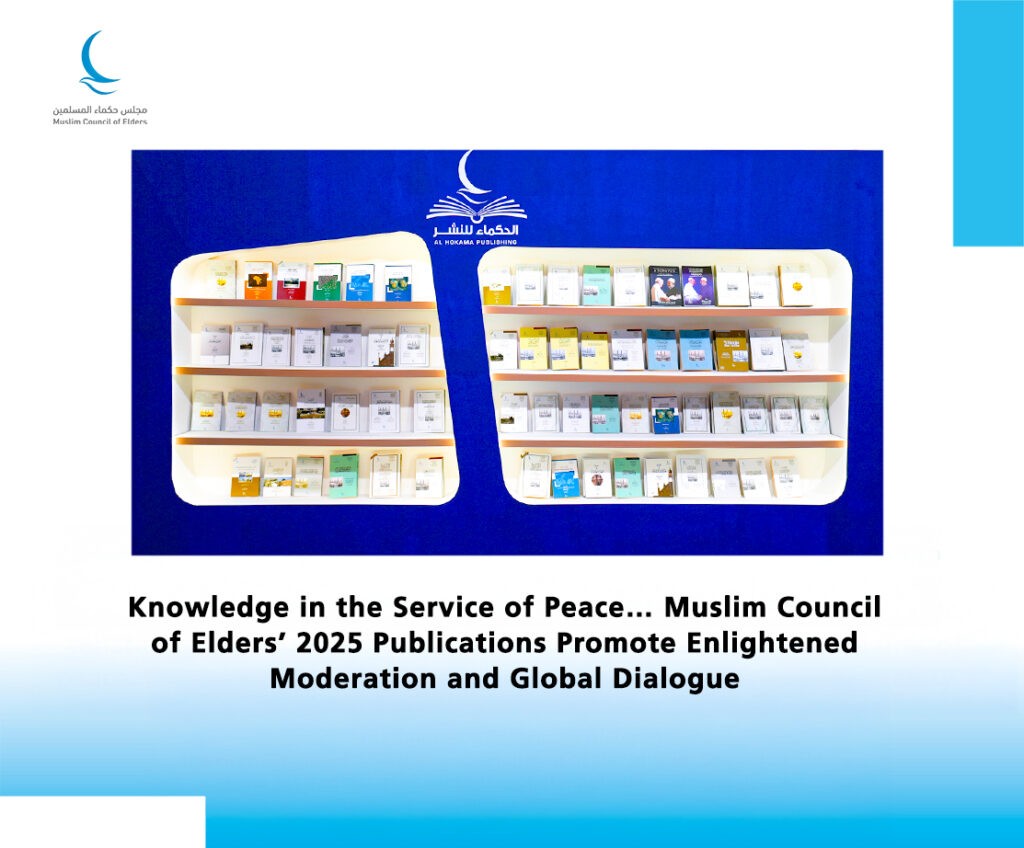
Knowledge in the Service of Peace… Muslim Council of Elders’ 2025 Publications Promote Enlightened Moderation and Global Dialogue

Throughout 2025, the Muslim Council of Elders continued to advance its intellectual and scholarly mission through its knowledge arm, Al-Hukama Publishing, releasing a wide range of thought-provoking books and studies addressing contemporary Islamic thought, social cohesion, interfaith dialogue, and the promotion of the culture of coexistence and peace.

These publications—spanning original scholarly works and carefully curated translations into several world languages—aim to convey the true message of Islam, grounded in compassion, justice, and wisdom, to a global audience. They seek to strengthen the presence of a balanced, enlightened discourse capable of addressing today’s intellectual challenges.

Among the most notable titles published are: The Roots of Sectarian Division in the Muslim World into Sunnis and Shias; Peace in Africa; Exploring Shared Contexts in Building International Peace; Islam and the West: Understanding the Causes of Tension and the Pathways to Dialogue; Managing Conflict in the Muslim World; Religion and the Great Civilizations of Asia; Islamic Principles in Family Organization; The Qur’anic Vision of Humanity; International Peace: Shared Values and Foundational Concepts; and The Ethics of Dialogue in the Qur’an—alongside many other works addressing questions of thought, identity, and constructive dialogue.

As part of its ongoing efforts to promote enlightened and moderate thought and counter misinterpretations of religion, the Muslim Council of Elders also published in 2025 the book “100 Questions on Methodology, Creed, and Law,” which presents thoughtful, scholarly responses to one hundred common questions and misconceptions exploited by extremist ideologies to sow division, mislead youth, and undermine social cohesion. The book adopts a calm, rigorous academic approach rooted in sound scholarship and intellectual balance.

Through a catalog that now exceeds 250 titles in eight world languages, the Muslim Council of Elders continues to invest in knowledge as a cornerstone of peacebuilding. These efforts reflect a firm conviction that enlightened thought is the first line of defense against hatred, extremism, close-mindedness, and a powerful tool for fostering dialogue, coexistence, and human fraternity across worldwide.

Knowledge in the Service of Peace… Muslim Council of Elders’ 2025 Publications Promote Enlightened Moderation and Global Dialogue Read More »

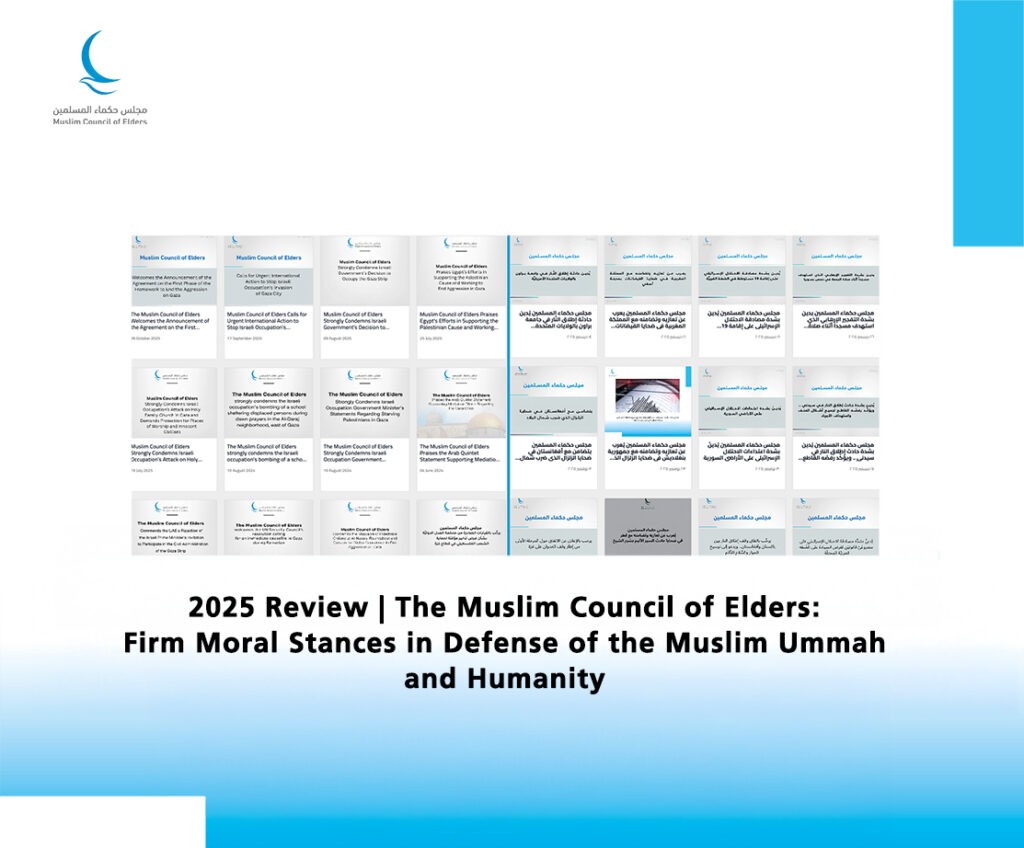
2025 Review | The Muslim Council of Elders: Firm Moral Stances in Defense of the Muslim Ummah and Humanity

Throughout 2025, the Muslim Council of Elders demonstrated a consistent and principled moral stance in addressing the pressing issues facing the Muslim world and humanity at large. Through its positions and initiatives, the Council reaffirmed its unwavering commitment to promoting peace, fostering the values of dialogue, coexistence, tolerance, and mutual respect, and rejecting all forms of hatred, violence, extremism, terrorism, and Islamophobia.

During the year, the Council focused its efforts on countering extremist ideologies, fostering interfaith dialogue, and reinforcing the values of understanding and coexistence among diverse communities within the Muslim world. It emphasized that safeguarding human dignity is a shared moral and religious responsibility, and that defending the causes of the Muslim Ummah is inseparable from defending universal human values. The Council consistently called upon the international community to adopt a just and balanced discourse that contributes to global peace and stability.

Concerning the aggression against Gaza, the Muslim Council of Elders issued a series of statements firmly condemning the ongoing assault on the Gaza Strip. It called for an end to the suffering of the Palestinian people, which has persisted for more than seven decades, and reaffirmed the necessity of reaching a just and lasting solution to the Palestinian cause, including recognition of the legitimate right of the Palestinian people to establish an independent state with East Jerusalem as its capital. The Council also categorically rejected all attempts to forcibly displace Palestinians and expressed support for Arab, Islamic, and international positions defending the legitimate rights of the Palestinian people.

The Council further condemned the violations committed by the Israeli occupation in Jerusalem, including statements by the Israeli occupation prime minister regarding the so-called “Greater Israel” vision, the announcement of the construction of 3,400 new settlement units in the West Bank, the approval of two laws imposing Israeli sovereignty over the occupied West Bank, and plans to establish 19 new settlements. It also denounced attempts to seize control of the Ibrahimi Mosque, repeated incursions into Al-Aqsa Mosque, the decision to occupy the Gaza Strip, and extremist calls to destroy the blessed Al-Aqsa Mosque. The Council strongly condemned attacks targeting Christian communities in Jerusalem, including assaults on the Latin Monastery Church in Gaza. It welcomed the announcements by France, the United Kingdom, Canada, Australia, and Portugal recognizing the State of Palestine, and urged all countries to recognize the establishment of the State of Palestine.

As part of its efforts to advance peace globally, the Council condemned the Israeli military strike on the Qatari capital, Doha, as well as Israeli occupation attacks on Iran and Syrian territory. It called on India and Pakistan to exercise restraint and prioritize dialogue and understanding, welcomed the ceasefire between the two countries, and also welcomed the ceasefire agreement between Pakistan and Afghanistan. The Council further welcomed peace negotiations between Armenia and Azerbaijan aimed at reaching a comprehensive peace agreement, as well as the outcomes of the Arab Extraordinary Summit in Cairo and the Arab-Islamic Extraordinary Summit convened in response to the Israeli occupation’s attack on Doha.

With regard to rejecting violence and terrorism, the Muslim Council of Elders strongly condemned acts of violence in New Orleans and Las Vegas in the United States; the shooting at an educational institution in Sweden; the vehicle-ramming attack in Munich, Germany; the terrorist attack on a train in Balochistan, Pakistan; the attack on a church in the Democratic Republic of the Congo; the attack on a church in the U.S. state of Michigan; the shooting incident at Brown University; the kidnapping of more than 300 students and staff from a Catholic school in Nigeria; the terrorist attack in northeastern Nigeria; and the attack on a humanitarian convoy in North Darfur, Sudan. The Council reiterated the urgent need to intensify global efforts to promote dialogue, tolerance, coexistence, and the values of human fraternity.

In addressing Islamophobia, the Council condemned the killing of a worshipper inside a mosque in southern France, the murder of Algerian student Rahma Ayat in the German city of Hanover, attacks on a mosque in northern Nigeria and another in North Darfur, and called for the development of a comprehensive global strategy to combat all forms of racism, extremism, hatred, and Islamophobia. It further urged the enactment of binding legislation criminalizing such acts and the promotion of a culture of dialogue, tolerance, coexistence, mutual respect, and human fraternity.

Regarding humanitarian solidarity in times of natural disasters, the Council expressed solidarity with the people of Afghanistan following the devastating earthquake in the country’s east and north; with the victims of floods in the Kurdistan Region; with Bangladesh following a deadly earthquake; with Indonesia after floods and landslides; with Thailand and Myanmar after devastating earthquakes; with Türkiye following the Marmara Sea earthquake; with Qatar after the tragic traffic accident in Sharm El-Sheikh; with Morocco following floods in the city of Safi; with Iraq after the bridge collapse in Karbala; with Pakistan after deadly floods; with Sudan following a devastating landslide in the Darfur region; and with Algeria after the Oued El-Harrach accident.

The 2025 record of the Muslim Council of Elders reflects a principled and steadfast moral approach rooted in the defense of human dignity and the causes of the Muslim Ummah, and the promotion of peace and coexistence. In a world facing mounting challenges, the Council continues to stand as a voice of wisdom, conscience, and responsibility.

2025 Review | The Muslim Council of Elders: Firm Moral Stances in Defense of the Muslim Ummah and Humanity Read More »

2025 Review | Branches of the Muslim Council of Elders Worldwide: Soft Religious Diplomacy in the Service of Coexistence and Human Fraternity

Throughout 2025, the Muslim Council of Elders, through its regional offices, continued to advance the values of dialogue, tolerance, coexistence, and peace, while expanding its global outreach and deepening engagement with Muslim communities worldwide. These efforts aimed to foster a deeper understanding of the most pressing challenges facing communities today and to draw inspiration from diverse experiences in building social cohesion and peaceful coexistence among people of different religions, cultures, and intellectual traditions. This work reflects a strategic vision to broaden the Council’s global impact and strengthen its on-the-ground presence across regions.
 
During 2025, the Council’s regional offices served as beacons of hope and bridges of communication, dialogue, and coexistence amid a world facing complex and interrelated challenges. These offices—located in Indonesia, Malaysia, Pakistan, and the Central Asia region, including Kazakhstan—played a central role in advancing the Council’s mission by organizing a wide range of scholarly, cultural, and outreach initiatives. These activities were implemented in partnership with official institutions and religious, academic, and civil society organizations at the local, regional, and international levels, with a focus on promoting dialogue, advancing a culture of tolerance, and fostering peaceful coexistence.
 
In Kazakhstan, the Central Asia office of the Muslim Council of Elders, headquartered in Astana, organized a series of major initiatives aimed at promoting spiritual diplomacy, advancing Islamic culture, and fostering the values of dialogue and coexistence. Among these initiatives was a joint workshop on artificial intelligence, organized in cooperation with L. N. Gumilyov Eurasian National University, bringing together leading AI specialists from across Central Asia. The two sides also signed a memorandum of understanding in the fields of artificial intelligence ethics and technological innovation, marking the beginning of a long-term academic and cultural partnership.
 
The office also organized an international roundtable at the Egyptian University of Islamic Culture “Nur-Mubarak” in Almaty, titled “Spiritual Diplomacy and the Preservation of the Sacred Heritage of World Religions.” The event explored the role of religious institutions in safeguarding global spiritual heritage. In addition, two workshops were held on “Media and Peace Journalism in the Age of Artificial Intelligence” in Turkistan, in cooperation with Khoja Akhmet Yassawi University, and in the city of Almaty, in partnership with the Senate of the Republic of Kazakhstan and the International Center for Interfaith and Interreligious Dialogue, with the participation of policymakers, academics, journalists, and media experts from Central Asia.
 
During the holy month of Ramadan, the Central Asia office organized several programs, including Ramadan missions, a communal iftar, and an Islamic calligraphy exhibition in Kazakhstan. These events were attended by senior officials, diplomats, representatives of religious institutions, and civil society organizations, and aimed to promote dialogue, tolerance, and peaceful coexistence.

At a ceremony held at the headquarters of the Spiritual Administration of Muslims of Kazakhstan, attended by His Eminence Sheikh Nauryzbai Kazhy Taganuly, Supreme Mufti of the Republic of Kazakhstan and Chairman of the Spiritual Administration of Muslims of Kazakhstan; His Eminence Professor Dr. Mohamed Al-Duweini, Undersecretary of Al-Azhar Al-Sharif; and His Excellency Judge Mohamed Abdelsalam, Secretary-General of the Muslim Council of Elders, the Central Asia branch launched the Kazakh-language edition of the book Foundations of Islam by His Eminence Professor Dr. Ahmed Al-Tayeb, Grand Imam of Al-Azhar and Chairman of the Muslim Council of Elders. On this occasion, His Eminence Sheikh Nauryzbai Kazhy Taganuly announced that the book would be incorporated into the curricula for training imams in Kazakhstan, as part of efforts to promote a balanced and enlightened understanding of Islam.
 
In Indonesia, the Council’s branch organized the Harmony Camp, a youth camp bringing together 40 participants from diverse religious backgrounds. The program focused on fostering coexistence, environmental responsibility, and ethical approaches to artificial intelligence as a shared human and religious responsibility. The branch also hosted a Ramadan communal iftar for religious leaders and organized the Council’s Ramadan outreach programs across the country, including a national Ramadan radio program and a Ramadan competition. In addition, it held a national seminar entitled “When Scholars Embrace Algorithms,” in cooperation with Sunan Kalijaga State Islamic University in Yogyakarta, attended by more than 700 academics, researchers, and postgraduate students.
 
The Indonesian branch also launched an initiative to translate the Document on Human Fraternity into Braille, coinciding with World Braille Day, and distributed it to persons with visual impairments to promote inclusive access to the values of peace and human fraternity. It also organized a nationwide sermon competition on the themes of human fraternity and religious responsibility toward the environment, with the participation of 890 imams from across Indonesia.
 
In Pakistan, the Muslim Council of Elders’ branch participated in the National Youth Climate Summit 2025, held in Islamabad, which brought together more than 500 participants, including policymakers, academics, youth leaders, government officials, and students. The Council emphasized the importance of empowering youth to play a leading role in addressing climate change and advancing environmental sustainability.
 
During the month of Ramadan, the Council’s office in Pakistan also hosted an iftar gathering for religious leaders, senior officials, diplomats, and academics. In addition, it took part in the Council’s Ramadan missions, which included visits to several regions—among them Khyber Pakhtunkhwa, Punjab, and the capital Islamabad—to lead religious programs, deliver lectures, promote moderation, and spread enlightened religious discourse. The branch also organized a Ramadan competition, translated several publications, and participated in the Lahore and Karachi International Book Fairs.
 
In Malaysia, the Council’s branch continued its efforts to strengthen engagement with all segments of Malaysian society through a wide range of activities. These included translating several of the Council’s publications into Malay and organizing cultural and educational initiatives aimed at promoting dialogue, tolerance, and peace.
 
Through all these efforts, the Muslim Council of Elders continues, in 2026, to implement a wide range of intellectual, cultural, and community-based programs aimed at promoting the values of dialogue, coexistence, and peace; strengthening moderation and balance; and building bridges of understanding among followers of different religions and cultures—thereby affirming its global mission to advance human fraternity and foster an enlightened, inclusive religious discourse responsive to the challenges of our time.

2025 Review | Branches of the Muslim Council of Elders Worldwide: Soft Religious Diplomacy in the Service of Coexistence and Human Fraternity Read More »