خبریں

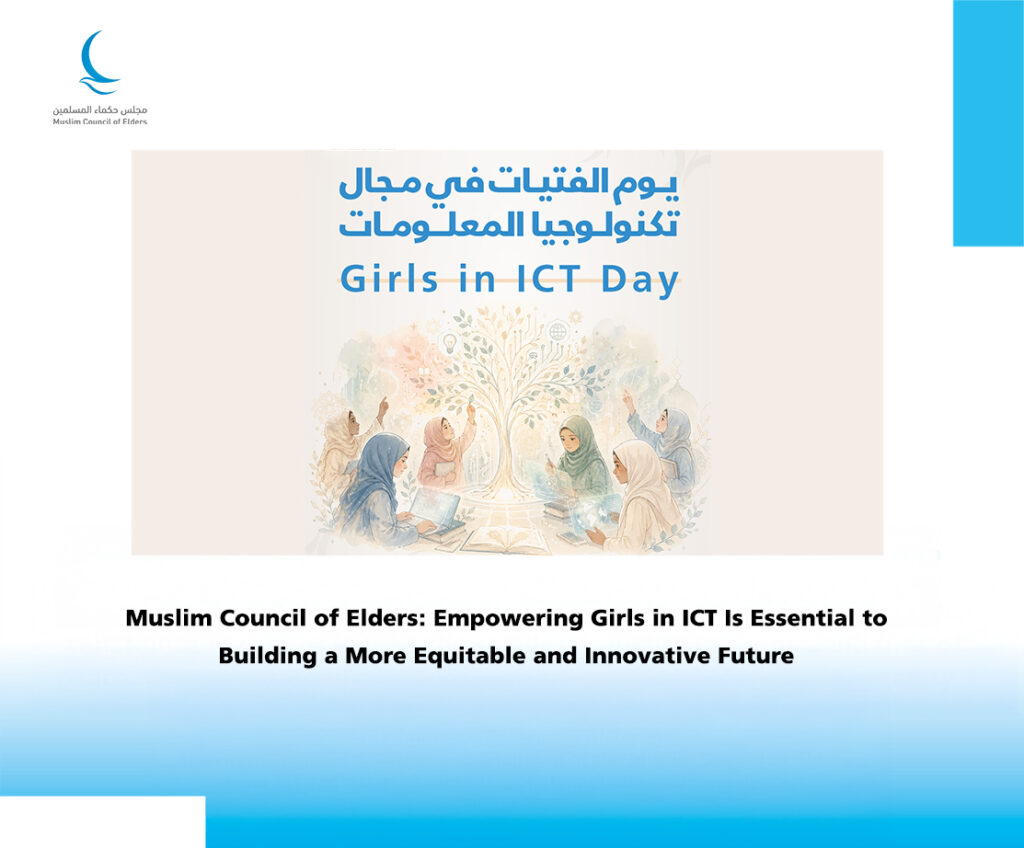
Muslim Council of Elders: Empowering Girls in ICT Is Essential to Building a More Equitable and Innovative Future

The Muslim Council of Elders, chaired by His Eminence Dr. Ahmed Al-Tayeb, Grand Imam of Al-Azhar, affirmed that empowering girls in information and communications technology (ICT) is a fundamental pillar for achieving sustainable development and building more balanced and equitable societies, stressing the importance of providing girls with equal access to education and training in modern technological fields.

In a statement issued on the occasion of International Girls in ICT Day, the Muslim Council of Elders said that investing in girls’ capabilities and expanding their participation in the technology sector helps unlock promising creative potential and strengthens their role in driving digital transformation and shaping the future, thereby advancing innovation and helping address rapidly evolving global challenges.

The statement noted that empowering girls in this field extends beyond technical skills alone to include fostering self-confidence and strengthening women’s presence in positions of influence and decision-making. It emphasized that achieving equality in educational and professional opportunities is a shared responsibility that requires coordinated international, institutional, and societal efforts.

The Muslim Council of Elders called for the launch of quality initiatives and specialized training programs aimed at equipping girls with skills in technology and artificial intelligence, while also creating supportive and innovation-friendly environments that enable girls to play an active role in building a knowledge-based economy driven by innovation and contributing to a more prosperous and sustainable future.

The Muslim Council of Elders places great importance on raising awareness about the need to support and empower girls in the fields of science and technology, based on its belief that such empowerment represents a strategic investment in the future of humanity and reflects a moral and humanitarian commitment to building a more just and inclusive world founded on the values of cooperation, innovation, and peace.
Muslim Council of Elders: Empowering Girls in ICT Is Essential to Building a More Equitable and Innovative Future Read More »

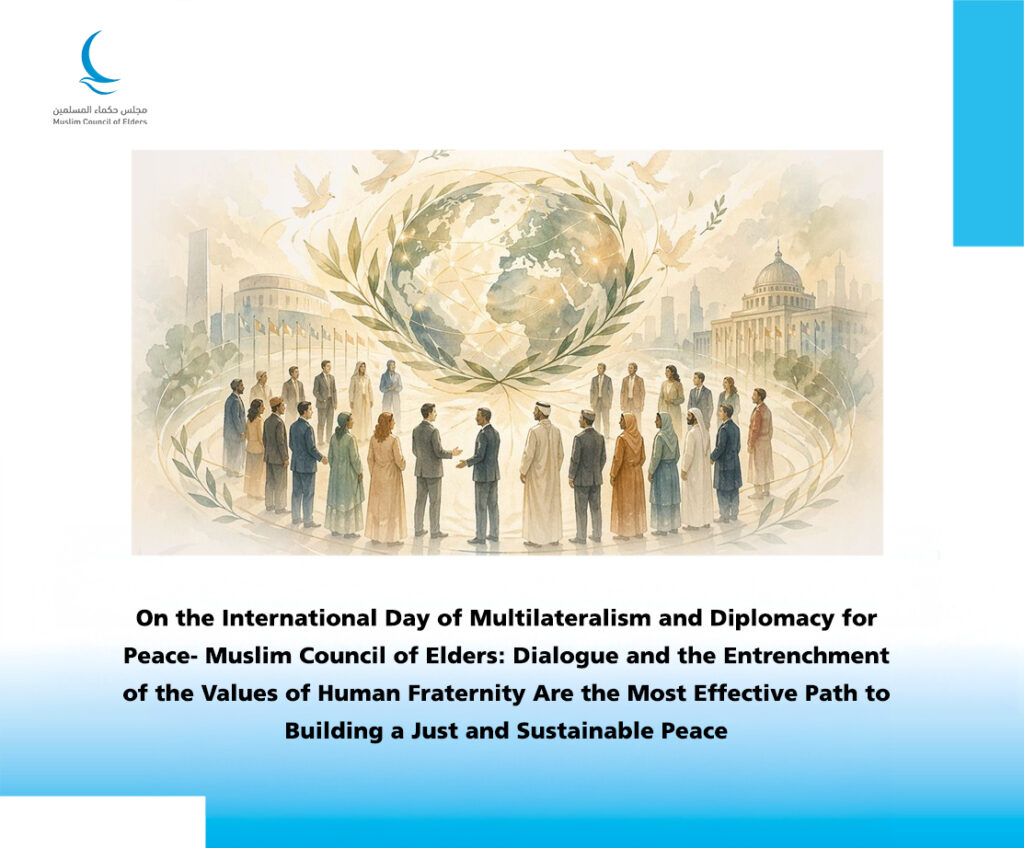
On the International Day of Multilateralism and Diplomacy for Peace- Muslim Council of Elders: Dialogue and the Entrenchment of the Values of Human Fraternity Are the Most Effective Path to Building a Just and Sustainable Peace

The Muslim Council of Elders, chaired by His Eminence Dr. Ahmed Al-Tayeb, Grand Imam of Al-Azhar, affirmed that the world today is in urgent need of entrenching a culture of dialogue, strengthening multilateral action, and supporting diplomatic pathways aimed at resolving conflicts and settling crises through peaceful means, in order to safeguard regional and international security and stability.

In a statement issued on the International Day of Multilateralism and Diplomacy for Peace, observed annually on 24 April, the Muslim Council of Elders underscored that the escalating challenges facing the world—including armed conflicts, humanitarian crises, and growing polarization—demonstrate that achieving peace requires sincere political will, wise diplomacy, and international cooperation grounded in mutual respect, justice, and the protection of human dignity.

The statement noted that shared religious and humanitarian values call for elevating the language of wisdom, prioritizing the interests of peoples, and resorting to dialogue in addressing differences, affirming that peace is not a fleeting option but a shared moral and humanitarian responsibility that necessitates concerted international and regional efforts to protect human lives and preserve the resources of nations.

The Muslim Council of Elders called upon the international community, as well as religious, intellectual, and cultural institutions, to support all initiatives aimed at promoting peace, strengthening dialogue, and entrenching the values of human fraternity, as the sound foundation for building a more just, understanding, and cooperative world. The Council reiterated that just and lasting peace begins with faith in the value of the human being, respect for peoples’ right to security and dignity, and the adoption of diplomacy, dialogue, and multilateral cooperation as essential tools for shaping a future marked by stability and harmony.

On the International Day of Multilateralism and Diplomacy for Peace- Muslim Council of Elders: Dialogue and the Entrenchment of the Values of Human Fraternity Are the Most Effective Path to Building a Just and Sustainable Peace Read More »

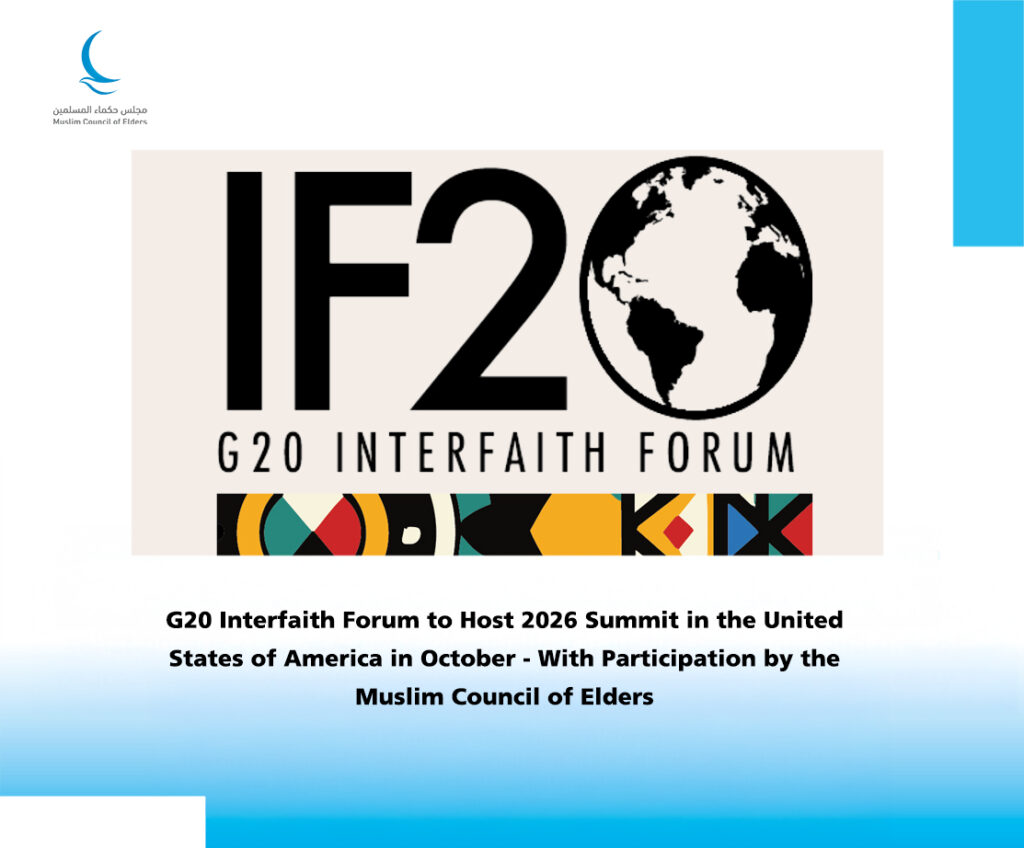
G20 Interfaith Forum to Host 2026 Summit in the United States of America in October – With Participation by the Muslim Council of Elders

The G20 Interfaith Forum Association (IF20) will hold its annual Forum in Salt Lake City, Utah, from October 15–17, 2026. With participation by the Muslim Council of Elders, the event will also bring together an international gathering of religious leaders, interfaith scholars, civil society representatives, and policymakers under the theme Interfaith Engagement for Policy Impact.

The Forum coincides with the United States of America’s presidency of the G20, with the G20 Leaders’ Summit scheduled for December 14–15 in Miami. As a parallel engagement process, IF20 provides faith-informed perspectives on the priorities shaping the global agenda — because faith communities are embedded to the world’s great challenges, with 84% of the world’s population identifying as part of religious or faith institutions.

The Forum’s plenary and working sessions will address the three priority themes of the 2026 U.S. G20 presidency, plus a fourth theme of particular urgency. The themes are: Economic Growth for the Common Good, Energy Security for a Sustainable Future, AI and the Human Future and Interfaith Engagement and the UN Sustainable Development Goals 2030. Additional themes — including the global food crisis, mental health, children’s issues, and refugees and displacement — will be addressed through the Forum’s working group sessions. 

The Muslim Council of Elders had co-organized the 2025 G20 Interfaith Forum (IF20) which was held in Cape Town, South Africa, from August 10 to 14, 2025, under the theme “Ubuntu in Action: Focusing on Marginalized Communities.” During the 2025 forum, the Council reaffirmed its willingness to strengthen its presence and impact across Africa through innovative initiatives focused on peacebuilding, empowering local religious actors, and expanding partnerships with regional institutions through dialogue, tolerance and coexistence.

G20 Interfaith Forum to Host 2026 Summit in the United States of America in October – With Participation by the Muslim Council of Elders Read More »

Muslim Council of Elders – Books Are a Bridge for Human Dialogue and a Powerful Tool for Advancing Awareness and Confronting Hate and Extremism

The Muslim Council of Elders, chaired by His Eminence Dr. Ahmed Al-Tayeb, affirms that the books constitute a foundational pillar in shaping human consciousness and a powerful instrument for promoting the values of dialogue, tolerance, and coexistence, as well as for strengthening mutual understanding among cultures and peoples.

In a statement issued on the occasion of World Book and Copyright Day, observed annually on 23 April, the Muslim Council of Elders emphasized that knowledge remains the most effective means of confronting hatred, ignorance, and extremism, and that investment in reading and publishing is an investment in a more stable and peaceful future. The Council noted that building an aware and enlightened individual begins with a responsible word, sound thought, and a book that broadens horizons of knowledge and reinforces the values of human fraternity—values that represent an authentic path toward a world grounded in understanding and coexistence.

The Muslim Council of Elders called upon cultural, educational, and media institutions to continue their efforts to promote a culture of reading, encourage authorship, and expand access to books—particularly among children and youth—in ways that enhance awareness, entrench the values of dialogue and respect for diversity, and lay the foundations for more cohesive societies capable of fostering peace.

The Muslim Council of Elders continues to exert concerted efforts to combat hatred and extremism and to correct misconceptions through Al-Hokama Publishing, which has produced over 275 publications in over five languages to date. These efforts contribute to broadening access to knowledge, disseminating enlightened and moderate thought, reinforcing the values of dialogue and coexistence, and building bridges of cultural and civilizational exchange among peoples.

Muslim Council of Elders – Books Are a Bridge for Human Dialogue and a Powerful Tool for Advancing Awareness and Confronting Hate and Extremism Read More »

Muslim Council of Elders: Protecting the Earth Is a Shared Moral and Human Responsibility and an Urgent Necessity to Safeguard the Future of Coming Generations

The Muslim Council of Elders, under the chairmanship of His Eminence Professor Dr. Ahmed Al‑Tayeb, the Grand Imam of Al‑Azhar, affirms that World Earth Day, observed annually on 22 April, is an important occasion to renew collective awareness of the necessity of preserving planet Earth, safeguarding its resources, and protecting its environment from degradation and depletion, in a manner that ensures the sustainability of life for present and future generations.

In a statement issued on World Earth Day, the Council emphasized that environmental protection is a shared moral and humanitarian duty and a collective responsibility that requires sincere commitment and a unified will to preserve life on this planet. It also called for the strengthening of joint efforts to confront escalating environmental challenges, foremost among them climate change, pollution, and the loss of biodiversity.

Furthermore, the statement notes that all divine religions have affirmed the importance of cultivating the Earth and refraining from causing corruption upon it, recognizing humanity as stewards entrusted with its care and protection. In this regard, the statement cited the Qur’anic verse: (And do not cause corruption on the Earth after it has been set in order) (Qur’an 7:56), highlighting the ethical and spiritual dimensions of environmental preservation and calling for the adoption of sustainable lifestyles that balance development with the protection of natural resources.

The Muslim Council of Elders further calls for the adoption of effective policies and innovative initiatives that contribute to mitigating the impacts of climate change, advancing the transition toward a green economy, and embedding a culture of environmental responsibility within communities. The Council underscored the importance of investing in environmental education and awareness—particularly among youth—as essential partners in building a more sustainable future.

The Council continues to exert significant efforts to strengthen the role of religious leaders and institutions in addressing global challenges, foremost among them environmental issues, in pursuit of climate justice. These efforts include initiatives such as the “Faith Pavilion,” held during COP28 in Dubai and COP29 in Azerbaijan.

In addition, the Council organized the Global Faith Leaders Summit for Climate Action in Abu Dhabi in 2023, which resulted in the document titled “A Call of Conscience: The Abu Dhabi Joint Statement for Climate” which was co-signed by over 30 religious leaders and figures from around the world, including His Eminence Dr. Ahmed Al‑Tayeb, the Grand Imam of Al‑Azhar and Chairman of the Muslim Council of Elders, and His Holiness the late Pope Francis of the Catholic Church, among other inspiring initiatives and efforts dedicated to preserving our planet.

Muslim Council of Elders: Protecting the Earth Is a Shared Moral and Human Responsibility and an Urgent Necessity to Safeguard the Future of Coming Generations Read More »

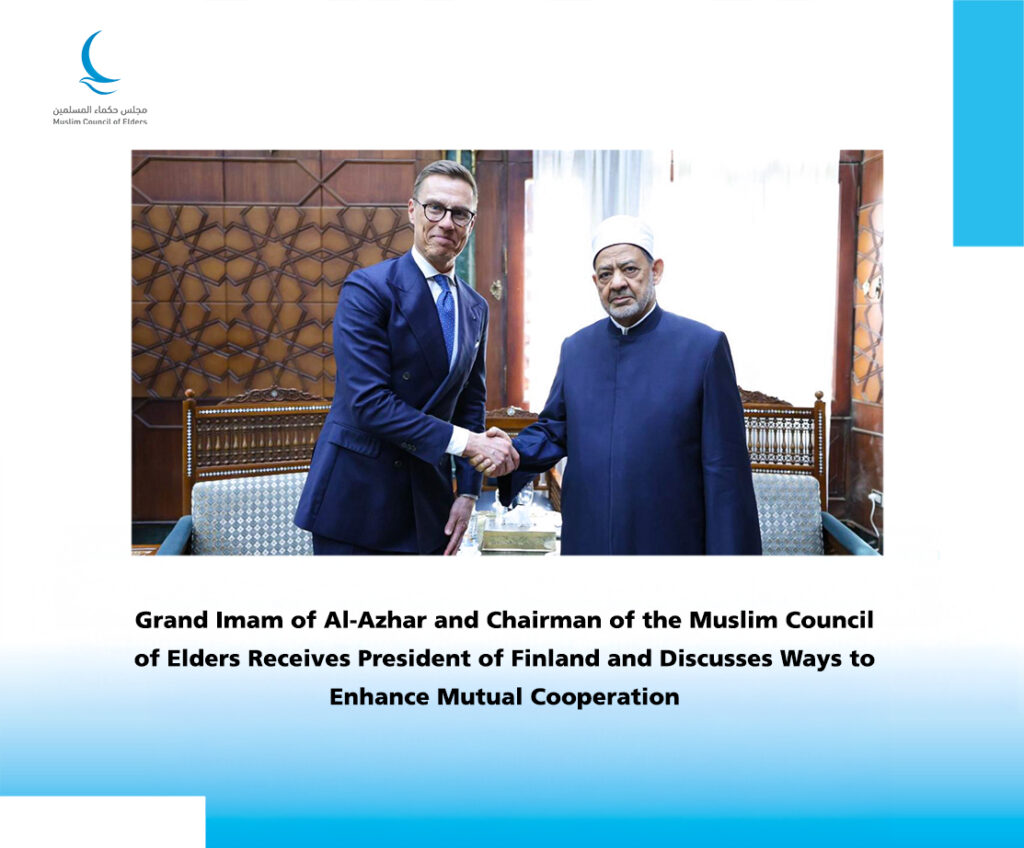
Grand Imam of Al-Azhar and Chairman of the Muslim Council of Elders Receives President of Finland and Discusses Ways to Enhance Mutual Cooperation

His Eminence Professor Dr. Ahmed Al-Tayeb, Grand Imam of Al-Azhar, received today, Tuesday, Mr. Alexander Stubb, President of the Republic of Finland, where His Eminence emphasized the importance of upholding moral values and returning to the teachings of religions. He noted that Al-Azhar and the Muslim Council of Elders are working to promote and strengthen the values of tolerance and coexistence through dialogue initiatives with various churches and religious and cultural institutions in the West, with the aim of laying the foundations for global peace.

For his part, the Finnish President expressed his pleasure at meeting the Grand Imam of Al-Azhar and Chairman of the Muslim Council of Elders, and his appreciation for His Eminence’s global efforts to promote peace and reinforce the values of coexistence and human fraternity. He also stressed the important role that religious leaders and symbols can play in addressing global challenges.

Grand Imam of Al-Azhar and Chairman of the Muslim Council of Elders Receives President of Finland and Discusses Ways to Enhance Mutual Cooperation Read More »

Muslim Council of Elders: Human Heritage is the Memory of Peoples & Islamic Heritage is a Civilizational Witness to the Values of Mercy and Coexistence

The Muslim Council of Elders, under the chairmanship of His Eminence Dr. Ahmed Al-Tayeb, Sheikhthe Grand Imam of Al-Azhar, affirmed that human heritage represents the memory of peoples and the record of their civilizational identity, serving as a bridge for communication between nations. It emphasized that preserving human heritage means protecting humanity’s collective memory and investing in a future governed by peace.

In a statement issued on the occasion of World Heritage Day, the Muslim Council of Elders declared that protecting heritage is a shared human responsibility, particularly in light of the threats it faces from conflicts, climate change, or attempts at erasure and distortion. The Council stressed that preservation includes safeguarding the values and customs that strengthen identity and belonging.

The Council clarified that Islamic heritage constitutes one of the most prominent tributaries of human heritage, as it embodies the values of mercy, justice, and mutual understanding. This is in accordance with the words of the Almighty:  
“O mankind, indeed We have created you from male and female and made you peoples and tribes that you may know one another.” (Holy Quran 49:13).

Throughout history, Islamic heritage has offered a civilizational model based on knowledge, respect for diversity, and positive interaction with other cultures.

The statement also noted that preserving Islamic heritage contributes to entrenching the values of moderation and openness, while confronting discourses of extremism and hatred. It called for utilizing this heritage to promote dialogue, tolerance, and the building of bridges of understanding among peoples.

The Muslim Council of Elders renewed its call to the international community to strengthen joint efforts aimed at protecting human heritage and preserving its components, thereby safeguarding humanity’s memory and advancing the path of coexistence and peace.

Muslim Council of Elders: Human Heritage is the Memory of Peoples & Islamic Heritage is a Civilizational Witness to the Values of Mercy and Coexistence Read More »

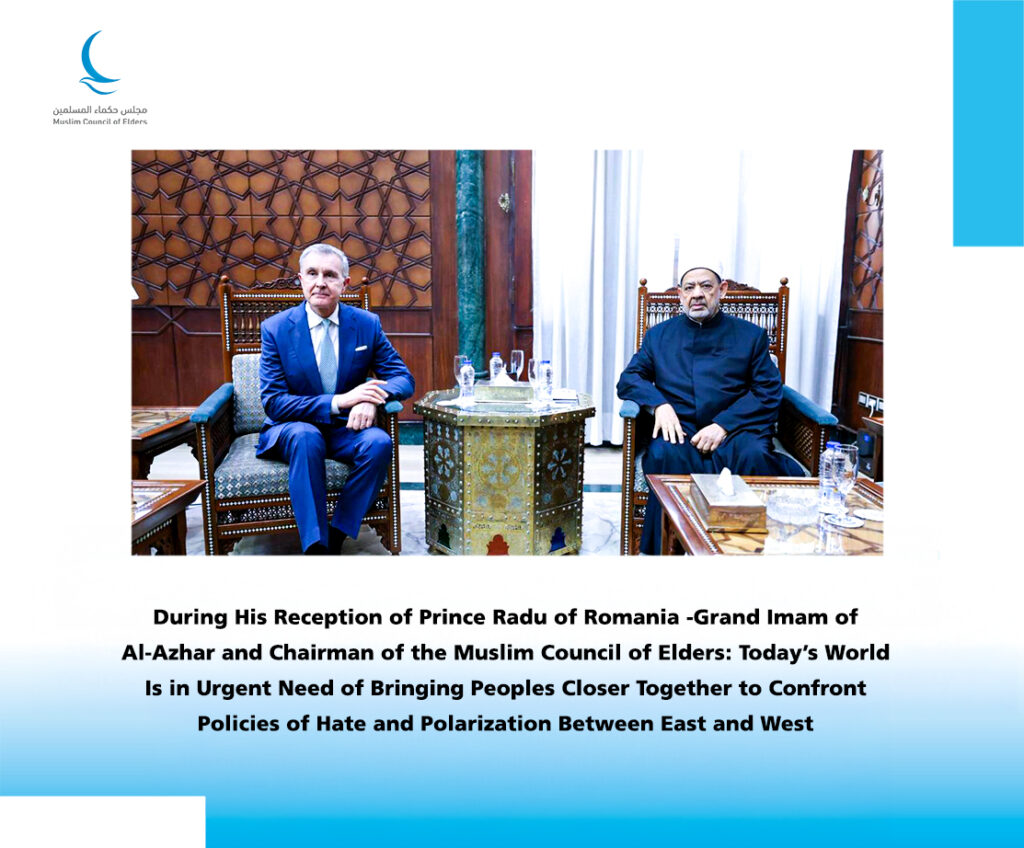
During His Reception of Prince Radu of Romania -Grand Imam of Al-Azhar and Chairman of the Muslim Council of Elders: Today’s World Is in Urgent Need of Bringing Peoples Closer Together to Confront Policies of Hate and Polarization Between East and West

His Eminence Professor Dr. Ahmed Al-Tayeb, the Grand Imam of Al-Azhar and Chairman of the Muslim Council of Elders has received His Royal Highness Prince Radu of Romania, to discuss strengthening mutual cooperation.

His Eminence stated that the world today is in dire need of seeking paths that unite peoples and bring them closer together, particularly at this challenging time when major global policies are fueling hatred and polarization between East and West. He emphasized that the issue is not a conflict between faiths, noting in this regard Al-Azhar’s openness—and that of the Muslim Council of Elders—to engagement with various Eastern and Western churches, including the Vatican, the Church of England, and the World Council of Churches. Rather, he explained, the real challenge lies in finding a path where major global policies align with the ethics and teachings of religion. He remarked: “When religion is not exploited to serve political or colonial agendas, religions come together in harmony, and genuine coexistence among their followers becomes possible.”

His Eminence further affirmed that the world places great hope in wise and concious leaders and decision-makers worldwide to confront the humanitarian tragedies afflicting the world today—challenges that require collective efforts to address them effectively.

For his part, His Royal Highness Prince Radu of Romania expressed his deep appreciation for His Eminence’s efforts to promote global peace and spread the culture of fraternity and coexistence. He noted that the separation of politics from the moral guidance and teachings of religion, along with a failure to properly understand the true purpose of religion and a decline in moral ideals within Western societies, has been a major factor behind the conflicts the world is witnessing today.

At the conclusion of the meeting, His Royal Highness Prince Radu presented His Eminence the Grand Imam with a copy of the translation of the Holy Qur’an into the Romanian language, as an expression of his nation’s appreciation for the true teachings of Islam.

During His Reception of Prince Radu of Romania -Grand Imam of Al-Azhar and Chairman of the Muslim Council of Elders: Today’s World Is in Urgent Need of Bringing Peoples Closer Together to Confront Policies of Hate and Polarization Between East and West Read More »

On World Health Day – Muslim Council of Elders: Health Is a Fundamental Human Right and a Cornerstone of Sustainable Development and Stable Societies

Under the chairmanship of His Eminence Dr. Ahmed Al-Tayeb, the Grand Imam of Al-Azhar, the Muslim Council of Elders affirmed that health is a fundamental human right and a core pillar for achieving sustainable development and building safe and stable societies.

In a statement marking World Health Day, observed annually on 7 April, the Council stressed the imperative of strengthening health systems, ensuring equitable access to medical services, and providing comprehensive healthcare without discrimination. It also emphasized that achieving these goals is a shared responsibility that requires concerted international efforts and the entrenchment of solidarity and cooperation among states and institutions.

The statement highlighted that health encompasses physical, mental, and spiritual well-being, underscoring its vital role in upholding human dignity and safeguarding humanity. The Council called for the adoption of comprehensive policies and initiatives that raise health awareness, enhance prevention, and address global health challenges—particularly in the most vulnerable and underserved communities.

The Muslim Council of Elders commended the dedicated efforts of healthcare workers worldwide, especially those serving in areas affected by wars and conflicts, describing them as the first line of defense in confronting health emergencies. The Council affirmed that their noble humanitarian mission deserves the highest appreciation and sustained support.

The Council also called for strengthening social responsibility, promoting healthy behaviors, and building a fair and sustainable healthcare system that places people at the heart of its priorities and guarantees a dignified and secure life for all. It renewed its commitment to supporting initiatives that advance public health and promote the values of compassion and human solidarity, in pursuit of the well-being and peace of all humanity.

On World Health Day – Muslim Council of Elders: Health Is a Fundamental Human Right and a Cornerstone of Sustainable Development and Stable Societies Read More »

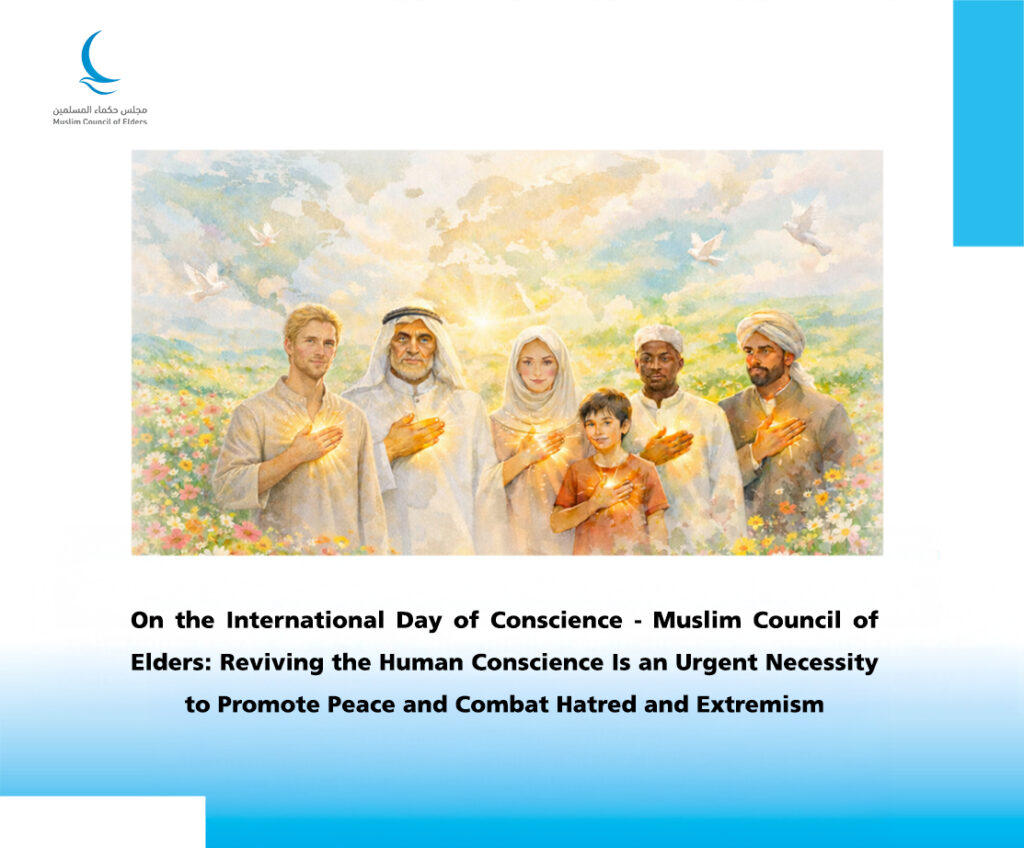
On the International Day of Conscience – Muslim Council of Elders: Reviving the Human Conscience Is an Urgent Necessity to Promote Peace and Combat Hatred and Extremism

The Muslim Council of Elders, under the chairmanship of His Eminence Dr. Ahmed Al-Tayeb, the Grand Imam of Al-Azhar, affirmed that the International Day of Conscience represents an important opportunity to renew the call to elevate the voice of the human conscience, strengthen the values of compassion, solidarity, and social responsibility, and enhance collective awareness of the importance of working toward a world founded on peace, justice, and mutual respect.

In a statement, the Muslim Council of Elders noted that the observance of this international occasion—marked annually on April 5—reflects the world’s growing need to revive moral and humanitarian values in the face of the successive wars, conflicts, and crises it continues to endure. The Council emphasized that a living and vigilant conscience remains a vital safeguard that protects societies from sliding into hatred, division, and violence.

The Council further stated that an awakened human conscience constitutes the cornerstone of fostering understanding among peoples and of promoting a culture of dialogue, tolerance, and peaceful coexistence. It reaffirmed that all divine religions have called for activating the conscience, safeguarding human dignity, rejecting injustice and aggression, and building bridges of fraternity and cooperation among humankind.

The Muslim Council of Elders renewed its call for coordinated international efforts to promote a culture of peace, strengthen dialogue among religions and cultures, and instill the values of human fraternity in the hearts of younger generations. Such efforts, the Council stressed, contribute to building a world that is more conscious of its shared humanity and better equipped to overcome the causes of hatred, conflict, and division. 


The Council also urged religious, educational, cultural, and media institutions to fulfill their essential role in nurturing the human conscience and instilling the values of compassion, respect, and responsibility, recognizing these principles as fundamental pillars for building cohesive societies capable of safeguarding human dignity and protecting every individual’s right to security, peace, and a dignified life.

On the International Day of Conscience – Muslim Council of Elders: Reviving the Human Conscience Is an Urgent Necessity to Promote Peace and Combat Hatred and Extremism Read More »