
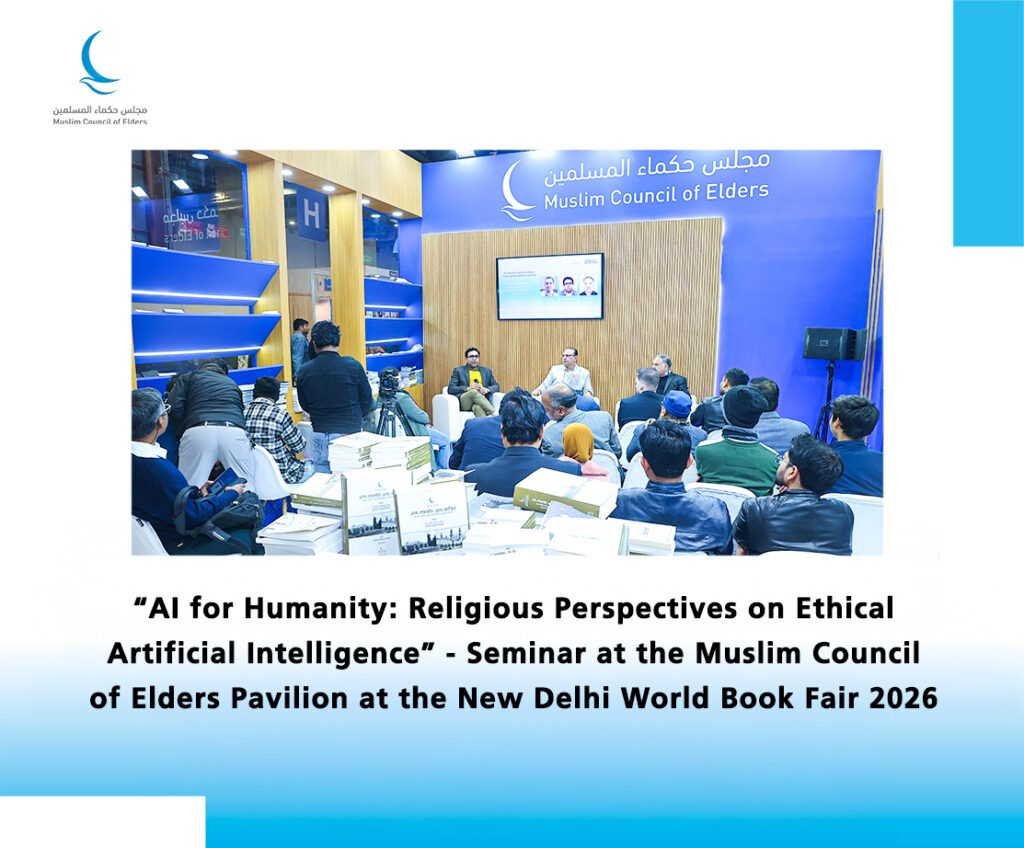
The Muslim Council of Elders hosted the first seminar at the New Delhi World Book Fair under the title “AI for Humanity: Religious Perspectives on Ethical Artificial Intelligence,” bringing together distinguished journalists and academics to examine AI’s transformative power through the lens of faith, ethics, and public interest.
The discussion explored how interfaith dialogue can provide a shared moral vocabulary—rooted in truthfulness, justice, compassion, and human dignity—to guide the development and deployment of AI for the common good.
Asad Mirza, Prominent Writer and Journalist emphasized that technologies which advance knowledge and benefit society are encouraged, provided they are used responsibly and transparently. He highlighted promising applications—such as traffic management, climate resilience, agricultural productivity, and weather forecasting—while warning against tools that could undermine justice. Mirza called for interfaith and interdisciplinary collaboration so that technologists, ethicists, and faith leaders can together define boundaries between beneficial use and morally ambiguous placing human judgment above automated outputs.
Prof. Dr. Mudassar Qamar, Associate Professor – Jawaharlal Nehru University, outlined three ethical pillars that should frame AI’s development across traditions and jurisdictions: ethical data generation that is free from bias and responsibly sourced; ethical processing that accounts for environmental costs such as energy and water use; and ethical usage secured by safeguards at the individual, societal, and governmental levels. He noted that these principles resonate across religious teachings and offer a practical foundation for cross faith cooperation, ensuring that AI remains equitable, sustainable, and aligned with human rights.
Sanjay Kapoor, President – Editors Guild of India, underscored the need for critical human oversight and distinct regulatory approaches for AI, given its capacity to produce convincing yet fabricated narratives. He pointed to emerging newsroom realities in which AI can rapidly generate sophisticated text but often lacks the human perspective and emotional nuance that readers trust.
Kapoor urged media organizations to reinvest in original reporting and rigorous fact checking, arguing that values driven editorial standards—shaped by ethical and interfaith commitments to truth and responsibility—are indispensable in an age of algorithmic content.
Participants in the seminar also agreed that while still young, AI direct role in interfaith relations and dialogue remains nascent yet promising with careful human supervision, it can facilitate comparative study of religious messages, enhance translation and interpretation of texts, and promote global understanding by illuminating the universal ethics shared across traditions. Concluding the session, panelists also agreed that AI’s enormous potential must be matched by robust regulation, developer responsibility, organizational codes of conduct, and vigilant human oversight. Above all, they affirmed that interfaith dialogue provides a vital forum for aligning technological innovation with enduring moral principles—so that artificial intelligence advances the dignity, well being, and flourishing of all.
The Muslim Council of Elders’ participation in the New Delhi World Book Fair stems from its belief in the pivotal role of knowledge and culture as fundamental pillars for fostering understanding, countering division, reinforcing social cohesion, and affirming the importance of religious and intellectual institutions in addressing global issues and building bridges of communication and dialogue among societies.
The Council’s pavilion at the New Delhi World Book Fair is located at Bharat Mandapam, Hall No. 4, Pavilion H-06.