منتظم

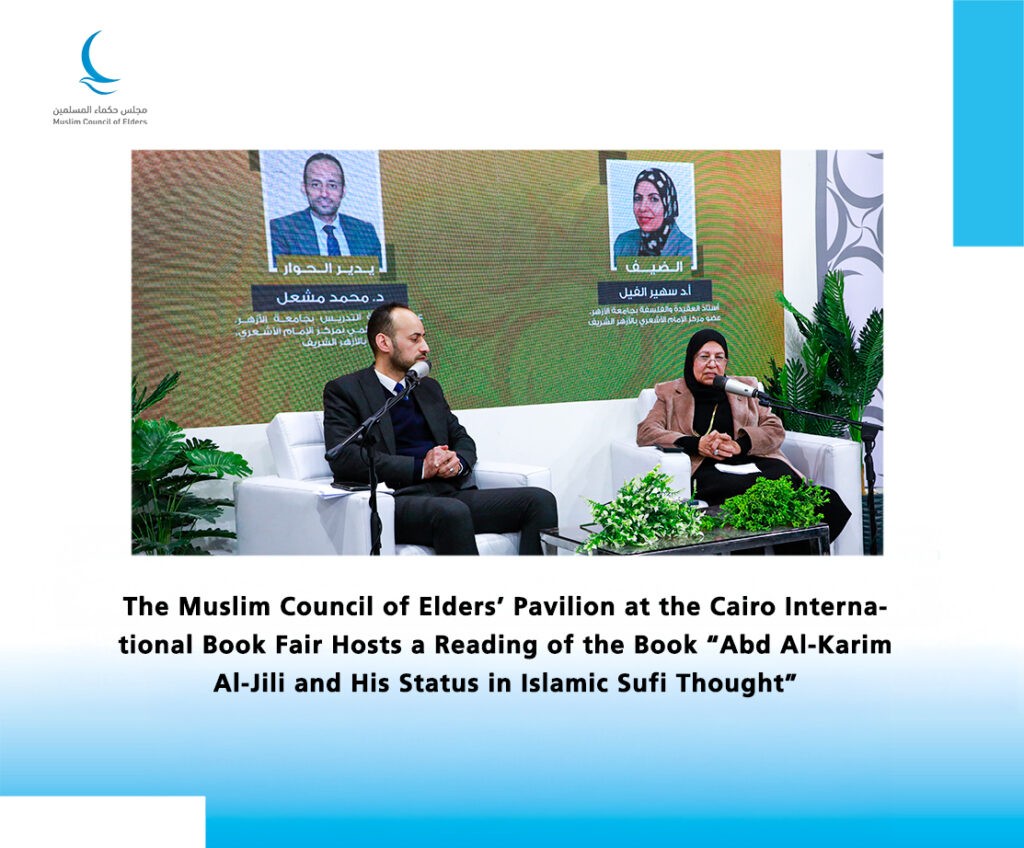
The Muslim Council of Elders’ Pavilion at the Cairo International Book Fair Hosts a Reading of the Book “Abd Al-Karim Al-Jili and His Status in Islamic Sufi Thought”

The Muslim Council of Elders’ Pavilion held its ninth cultural seminar at the 57th Cairo International Book Fair, titled “A Reading of the Book ‘Abd Al-Karim Al-Jili and His Status in Islamic Sufi Thought,” authored by Najah Al-Ghanimi. The seminar featured Professor Dr. Suhair Al-Feel, Professor of Creed and Philosophy at Al-Azhar University, and was moderated by Dr. Mohamed Mash’al, faculty member at Al-Azhar University.

The seminar discussed the contributions of Imam Abd Al-Karim Al-Jili to Islamic Sufi thought and the impact of his works in establishing spiritual and intellectual values, highlighting his scholarly position within Islamic heritage.

The discussion revealed that the author adopted a threefold methodological approach in studying Al-Jili’s thought: a historical, analytical, and comparative method. This rigorous approach was deemed among the most precise and appropriate for the subject, as relying solely on historical developmental analysis would not sufficiently address the issue of originality. Likewise, exclusive reliance on philological textual criticism would not yield decisive results. Therefore, the integration of both methods proved essential, complemented by the comparative approach whenever necessary to better understand the school of thought, verify its authenticity, and identify points of agreement and divergence with earlier traditions.

Professor Suhair Al-Feel explained that the author collected a wide range of documents, texts, and sources related to the study, most of which were manuscripts dispersed across libraries worldwide. The research extended beyond Al-Jili’s own writings to include texts by his students and commentators, as well as works by Ibn Arabi and prominent figures of his school who preceded Al-Jili, in addition to utilizing foreign sources that addressed Al-Jili’s life and Sufi doctrine.

It is worth noting that the book “Abd Al-Karim Al-Jili and His Status in Islamic Sufi Thought,” by Najah Mahmoud Al-Ghanimi, is published by Al-Hokma Publishing and is available at the Muslim Council of Elders’ Pavilion at the Cairo International Book Fair 2026.

The Muslim Council of Elders is participating with a dedicated pavilion at the 57th Cairo International Book Fair, held from 21 January to 3 February 2026. The pavilion features a wide range of the Council’s distinguished publications, alongside a series of seminars, activities, and events aimed at promoting the values of goodness, love, peace, and peaceful coexistence among all people.

The Muslim Council of Elders’ Pavilion is located next to the Al-Azhar Pavilion in Heritage Hall No. 4 at the Egypt International Exhibitions and Conferences Centre in the Fifth Settlement.
The Muslim Council of Elders’ Pavilion at the Cairo International Book Fair Hosts a Reading of the Book “Abd Al-Karim Al-Jili and His Status in Islamic Sufi Thought” Read More »

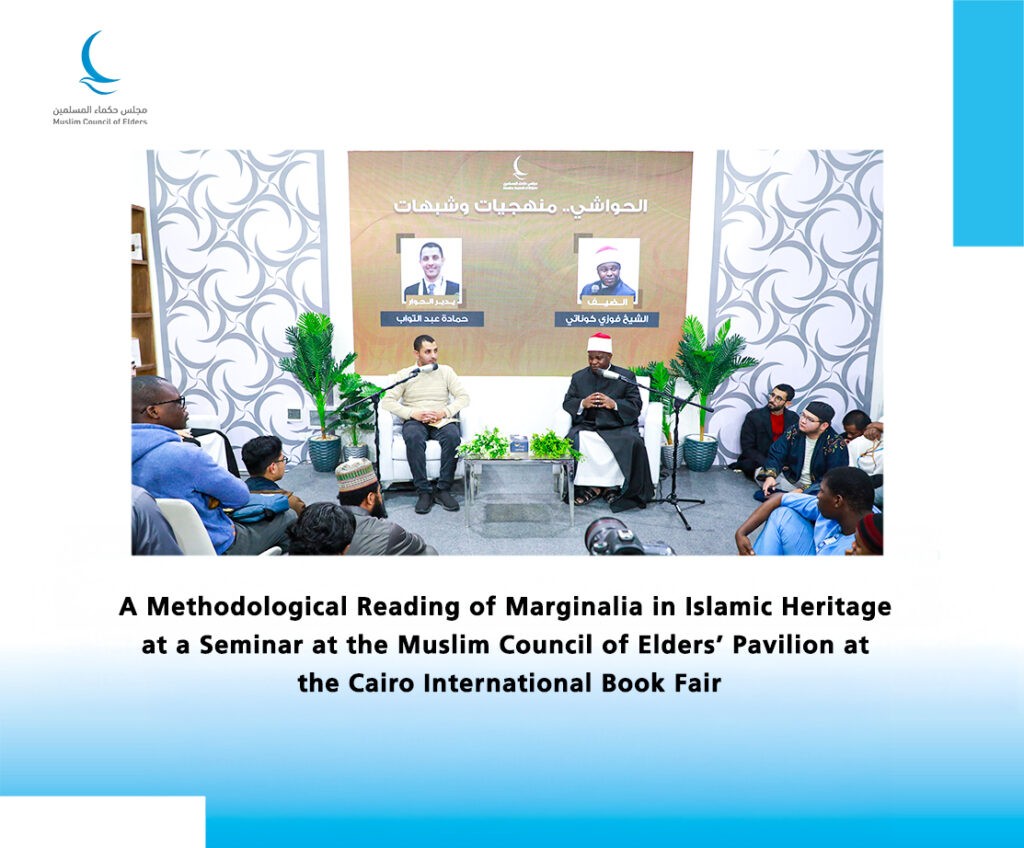
A Methodological Reading of Marginalia in Islamic Heritage at a Seminar at the Muslim Council of Elders’ Pavilion at the Cairo International Book Fair

The Muslim Council of Elders held its eighth cultural seminar at the 57th Cairo International Book Fair, titled “Marginalia: Methods and Misconceptions,” with the participation of Sheikh Fawzi Konaté.

The seminar aimed to offer a methodological and scholarly examination of “marginalia” (ḥawāshī) in Islamic heritage, highlighting how they should be approached and addressing the academic concerns raised about them—ensuring that the Islamic intellectual tradition is both preserved and critically assessed through rigorous scholarly standards.

During the seminar, Sheikh Fawzi Konaté explained that linguistically the term “ḥāshiya” refers to the edge or margin of something, and over time it became a conventional term for what is written on the margins of a manuscript. He clarified that marginalia fall into two types: marginal notes on commentaries and marginal notes on primary texts. He noted that before the 10th century AH, most marginalia were written on primary texts, while after the 10th century AH, marginalia increasingly appeared on commentaries.

Regarding the origins and development of marginalia, Konaté highlighted that marginal notes often first appear on a student’s personal copy of a book, reflecting what he received from his teacher during the reading of the text. He explained that marginalia became available to the wider scholarly community in several ways: either the scholar compiles them himself, others compile them during his lifetime, or his students collect them after his passing.

Konaté also explained that scholars who wrote marginalia aimed to supplement what the commentator may have overlooked, clarify points that were obscure or concealed in the author’s intent, or correct errors and lapses. He summarized the purposes of marginalia into three principal functions: clarifications, verifications, and critical refinements.

The Muslim Council of Elders is participating at the 57th Cairo International Book Fair, held from 21 January to 3 February 2026 with a large selection of the Council’s distinguished publications, along with a series of seminars, activities, and events focused on promoting the values of peace and peaceful coexistence among all people.

The pavilion of the Muslim Council of Elders is located next to the Al‑Azhar Pavilion in Heritage Hall No. 4 at the Egypt International Exhibition and Convention Center in the Fifth Settlement.

A Methodological Reading of Marginalia in Islamic Heritage at a Seminar at the Muslim Council of Elders’ Pavilion at the Cairo International Book Fair Read More »

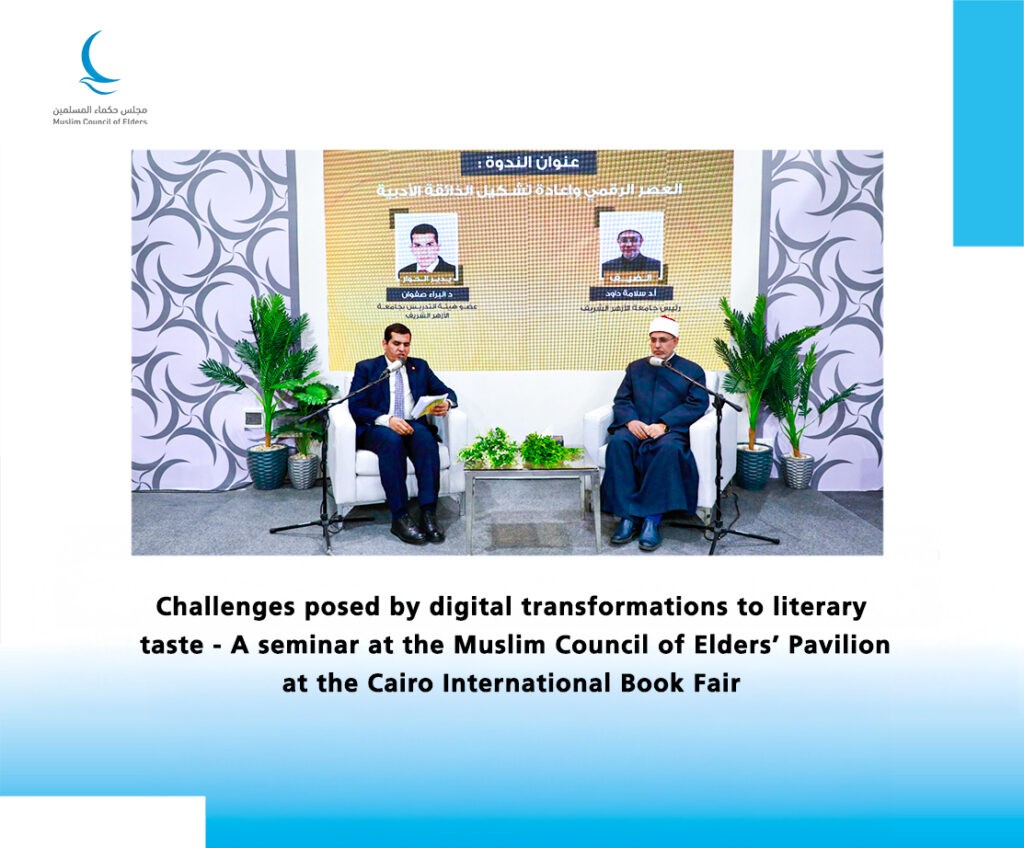
Challenges posed by digital transformations to literary taste – A seminar at the Muslim Council of Elders’ Pavilion at the Cairo International Book Fair

The pavilion of the Muslim Council of Elders at the Cairo International Book Fair held its sixth cultural seminar, titled “The Digital Age and the Reshaping of Literary Taste,” with the participation of Professor Dr. Salama Dawood, President of Al‑Azhar University, in the presence of a distinguished audience of intellectuals, researchers, and students.

The seminar shed light on the challenges that digital transformations impose on literary taste, and how literary creativity can endure amid modern technology, with a focus on balancing authenticity and contemporary approaches in the reception of knowledge.

Dr. Salama Dawood emphasized that nurturing talent and refining literary taste are the result of a cumulative journey that begins with extensive reading, structured memorization, and exposure to elevated examples drawn from the finest classical texts and eloquent poetry. This, combined with training the mind to balance and compare different styles and texts, develops within the reader a “rhetorical faculty” that enables distinguishing between what is refined and what is inferior.

The President of Al‑Azhar University warned against being swept away by the language used by some on social media platforms, which has had a negative impact on the literary taste of the current generation. He pointed out that a person is shaped by what they read and hear; if one regularly hears articulate and elevated speech, a refined sense of language develops, whereas habitual exposure to crude language corrupts one’s linguistic and literary faculty.

In an important remark, Dr. Dawood also stressed that cultivating literary taste is not merely an “intellectual luxury” but a necessity. He explained that an inability to appreciate literature or distinguish between what is fine and what is coarse leads inevitably to an inability to sense the rhetorical miracle of the Qur’an and to recognize the superiority of Allah’s words over human speech.

Dr. Salama Dawood concluded his remarks by linking the success of educational institutions—schools, institutes, and universities—to their ability to cultivate this “rhetorical faculty” in students. He affirmed that the capacity to appreciate what is spoken and heard is the true measure of success within the educational process.

The Muslim Council of Elders is participating at the 57th Cairo International Book Fair, held from 21 January to 3 February 2026 with a wide range of the Council’s publications, alongside a series of seminars, activities, and events focused on promoting the values of peace and peaceful coexistence among all people.

The pavilion of the Muslim Council of Elders is located next to the Al‑Azhar Pavilion in Heritage Hall No. 4 at the Egypt International Exhibition and Convention Center in the Fifth Settlement.

Challenges posed by digital transformations to literary taste – A seminar at the Muslim Council of Elders’ Pavilion at the Cairo International Book Fair Read More »

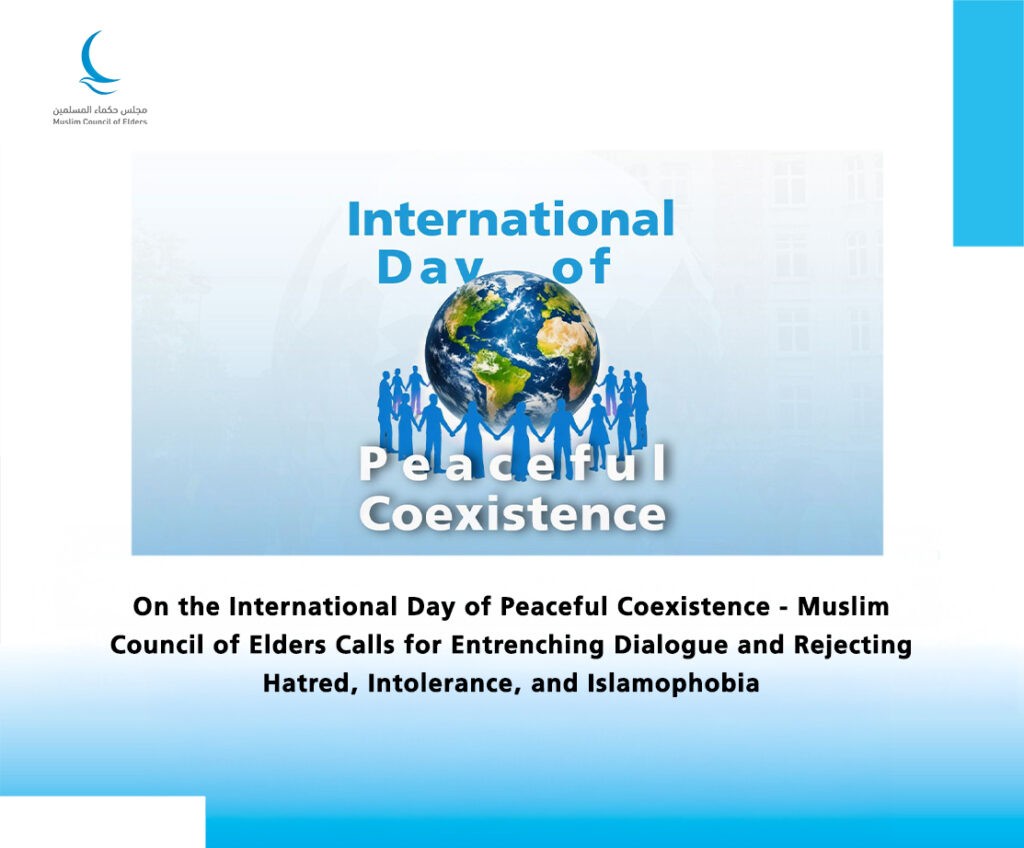
On the International Day of Peaceful Coexistence – Muslim Council of Elders Calls for Entrenching Dialogue and Rejecting Hatred, Intolerance, and Islamophobia

The Muslim Council of Elders, under the chairmanship of His Eminence Dr. Ahmed Al‑Tayeb, the Grand Imam of Al‑Azhar, affirms that peaceful coexistence among people of different religions, cultures, and ethnicities is a fundamental pillar for ensuring the security and stability of societies—especially in light of the challenges the world faces today.

In a statement issued on the International Day of Peaceful Coexistence—observed for the first time this year on January 28—the Council emphasized that fostering coexistence rests on mutual respect, the recognition of shared human dignity, and the rejection of hate speech, violence, exclusion, and Islamophobia. The statement noted that religions and divine laws, in the essence of their messages, were revealed to uphold the values of mercy, justice, and peace, and to promote understanding and cooperation among all people.

The statement added that the conflicts and escalating challenges the world is witnessing today require intensified international efforts to strengthen dialogue, build bridges of communication between peoples, empower younger generations to embrace the values of coexistence and mutual respect, and confront extremist ideologies.

The Muslim Council of Elders calls on religious and intellectual leaders, policymakers, and educational and media institutions to fulfill their responsibilities in promoting peaceful coexistence, reinforcing the values of full citizenship, and working collectively to build a more just and peaceful world—one in which human dignity is at the heart of policies and development programs.

The Council places great importance on embedding the values of peaceful coexistence through a wide range of initiatives and efforts that promote dialogue, tolerance, and human fraternity. Notable examples include East–West Dialogue, Intra–Islamic Dialogue, and the Emerging Peacemakers Forum, in addition to numerous programs and publications that reaffirm the Council’s commitment to advancing a culture of peace and strengthening human fraternity. This commitment is grounded in the Council’s firm conviction that peaceful coexistence is the most effective path to safeguarding human dignity and achieving security, stability, and sustainable development.

On the International Day of Peaceful Coexistence – Muslim Council of Elders Calls for Entrenching Dialogue and Rejecting Hatred, Intolerance, and Islamophobia Read More »

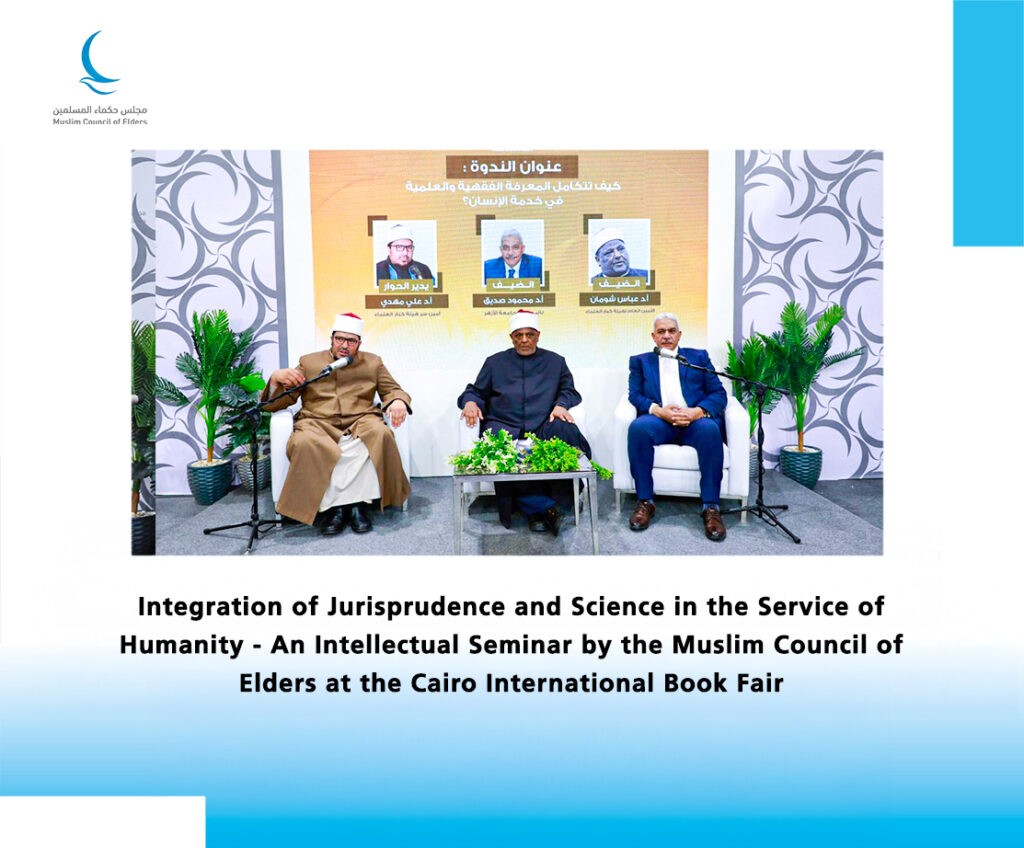
Integration of Jurisprudence and Science in the Service of Humanity – An Intellectual Seminar by the Muslim Council of Elders at the Cairo International Book Fair

ic jurisprudential sciences with modern scientific knowledge to advance human welfare and to build civilizational awareness grounded in a balance between religious values and contemporary needs. The discussion highlighted how such integration enhances human development and addresses modern challenges with a comprehensive vision.

In his remarks, Dr. Abbas Shoman emphasized the deep connection between Islamic law and all other sciences. He explained that religious and worldly sciences are inseparable and noted that issuing a legal opinion (fatwa) often requires reference to various other disciplines, such as economics and medicine. He added that jurisprudence may at times rely on the determinations of specialists in different scientific fields. Dr. Shoman also pointed to the Islamic Research Academy as a model of knowledge integration due to its diverse membership of experts in both religious and scientific fields, enabling the development of jurisprudence that is attentive to contemporary issues and developments.

For his part, Dr. Mahmoud Seddik stated that the Qur’an and the Prophetic Sunnah call for the integration of different fields of knowledge. He referred to the Prophet Muhammad’s (PBUH) guidance in certain hadiths to prevent mixing between the sick and the healthy—an instruction that modern medical institutions endorse today to limit the spread of disease.

The Vice President of Al‑Azhar University explained that the life sciences, especially medical sciences, complement jurisprudential studies to ensure that human life can continue in a sound manner. He noted that the jurist sometimes sets boundaries for the physician’s decisions, just as the jurist needs the insights of medical and scientific specialists before issuing legal opinions. He explained that jurists at the Islamic Research Academy regularly consult specialists in medicine, genetics, economics, and other modern sciences and engage in extensive discussions with them before issuing fatwas or ruling on contemporary issues. This approach, he added, reflects the authenticity of Islamic thought and its openness to diverse fields of knowledge.

The Muslim Council of Elders is participating at the 57th Cairo International Book Fair, held from 21 January to 3 February 2026 with a large selection of the Council’s distinguished publications, along with a series of seminars, activities, and events focused on promoting the values of peace and peaceful coexistence among all people.

The pavilion of the Muslim Council of Elders is located next to the Al‑Azhar Pavilion in Heritage Hall No. 4 at the Egypt International Exhibition and Convention Center in the Fifth Settlement.

Integration of Jurisprudence and Science in the Service of Humanity – An Intellectual Seminar by the Muslim Council of Elders at the Cairo International Book Fair Read More »

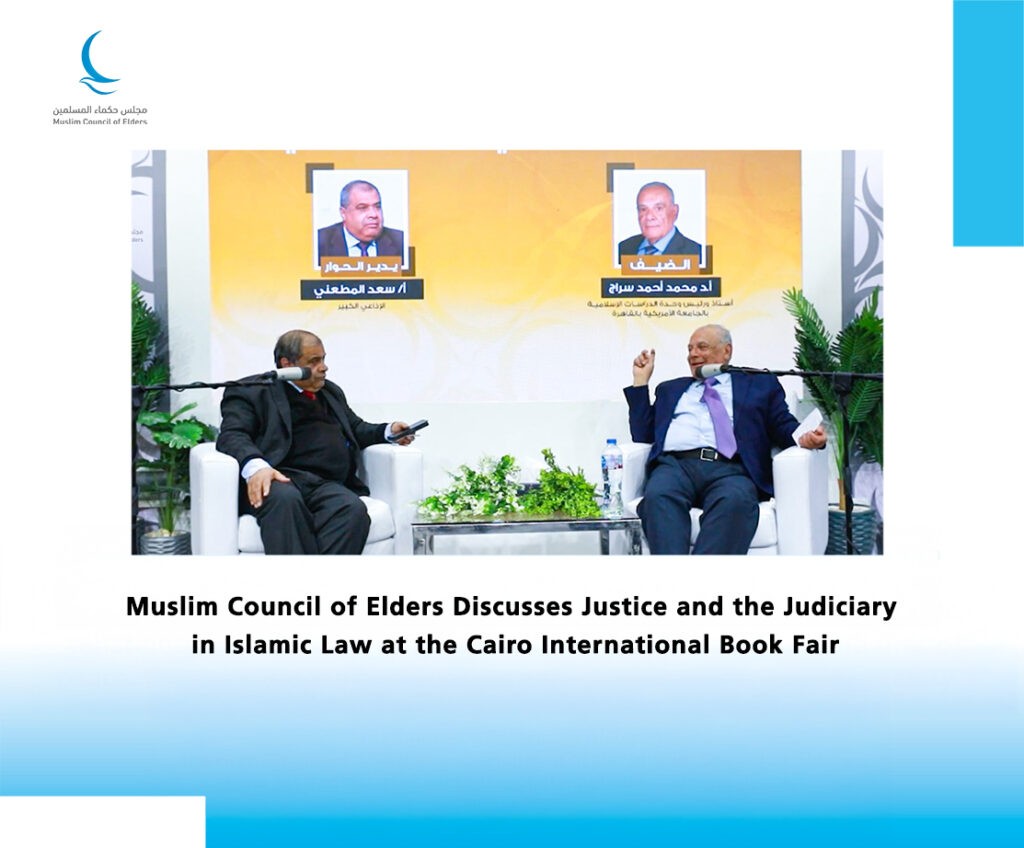
Muslim Council of Elders Discusses Justice and the Judiciary in Islamic Law at the Cairo International Book Fair

The pavilion of the Muslim Council of Elders held its fourth seminar at the 57th Cairo International Book Fair, titled “Justice and the Judiciary in Islamic Law,” with the participation of Prof. Dr. Mohamed Ahmed Siraj, Professor and Head of the Islamic Studies Unit at the American University in Cairo.

The seminar, moderated by journalist Saad Al‑Matani, examined the ethical and jurisprudential foundations of the concept of justice in Islamic law, the role of the judiciary in upholding human values, safeguarding rights, and achieving balance between legal texts and higher objectives, within a scholarly framework that enhances legal awareness.

During the seminar, Dr. Mohamed Siraj affirmed that the Holy Qur’an sought to establish a legal and legislative system within societies by laying down the governing principles of that system, while leaving it to society to develop the mechanisms necessary to implement those principles. Foremost among these principles, he noted, is justice, which represents the primary axis from which many other principles emerge, such as equality and freedom of belief.

The Head of the Islamic Studies Unit at the American University in Cairo explained that throughout its history, the Islamic world developed a legal system rooted in the authority of the Qur’an. He emphasized that no society can function without a legislative framework that preserves rights and regulates relationships, noting that such a system contributed to the protection of the Islamic state and the realization of justice among people.

Dr. Siraj also pointed out that judges throughout the history of Islamic legislation played a key role in developing high‑level legal principles and establishing judicial precedents that reflected remarkable legal maturity, from which Western legal thought later benefited. He noted that judges in the history of Islamic law enjoyed full independence in carrying out their judicial responsibilities.

The seminar concluded with Dr. Mohamed Siraj calling on researchers and academic institutions to give greater attention to the Islamic legal system, as well as to the curricula and history of judges in Islam, rather than limiting study to abstract legal texts alone. He expressed regret that the volume of academic research published on this heritage in English far exceeds that available in Arabic, and called for addressing this research gap in order to strengthen legal awareness of the treasures of Islamic heritage.

The Muslim Council of Elders is participating at the 57th Cairo International Book Fair, held from 21 January to 3 February 2026. The pavilion features a wide range of the Council’s publications, in addition to organizing a series of seminars, activities, and events focused on promoting the values of peace, and peaceful coexistence among all people.

The Muslim Council of Elders’ pavilion is located next to the Al‑Azhar Pavilion in Heritage Hall No. 4 at the Egypt International Exhibition and Convention Center in the Fifth Settlement.

Muslim Council of Elders Discusses Justice and the Judiciary in Islamic Law at the Cairo International Book Fair Read More »

Cairo International Book Fair Hosts an Intellectual Seminar Titled “In the Sanctuary of Imam Al‑Tayeb”

The pavilion of the Muslim Council of Elders at the 57th Cairo International Book Fair hosted a large‑scale seminar titled “In the Sanctuary of Imam Al‑Tayeb: A Reading of the Works Dedicated to His Eminence the Grand Imam.” The seminar was attended by the eminent scholar Sheikh Hassan Al‑Shafie, member of the Council of Senior Scholars at Al‑Azhar and Member of the Muslim Council of Elders, and Professor Dr. Mohamed Al‑Duwaini, Deputy of Al‑Azhar.

The seminar, moderated by Dr. Samir Boudinar, Director of the Al Hokama Center for Peace Research, marked the launch of the first edition of this unique documentary and humanitarian work. The book includes a collection of articles and testimonies written by senior religious leaders, thinkers, and international figures, dedicated to His Eminence Professor Dr. Ahmed Al‑Tayeb, Grand Imam of Al‑Azhar and Chairman of the Muslim Council of Elders, on the occasion of his 80th birthday.

The diversity of international testimonies featured in the book reflects the high global standing of the Grand Imam as a moral conscience for the world, a voice of wisdom in a turbulent era, and a symbol of moderation, dialogue, and human coexistence. Rather than merely celebrating an individual, the book documents the journey of a comprehensive ethical and intellectual school embodied by Imam Al‑Tayeb through decades of scholarship, wisdom, moderation, dialogue, defense of human dignity, and the promotion of human fraternity and global peace.

In remarks filled with appreciation, Sheikh Hassan Al‑Shafii affirmed that His Eminence Professor Dr. Ahmed Al‑Tayeb has presented a model to be emulated in wisdom, moral integrity, and the assumption of responsibility amid profound challenges. He noted that the Imam’s deeply rooted place in the hearts of Arabs and Muslims did not come by chance, but is the result of a sincere and devoted journey of giving.

Sheikh Al‑Shafii revealed what he described as “the secret behind Imam Al‑Tayeb’s enduring contribution,” summarizing it in key elements that shaped his exceptional character: a deep scholarly passion and genuine love for knowledge; dedication to its pursuit and dissemination; sincere loyalty to Al‑Azhar and its historic mission; constant consciousness of God and focus on the Hereafter; detachment from worldly temptations and transient positions; and a Sufi upbringing that elevates the value of knowledge while diminishing attachment to wealth and worldly gain.

At the outset of his remarks, Dr. Mohamed Al‑Duwaini described the Grand Imam as a proponent of “conscious and sound religious guidance,” emphasizing that whenever Imam Al‑Tayeb addresses jurisprudential or societal issues, he does so with keen insight that reads reality and anticipates the future, placing the concerns of the nation and the Ummah above all else—so much so that his words came to embody the principle, “Peace by which no one suffers.”

The Deputy of Al‑Azhar noted that Imam Al‑Tayeb assumed the position of Grand Imam at a time of exceptional global complexity, when Islam faced unfounded accusations. Yet he traveled across the world, east and west, with courage and steadfastness, ultimately succeeding in dispelling fears of Islamophobia to the extent that Europe itself turned to Al‑Azhar seeking its moderate methodology.

On the domestic level, Dr. Al‑Duwaini highlighted Imam Al‑Tayeb’s role in extinguishing sectarian strife, stating that the Imam courageously led the establishment of the Egyptian Family House to unite Muslims and Christians of all denominations, thereby neutralizing calls to fanaticism. He also pointed to the Imam’s call to abandon the term “minorities” in favor of “full citizenship,” which embraces all without discrimination based on religion or ethnicity.

Dr. Al‑Duwaini further shed light on the human and administrative dimensions of Imam Al‑Tayeb’s personality, explaining that he leads institutions with gentleness and mercy without weakness, and firmness in truth without harshness. He emphasized that the Imam’s office is always open to everyone, and that he consistently instructs his aides, “Do not bar people from me, and do not turn away anyone who seeks me.”

The Deputy of Al‑Azhar concluded by highlighting one of Imam Al‑Tayeb’s major international achievements: Al‑Azhar’s efforts to promote dialogue, tolerance, and peaceful coexistence—undertaken with the support of Judge Mohamed Abdelsalam—which culminated in the launch of the historic Document on Human Fraternity in Abu Dhabi in 2019, alongside the late Pope Francis, former Pope of the Catholic Church. The document has since become a cornerstone of dialogue between East and West and a foundational reference for affirming human dignity as a basis for global engagement.

The Muslim Council of Elders is participating at the 57th Cairo International Book Fair, held from 21 January to 3 February 2026. The pavilion features a wide range of publications by the Council, in addition to organizing a series of seminars, activities, and events focused on promoting the values of goodness and peaceful coexistence among all people.

The Muslim Council of Elders’ pavilion is located next to the Al‑Azhar Pavilion in Heritage Hall No. 4 at the Egypt International Exhibition and Convention Center in the Fifth Settlement.

Cairo International Book Fair Hosts an Intellectual Seminar Titled “In the Sanctuary of Imam Al‑Tayeb” Read More »

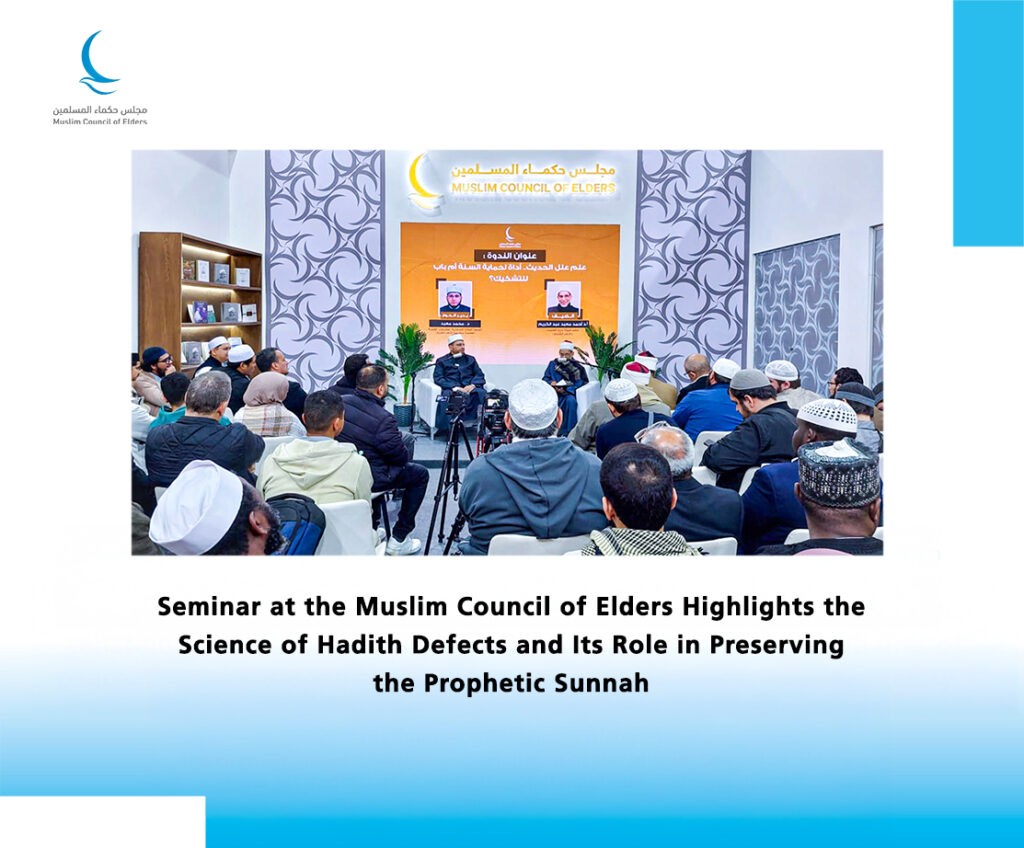
Seminar at the Muslim Council of Elders Highlights the Science of Hadith Defects and Its Role in Preserving the Prophetic Sunnah

The pavilion of the Muslim Council of Elders at the Cairo International Book Fair held the second seminar during the 57th edition of the fair, titled “The Science of Hadith Defects: A Tool for Protecting the Sunnah or a Gateway to Doubt?”, with the participation of Professor Dr. Ahmed Ma‘bad Abdel Karim, Member of the Council of Senior Scholars at Al‑Azhar.

The seminar, moderated by Dr. Mohamed Ma‘bad, a researcher at Al‑Azhar, was held as part of the Muslim Council of Elders’ efforts to preserve Islamic heritage and promote knowledge‑based dialogue founded on sound methodology and awareness. The discussion addressed the science of Ilal al‑Hadith as one of the most precise disciplines of Prophetic Sunnah studies, examining its role in safeguarding the Hadith tradition, preserving its scientific methodology, and responding to doubts raised against it within a rigorous scholarly framework that reinforces confidence in the Hadith heritage and affirms the importance of critical methodology in the service of the noble Prophetic Sunnah.

During the seminar, Dr. Ma‘bad noted that His Eminence Dr. Ahmed Al‑Tayeb, the Grand Imam of Al‑Azhar and Chairman of the Muslim Council of Elders, deserves credit and recognition for introducing the teaching of this discipline at Al‑Azhar University, in recognition of its great importance in serving the Prophetic Hadith. He explained that this subject had not been included in the university’s curricula prior to his assumption of the office of Grand Imam.

Dr. Ahmed Ma‘bad affirmed that the science of Ilal al‑Hadith is among the most noble, precise, and honorable of Islamic sciences, and that engaging with it requires extensive study and deep reading of the works of the great scholars. He explained that defects appear more clearly and frequently in chains of transmission than in the text itself, noting that the presence of defects in the chain does not negate careful attention to the text, as the text may still be authenticated through other routes or supporting narrations.

The Muslim Council of Elders is participating at the 57th Cairo International Book Fair, held from 21 January to 3 February 2026. The pavilion features a wide range of the Council’s publications, alongside a series of seminars, activities, and events that promote the values of peace and coexistence among all people.

The Muslim Council of Elders’ pavilion is located next to the Al‑Azhar Pavilion in Heritage Hall No. 4 at the Egypt International Exhibition and Convention Center in the Fifth Settlement.

Seminar at the Muslim Council of Elders Highlights the Science of Hadith Defects and Its Role in Preserving the Prophetic Sunnah Read More »

Muslim Council of Elders: Empowering Youth Is a Fundamental Pillar in Shaping Education that Upholds Values and Builds the Future of Humanity

The Muslim Council of Elders, under the chairmanship of His Eminence Dr. Ahmed Al‑Tayeb, the Grand Imam of Al‑Azhar, affirms that empowering young people and engaging them as active partners in the educational process represents one of the essential pathways to building aware, cohesive societies capable of fostering the values of peace, coexistence, and mutual respect.

In a statement issued on the occasion of the International Day of Education, observed annually on 24 January and celebrated this year under the theme “The Power of Youth in Co-creating Education,” the Council emphasized that education is a humanistic and ethical project aimed at building the individual, developing awareness, and refining capacities for critical thinking, dialogue, and responsibility. From this perspective, involving youth in designing educational visions, developing curricula, and formulating educational policies is a fundamental step toward ensuring more inclusive education that is responsive to societal realities and contemporary challenges.

The Muslim Council of Elders underscored the importance of harnessing the vast intellectual and creative energies of young people, noting that affording them the space to express themselves and participate actively helps transform education into a platform for instilling values, promoting a culture of positive difference, and reinforcing the principles of human fraternity.

In line with its mission to promote a culture of peace and counter extremist ideology and hate speech, the Council places special emphasis on educational and intellectual initiatives targeting youth. These initiatives seek to empower young people intellectually and ethically, preparing them to become effective contributors to their communities and to engage positively with society in a spirit of responsibility and wisdom.

The Council concluded by affirming that investing in education rooted in values, participation, and dialogue is an investment in the future of humanity as a whole, stressing that empowering youth to participate in shaping education is a pivotal step toward building a more just, understanding, and peaceful world.

Muslim Council of Elders: Empowering Youth Is a Fundamental Pillar in Shaping Education that Upholds Values and Builds the Future of Humanity Read More »

Sheikh Hassan Al‑Shafiie Recounts His Scholarly Journey with Imam Al‑Amidi at the Muslim Council of Elders’ Pavilion at the Cairo Book Fair

The Muslim Council of Elders hosted its first seminar at the 57th Cairo International Book Fair, titled “From My Experience with Imam Al‑Amidi,” featuring Professor Dr. Hassan Al‑Shafie, Member of the Council of Senior Scholars at Al‑Azhar and the Muslim Council of Elders. The session was moderated by Dr. Mohamed Mashal, a faculty member at Al‑Azhar University, and was held within the Council’s broader effort to revive Islamic scholarly and intellectual heritage and to examine its themes from a contemporary perspective.

During the seminar, which explored the impact of Imam Al‑Amidi in establishing a rational methodology and his role in strengthening intellectual dialogue and openness within the Islamic tradition, Dr. Hassan Al‑Shafie reflected on his academic and intellectual engagement with Al‑Amidi’s legacy. He highlighted the enduring scholarly significance of Imam Al‑Amidi in the fields of theology and Islamic philosophy, describing him as the greatest thinker and jurist after Imam Al‑Ghazali, whom he characterized as a landmark figure in Arab and Islamic intellectual history.

Al‑Shafie also elaborated on the profound intellectual contributions of Imam Al‑Amidi and his influential body of works, which have shaped the thought of generations of scholars. Among his most prominent writings are “Abkar al‑Afkar,” considered a comprehensive encyclopedic work in Islamic theology; “Ghayat al‑Maram,” which presents a concise synthesis of his theological views; and “Al‑Ihkam fi Usul al‑Ahkam,” regarded as the most significant work in the science of Islamic legal theory after Imam Al‑Ghazali’s “Al‑Mustasfa.”

Concluding the seminar, Dr. Al‑Shafie offered guiding advice to the younger generation of researchers, stressing the vital importance of mastering the Arabic language as an indispensable tool for scholarly investigation. He stated, “Mastery of the language is my weapon and the weapon of every serious researcher,” and urged students of knowledge to pursue learning with sincerity and diligence.

The Muslim Council of Elders is participating at the 57th Cairo International Book Fair, held from 21 January to 3 February 2026. The pavilion features a wide range of the Council’s publications, alongside a series of seminars, activities, and events that promote the values of peace and coexistence among all people.

The Muslim Council of Elders’ pavilion is located next to the Al‑Azhar Pavilion in Heritage Hall No. 4 at the Egypt International Exhibition and Convention Center in the Fifth Settlement.

Sheikh Hassan Al‑Shafiie Recounts His Scholarly Journey with Imam Al‑Amidi at the Muslim Council of Elders’ Pavilion at the Cairo Book Fair Read More »