منتظم

Muslim Council of Elders Congratulates Arab and Islamic Nations on the Arrival of the Blessed Month of Ramadan

The Muslim Council of Elders, under the chairmanship of His Eminence Dr. Ahmed Al‑Tayeb, the Grand Imam of Al‑Azhar, extends its warmest congratulations and sincere wishes to the Arab and Islamic nations on the advent of the blessed month of Ramadan.

The Council affirms that the holy month of Ramadan is a profound spiritual occasion for renewing the values of mercy, tolerance, and solidarity, and for drawing inspiration from the lofty human principles enshrined in the noble teachings of Islam. It also emphasizes the importance of embracing this sacred month as an opportunity to strengthen compassion for the poor and the needy, and to extend bridges of love, empathy, and mutual care among all people.

The Muslim Council of Elders calls for reflecting deeply on the spiritual and moral lessons embodied in Ramadan and translating them into meaningful, practical conduct that reinforces unity and coexistence among all components of the Islamic world. It further underscores the importance of consolidating the values of human fraternity and promoting dialogue and acceptance of others, in a manner that supports efforts to achieve peace and stability within societies.

On this blessed occasion, the Muslim Council of Elders prays to Almighty Allah to return the holy month of Ramadan to the Arab and Islamic nations—and to all humanity—with goodness, prosperity, and abundant blessings, and to make it a month of security, peace, and mercy for the entire world.

Muslim Council of Elders Congratulates Arab and Islamic Nations on the Arrival of the Blessed Month of Ramadan Read More »

Muslim Council of Elders – Intellectual Prevention and Sound Awareness Are the First Line of Defense Against Hate Speech, Racism, Extremism, and Terrorism

The Muslim Council of Elders, under the chairmanship of His Eminence Professor Dr. Ahmed Al‑Tayeb, the Grand Imam of Al‑Azhar, affirms that intellectual prevention and the consolidation of sound, enlightened awareness constitute the first line of defense against all forms of extremism, racism, terrorism, and Islamophobia.

In a statement issued on the International Day for the Prevention of Violent Extremism as and when Conducive to Terrorism, observed annually on 12 February, the Council emphasized that violent extremism and the rise of hate speech are not confined to any specific religion or culture. It also underscored the importance of strengthening the values of citizenship, entrenching dialogue, respecting diversity, and promoting enlightened religious awareness—particularly among young people, who remain the primary targets of extremist groups.

His Eminence Dr. Ahmed Al‑Tayeb, Grand Imam of Al‑Azhar and Chairman of the Muslim Council of Elders, stressed that the teachings of Islam, like those of all divine religions, were revealed to bring well‑being and dignity to humanity and were never intended to serve as vehicles for hatred, violence, extremism, or terrorism. He called for unified efforts to promote the values of dialogue, tolerance, coexistence, and peace among all people, regardless of their religions, cultures, or ethnic backgrounds, affirming that this approach represents the most effective path to safeguarding societies and protecting human dignity.

The Muslim Council of Elders has undertaken sustained efforts to dismantle extremist ideologies and correct misconceptions. In this context, the Council has convened seven rounds of East–West dialogue, launched more than fifteen international peace convoys that have reached communities across multiple continents, and organized the Emerging Peacemakers Forum to empower young people to play an active role in promoting the values of peace and coexistence. These and other pioneering initiatives culminated in the signing of the historic Document on Human Fraternity in Abu Dhabi in 2019 by His Eminence the Grand Imam Ahmed Al‑Tayeb and the late Pope Francis, former Pope of the Catholic Church.

The Muslim Council of Elders renews its commitment to continuing its efforts to promote the values of human fraternity and peace, and to working closely with international partners to build societies founded on mutual respect and the preservation of human dignity. These efforts are pursued through a wide range of initiatives and programs aimed at elevating the voice of wisdom and advancing the values of dialogue, tolerance, and peaceful coexistence.

Muslim Council of Elders – Intellectual Prevention and Sound Awareness Are the First Line of Defense Against Hate Speech, Racism, Extremism, and Terrorism Read More »

Muslim Council of Elders Expresses Solidarity with Morocco and Offers Condolences for Flood Victims

The Muslim Council of Elders, under the chairmanship of His Eminence Dr. Ahmed Al‑Tayeb, Grand Imam of Al‑Azhar, expresses its solidarity with the Kingdom of Morocco following the floods that swept through several regions as a result of heavy rainfall, leading to a number of deaths and injuries.

The Council extends its deepest condolences to the Kingdom of Morocco—its leadership, government, and people—and to the families of the victims, praying that Almighty Allah grant the injured a swift recovery.

Muslim Council of Elders Expresses Solidarity with Morocco and Offers Condolences for Flood Victims Read More »

ai muslim elders

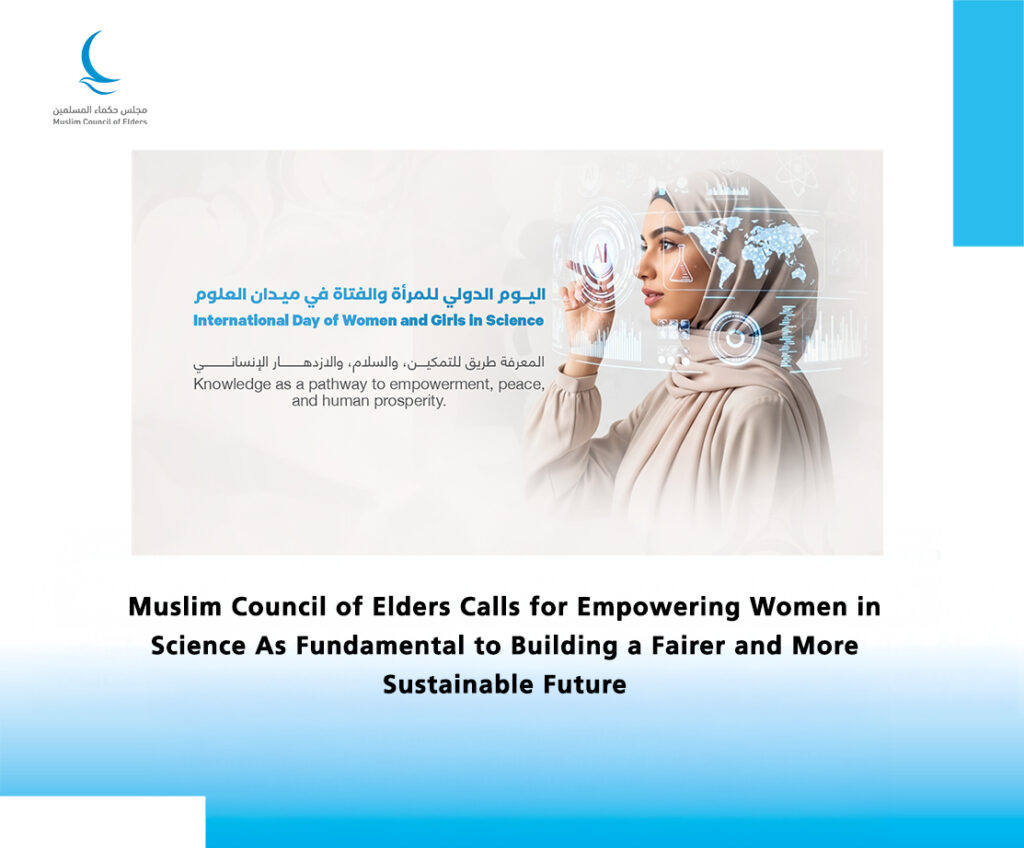
Muslim Council of Elders Calls for Empowering Women in Science As Fundamental to Building a Fairer and More Sustainable Future

The Muslim Council of Elders, under the chairmanship of His Eminence Dr. Ahmed Al‑Tayeb, the Grand Imam of Al‑Azhar, affirms that empowering women and girls in the fields of science, research, and innovation is both a moral imperative and a humanitarian necessity for cultivating societies that are more just, resilient, and sustainable. The Council emphasized that strengthening women’s participation in scientific disciplines is a genuine investment in the future of humanity.

In a statement issued on the International Day of Women and Girls in Science—observed annually on 11 February—the Council highlighted that women’s contributions to science throughout history have been foundational to the advancement of human civilization. It underscored the importance of ensuring that girls have access to high‑quality and equitable education in science, technology, engineering, and mathematics (STEM), enabling them to help address the pressing global challenges of our time, from climate change to public health, food security, and digital transformation.

His Eminence Dr. Ahmed Al‑Tayeb, Grand Imam of Al‑Azhar and Chairman of the Muslim Council of Elders, reaffirmed that “women are the sisters of men,” noting that Islam liberated women from outdated pre‑Islamic customs and honored them as mothers, sisters, daughters, and wives. He emphasized the need to ensure that women and girls obtain their full rights and to support and develop their capabilities, recognizing them as indispensable partners in the journey of development and nation‑building.

The Muslim Council of Elders calls for the removal of the social, cultural, and economic barriers that hinder women’s full participation in scientific fields. It stressed the need to adopt policies and initiatives that guarantee a fair, safe, and empowering scientific environment—one that nurtures creativity, excellence, and equal opportunity.

The Council reiterated its strong commitment to advancing women’s empowerment and enhancing their roles across all sectors and that promoting justice, equality, and equal opportunity is essential to achieving social harmony and sustainable development. Likewise, integrating women into the pursuit of scientific progress is key to shaping a future founded on cooperation, complementarity, and shared responsibility among all members of society.

Muslim Council of Elders Calls for Empowering Women in Science As Fundamental to Building a Fairer and More Sustainable Future Read More »

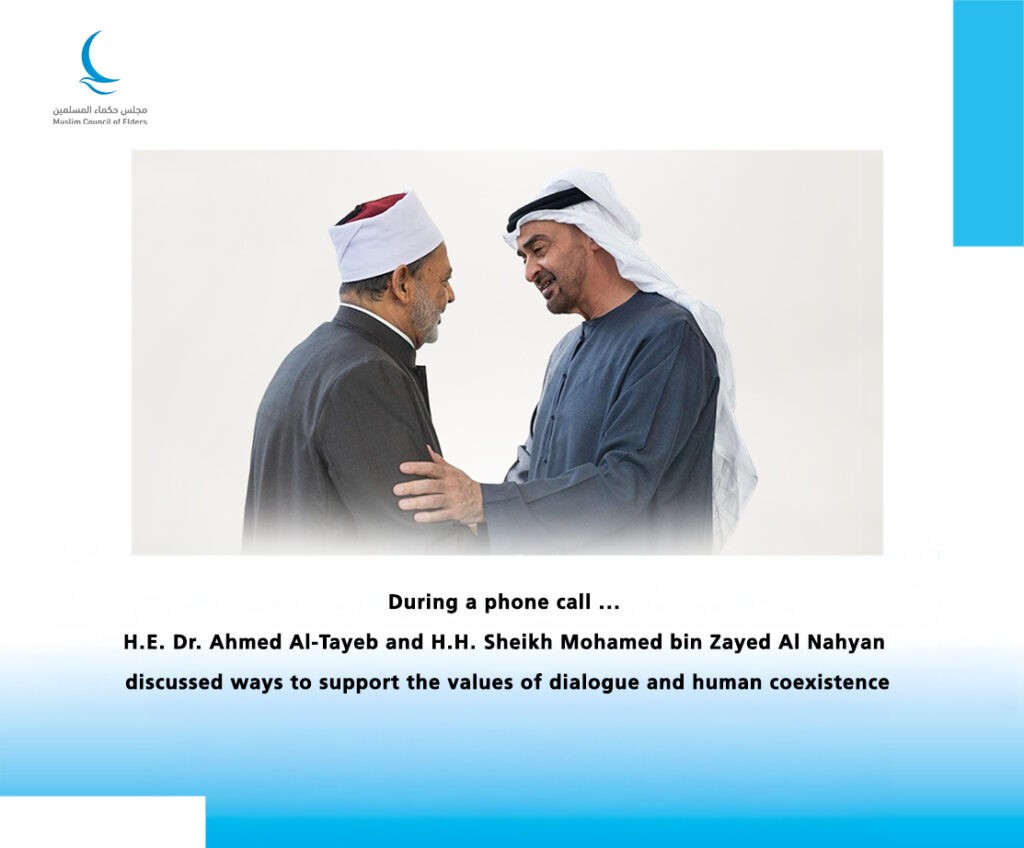
During a Telephone Call – Grand Imam of Al‑Azhar and Chairman of the Muslim Council of Elders and His Highness Sheikh Mohamed bin Zayed Discuss Advancing the Values of Dialogue and Coexistence

During a telephone call today, His Highness Sheikh Mohamed bin Zayed Al Nahyan, President of the United Arab Emirates, and His Eminence Professor Dr. Ahmed Al‑Tayeb, the Grand Imam of Al‑Azhar and Chairman of the Muslim Council of Elders, discussed ongoing and prospective joint initiatives between the United Arab Emirates’ institutions and Al‑Azhar. The conversation focused particularly on efforts to promote the values of coexistence and dialogue among diverse peoples and cultures—efforts that contribute to strengthening peace and stability across the region and the wider world.

The two leaders also exchanged warm greetings ahead of the blessed month of Ramadan, praying that Almighty Allah makes it a month filled with blessings and goodness for the United Arab Emirates and the Arab Republic of Egypt, for their two fraternal peoples, and for all humanity, bringing with it peace and stability.

His Eminence the Grand Imam expressed his sincere gratitude and profound appreciation to His Highness Sheikh Mohamed bin Zayed Al Nahyan for the UAE’s continuous support for Al‑Azhar and its global mission. He prayed that Allah protect His Highness and grant the UAE and its people enduring progress, prosperity, and well‑being.

The Grand Imam also underscored the significance of the Zayed Award for Human Fraternity and its vital role in recognizing and honoring efforts worldwide that promote coexistence, cooperation, dialogue, and human fraternity.

For his part, His Highness Sheikh Mohamed bin Zayed Al Nahyan conveyed his appreciation to His Eminence the Grand Imam, praising the essential role he and Al‑Azhar play in presenting the true, noble message of Islam, fostering fraternity and peace, and countering misconceptions promoted by those who seek to distort the image of the religion. His Highness further highlighted the deep scholarly, spiritual, and historical ties that connect the people of the UAE with Al‑Azhar and its distinguished scholars.

During a Telephone Call – Grand Imam of Al‑Azhar and Chairman of the Muslim Council of Elders and His Highness Sheikh Mohamed bin Zayed Discuss Advancing the Values of Dialogue and Coexistence Read More »

Muslim Council of Elders Strongly Condemns Terrorist Attack on Mosque in Pakistan

The Muslim Council of Elders, under the chairmanship of His Eminence Dr. Ahmed Al-Tayeb, the Grand Imam of Al-Azhar, strongly condemns the terrorist attack that targeted a mosque in Pakistan’s capital, Islamabad, resulting in the deaths of dozens and injuries to many others.

The Muslim Council of Elders affirms its categorical rejection of such terrorist acts, which contradict the tolerant teachings of the noble Islamic faith and all religions, as well as international conventions and norms that prohibit any infringement on places of worship and call for their protection, preservation, and respect.

The Muslim Council of Elders extends its sincere condolences to the Islamic Republic of Pakistan and to the families and loved ones of the victims, praying to Almighty Allah to grant the injured a speedy recovery.

Muslim Council of Elders Strongly Condemns Terrorist Attack on Mosque in Pakistan Read More »

Muslim Council of Elders Congratulates the Arab and Islamic Nations on the Occasion of the Night of Mid‑Sha’ban

The Muslim Council of Elders, under the chairmanship of His Eminence Professor Dr. Ahmed Al‑Tayeb, the Grand Imam of Al‑Azhar, extends its heartfelt congratulations to the Arab and Islamic nations on the occasion of the Night of Mid‑Sha’ban, praying that Almighty Allah grants this blessed occasion to the Arab and Islamic nations—and to all humanity—with goodness, blessings, and peace.

The Muslim Council of Elders affirms that the Night of Mid‑Sha’ban is a significant spiritual milestone in the collective consciousness of the Islamic Ummah and a renewed opportunity for self‑reflection, the revival of mercy and forgiveness, and the upholding of human dignity.

The Council adds that this blessed night reminds Muslims of the importance of purifying the heart, strengthening the spirit of moral responsibility, and drawing people closer together—especially in a world of mounting challenges and an urgent need to elevate the values of wisdom, justice, and peaceful coexistence.

The Muslim Council of Elders calls on all to seize this occasion to spread a culture of love, reject hatred and intolerance, reinforce the values of human fraternity, and translate faith‑inspired principles into practical action that serves communities, enhances stability, and builds peace.

Muslim Council of Elders Congratulates the Arab and Islamic Nations on the Occasion of the Night of Mid‑Sha’ban Read More »

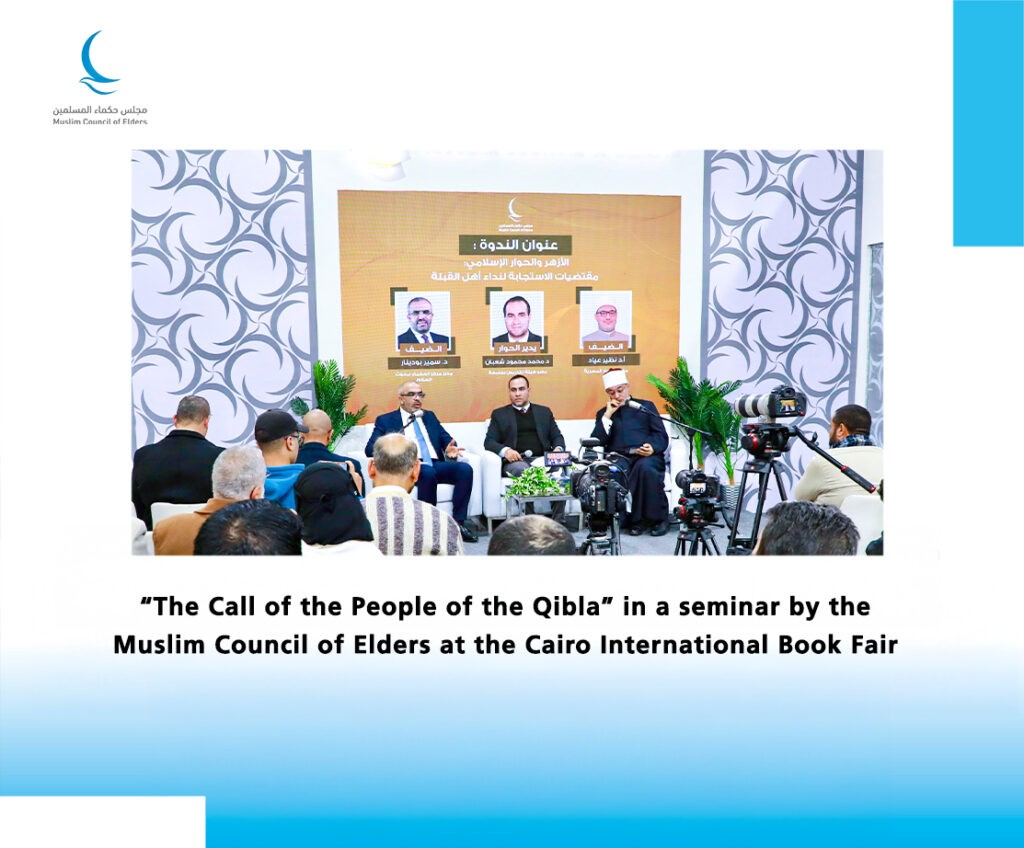
“The Call of the People of the Qibla” at a Seminar by the Muslim Council of Elders at the Cairo International Book Fair

The pavilion of the Muslim Council of Elders held its twelfth cultural seminar at the 57th edition of the Cairo International Book Fair, under the title: “Al Azhar and Islamic Dialogue: Requirements for Responding to the Call of the People of the Qibla.”

The seminar featured Professor Dr. Nazir Mohamed Ayyad, Grand Mufti of Egypt, and Dr. Samir Boudinar, Director of the Hikma Center for Peace Research. The discussion was moderated by Dr. Mohamed Mahmoud Shaaban, a faculty member at Al Azhar University.

At the beginning of the seminar, Professor Dr. Nazir Mohamed Ayyad emphasized that uniting the Islamic Ummah is neither an intellectual luxury nor a secondary matter. He noted that the world today is undergoing rapid transformations and complex challenges, which place greater responsibility on institutions concerned with dialogue. He explained that achieving unity depends on several key mechanisms, including objective engagement with the texts of revelation, confronting deviant fatwas, correcting misconceptions, and promoting a culture of understanding and dialogue among different schools of thought and intellectual trends.

The Grand Mufti of Egypt also highlighted that scholars of Islamic civilization presented pioneering models of sound interpretation of religious texts, contributing to healing divisions and uniting the Ummah. He cited Imam Abu al Hasan al Ashari, founder of the Ashari school, who, upon his death, advised one of his students:
“Bear witness that I do not declare any of the People of the Qibla disbelievers, for all point to one God, and all differences are merely differences in expression.”

He further noted that the “Call of the People of the Qibla” represents a comprehensive, consensus based initiative involving scholars, thinkers, and muftis from across the Islamic world, aimed at confronting sectarian strife and shared challenges and reuniting the Ummah. He stressed the importance of academic institutions studying the document in depth to strengthen Islamic unity and address the causes of division.

For his part, Dr. Samir Boudinar explained that the “Call of the People of the Qibla” is not merely a text or statement, but a profound vision rooted in Islamic heritage, particularly the Ashari theological tradition to which the majority of Muslim scholars belong, based on the principle of not declaring any of the People of the Qibla as disbelievers. He emphasized the need to re establish unity through reviving Ashari intellectual heritage, along with integrating religious and human sciences to achieve the document’s objectives.

Boudinar added that the initiative seeks to open horizons of dialogue among people to remove misconceptions and dispel distorted stereotypes, warning that the absence of dialogue could leave the Ummah vulnerable to those who seek to exploit its divisions.

He also pointed out that history teaches that the Ummah has often been targeted through division and fragmentation, while its moments of strength and victory were tied to unity, knowledge, and awareness of divine laws. Unity, he affirmed, has always been and will remain the source of the Ummah’s strength.

It is worth noting that the “Call of the People of the Qibla” is one of the key outcomes of the first edition of the Intra Islamic Dialogue Conference, hosted by the Kingdom of Bahrain in February 2025 under the gracious patronage of King Hamad bin Isa Al Khalifa, and attended by His Eminence Dr. Ahmed Al-Tayeb, the Grand Imam of Al-Azhar and Chairman of the Muslim Council of Elders, with the participation of more than 400 scholars and religious leaders from across the Islamic world.

The Muslim Council of Elders is participating with a dedicated pavilion at the 57th Cairo International Book Fair, running from 21 January to 3 February 2026. The pavilion features a wide range of the Council’s publications, in addition to organizing numerous seminars, activities, and events focused on promoting values of goodness, love, peace, and coexistence among all people.

The Muslim Council of Elders’ pavilion is located next to the Al Azhar pavilion in Heritage Hall No. 4 at the Egypt International Exhibition and Convention Center in New Cairo.

“The Call of the People of the Qibla” at a Seminar by the Muslim Council of Elders at the Cairo International Book Fair Read More »

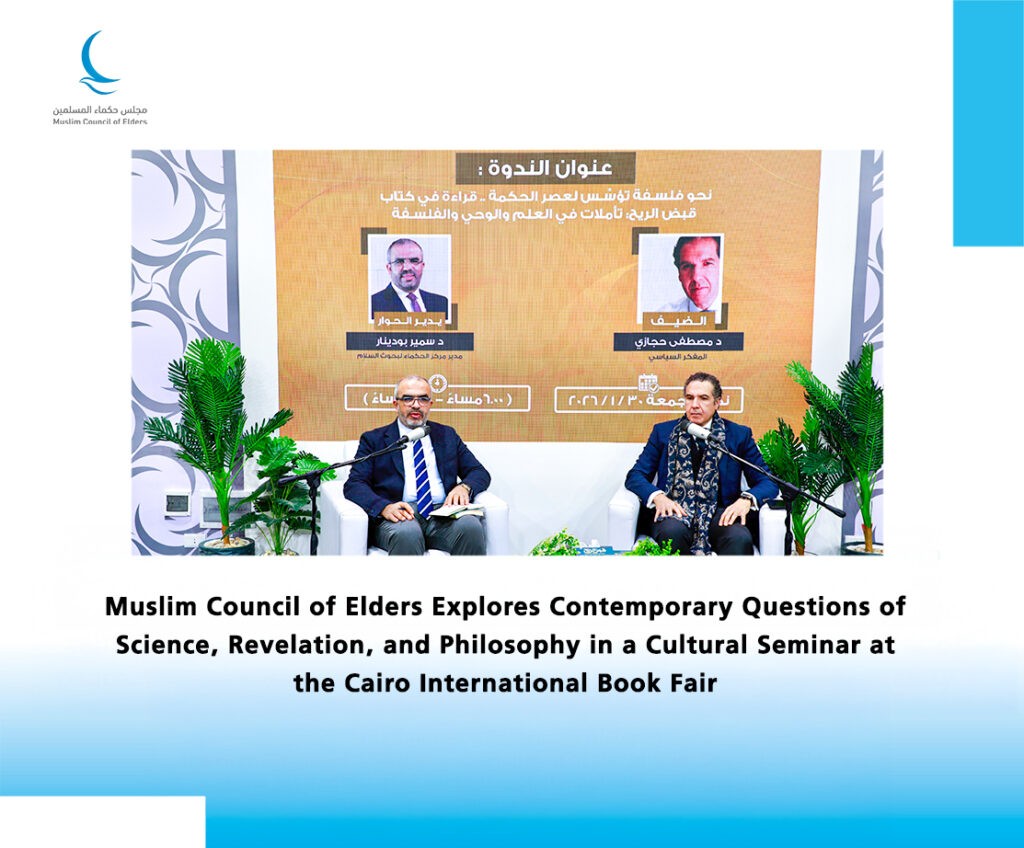
Muslim Council of Elders Explores Contemporary Questions of Science, Revelation, and Philosophy in a Cultural Seminar at the Cairo International Book Fair

The Muslim Council of Elders held its eleventh seminar at the 57th Cairo International Book Fair, titled “Toward a Philosophy that Establishes an Age of Wisdom: A Reading in the Book ‘Grasping the Wind – Reflections on Science, Revelation, and Philosophy’ with participation of the book’s author, Dr. Mostafa Hejazi. The discussion was moderated by Dr. Smir Boudinar, Director of the Al Hokama Center for Peace Research.

The seminar offered an analytical reading of ‘Grasping the Wind’, highlighting key intellectual themes the book raises in the fields of science, revelation, and philosophy. It also explored how to build a balanced epistemological vision that contributes to reinforcing the concept of wisdom and strengthening civilizational awareness amid rapidly evolving knowledge landscapes.

Dr. Mostafa Hejazi explained that the book targets writers, educators, and thinkers who seek to revive a new humanistic discourse—one that addresses the mind not to dazzle it, but to stimulate it, and speaks to the spirit not to immerse it in moralizing, but to awaken its innate sense of wonder.

In a philosophical reflection, Dr. Hejazi noted that the book was written specifically for those driven by intellectual restlessness—those searching for an equilibrium between spirit and matter, and those who fear being in a state of understanding without wisdom, faith without intellect, action without thought, or a path without purpose.

He explained that the essence of the book revolves around the search for the “missing questions of truth,” noting that technological advancement has, in some cases, overtaken the human mind, causing it to surrender to appearances. Meanwhile, others remain confined to past eras, clinging to time rather than place, holding on to understandings humanity has long surpassed. He addressed the “fragmented human being,” stressing that one does not need to choose between zero‑sum dualities, but must “resume contemplation”: revelation does not conflict with science, science is incomplete without purpose, and philosophy is an essential means.

The seminar concluded with a signing ceremony for ‘Grasping the Wind’, offering attendees an open discussion with the author about the book’s ideas and themes, enriching cultural engagement and deepening scholarly dialogue.

‘Grasping the Wind – Reflections on Science, Revelation, and Philosophy’ is among the latest 2026 releases of Al Hokama’ Publishing. The book contains several key chapters, including: Philosophical Lineage – When Does the Word Become Necessary? Between Two Humanisms; Who Is This Book For? Reflections on Existence, Time, and Meaning; Maqāṣidī Thought – The Philosophy of Contextual Purposiveness; Margins on the Text of Wisdom – Some of the Questions of Truth – On Science, Thought, and Creativity.

The Muslim Council of Elders is participating at the 57th Cairo International Book Fair, held from 21 January to 3 February 2026. The Council’s pavilion features a wide array of publications, in addition to a series of seminars, activities, and events focused on promoting the values of peace and peaceful coexistence among all people.

The pavilion of the Muslim Council of Elders is located next to the Al‑Azhar Pavilion in Heritage Hall No. 4 at the Egypt International Exhibition and Convention Center in the Fifth Settlement.

Muslim Council of Elders Explores Contemporary Questions of Science, Revelation, and Philosophy in a Cultural Seminar at the Cairo International Book Fair Read More »

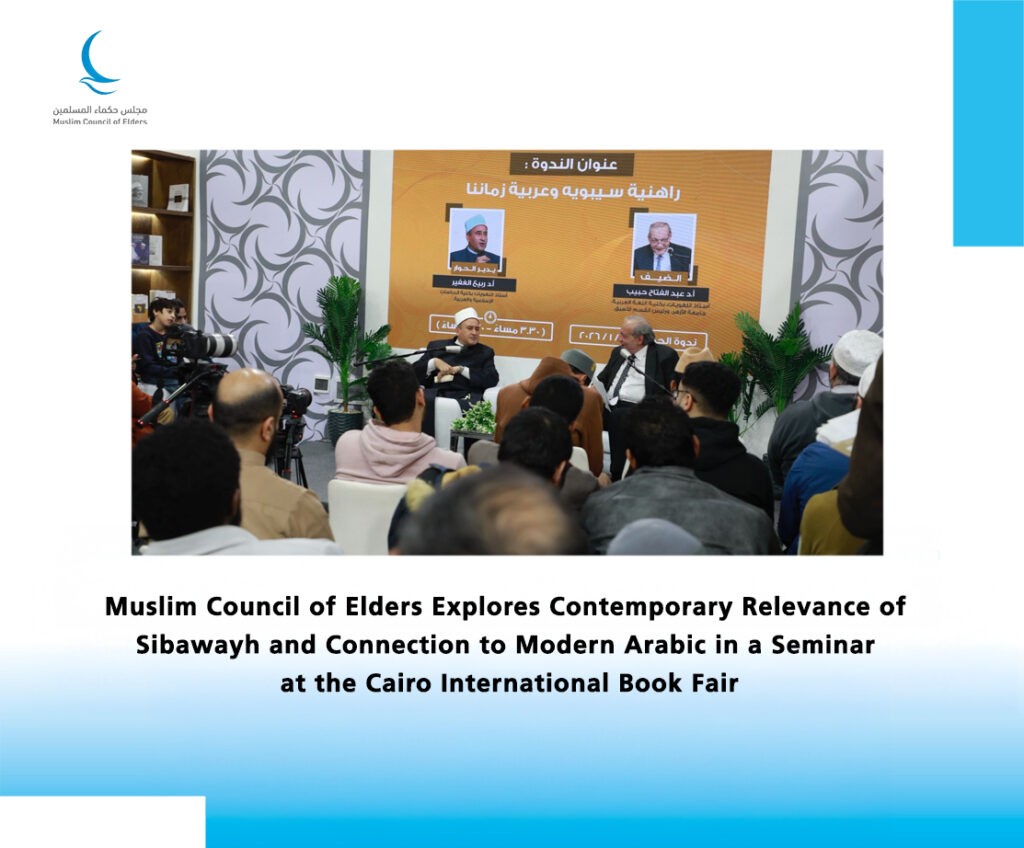
Muslim Council of Elders Explores Contemporary Relevance of Sibawayh and Connection to Modern Arabic in a Seminar at the Cairo International Book Fair

The pavilion of the Muslim Council of Elders held its tenth cultural seminar at the 57th Cairo International Book Fair, titled “The Contemporary Relevance of Sibawayh and the Arabic of Our Time,” with the participation of Professor Dr. Abdel Fattah Habib, Professor of Linguistics at Al‑Azhar University. The discussion was moderated by Dr. Rabee’ Al‑Ghafir, also a Professor of Linguistics at Al‑Azhar University.

The seminar explored Sibawayh’s prominent position in the heritage of Arabic linguistics, the impact of his contributions on understanding contemporary Arabic, and the role of linguistic scholarship in preserving the authenticity of the language while enabling it to meet the needs of the modern era.

Professor Dr. Abdel Fattah Habib stated that Sibawayh possessed extraordinary intellect and a powerful, authoritative scholarly reasoning. He noted that his book is a foundational reference for scholars past and present. He emphasized that anyone engaging in any branch of Arabic or Islamic sciences must begin with a thorough study of Sibawayh’s book prior to delving deeper into their chosen field.

He added that everything in Sibawayh’s book is governed by a precise scientific methodology. He stressed that the sequence of examples in the work was not random, but rather reflected a well‑established method for shaping linguistic reasoning. He explained that the intellectual training fostered by the book stems from Sibawayh’s mastery of analogical reasoning, in which he reached an advanced level of scholarly distinction.

Professor Habib also highlighted that the book must be read patiently and deliberately due to the depth and richness of its scholarly content. He noted that interest in the work has never waned since its appearance; it has remained a subject of careful study among scholars and students—both publicly and privately—throughout the centuries. He pointed to two notable critical editions of the book: one by Sheikh Abd al‑Salam Haroun of Egypt, and another by Professor Muhammad Al‑Bakka’ of Iraq.

The Muslim Council of Elders is participating at the 57th Cairo International Book Fair, held from 21 January to 3 February 2026. The pavilion showcases a wide range of the Council’s publications, alongside a series of seminars, activities, and events focused on promoting the values of peace and peaceful coexistence among all people.

The pavilion of the Muslim Council of Elders is located next to the Al‑Azhar Pavilion in Heritage Hall No. 4 at the Egypt International Exhibition and Convention Center in the Fifth Settlement.

Muslim Council of Elders Explores Contemporary Relevance of Sibawayh and Connection to Modern Arabic in a Seminar at the Cairo International Book Fair Read More »