
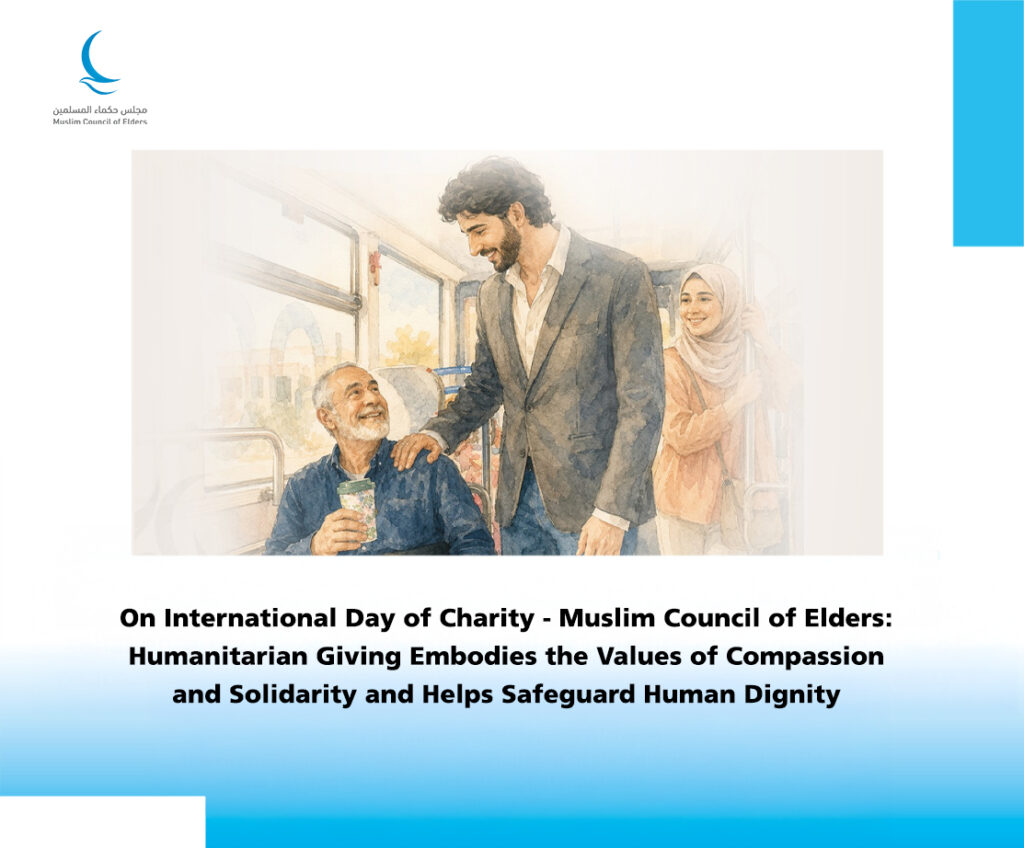
The Muslim Council of Elders affirms that charitable work represents one of the highest forms of human solidarity and a practical embodiment of the values of compassion, mutual support, and mercy advocated by Islam and all divine religions. Such efforts contribute to safeguarding human dignity and alleviating the suffering of those in need and affected communities.
On the occasion of the International Day of Charity, observed annually on 5 September, the Muslim Council of Elders calls for strengthening a culture of giving, volunteerism, and social responsibility, and for enhanced cooperation among institutions and individuals to support the most vulnerable groups. This call comes at a time when the world continues to face humanitarian crises, disasters, and conflicts that have left millions in need, displaced, or seeking refuge. The Council underscores the importance of ensuring that humanitarian assistance reaches those who need it most, without discrimination, in a manner that preserves their dignity and addresses their essential needs.
The Muslim Council of Elders commends the efforts of humanitarian and charitable organizations, as well as aid workers and volunteers around the world, for the inspiring examples they set through their generosity, dedication, and service to humanity. The Council emphasizes that promoting a culture of charitable work, particularly among youth and younger generations, contributes to building more cohesive and compassionate societies, and a world marked by greater peace, cooperation, and human fraternity.
The Muslim Council of Elders reaffirms its commitment to advancing initiatives and efforts aimed at promoting the values of solidarity, mutual support, and human fraternity, inspired by the principles of the historic Document on Human Fraternity, which was signed in Abu Dhabi in 2019 by His Eminence Dr. Ahmed Al-Tayeb, Grand Imam of Al-Azhar and Chairman of the Muslim Council of Elders, and the late His Holiness Pope Francis, former Pontiff of the Catholic Church. The Document calls for extending support to the poor, the underprivileged, the needy, and the marginalized, and for providing relief to victims of war, persecution, and disasters without exclusion or discrimination.