
Dr. Samir Boudinar: Inter-Islamic dialogue is a cornerstone of the Muslim world today
Dr. Ismail Al-Alwani: The pulpit is a vital tool for raising public awareness and strengthening the Muslim Ummah’s collective identity
Dr. Jassim Juayiz: Unity is a process of mutual acceptance rooted in social harmony, diversity, and pluralism
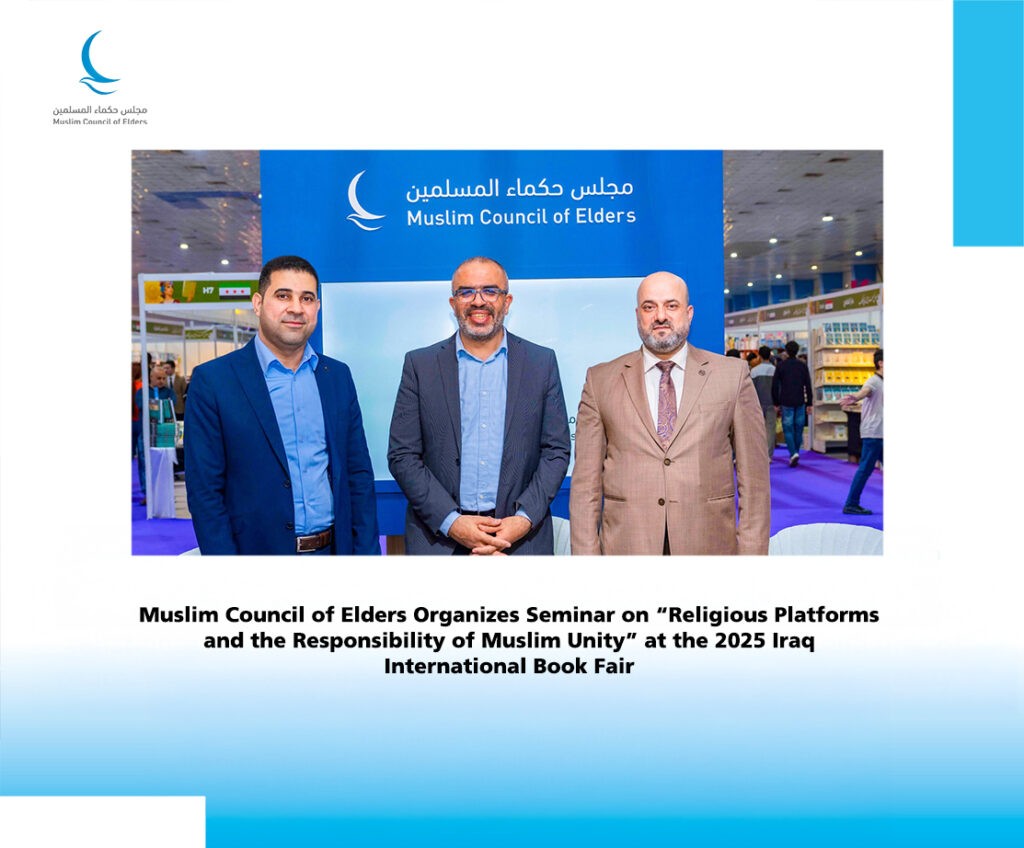
On the third day of the Iraq International Book Fair, the Muslim Council of Elders hosted an intellectual seminar titled “Religious Platforms and the Responsibility of Muslim Unity.” The session featured Prof. Dr. Ismail Khalil Al-Alwani, Assistant Dean of Al-Imam Al-Azam University College, and Dr. Jasim Juayiz Mankhi, Assistant Dean of Al-Imam Al-Kadhim University College, and was moderated by Dr. Samir Boudinar, Director of Al-Hokama Center for Peace Research.
Opening the discussion, Dr. Samir Boudinar underscored that inter-Islamic dialogue is a fundamental pillar of contemporary Muslim society. It is deeply intertwined with questions of identity, belonging, and the role of scholars in engaging communities through religious and media platforms. He noted that Iraq stands out as an exemplary model in this regard, given its long history, rich sectarian and intellectual diversity, and profound civilizational and religious heritage—all of which make dialogues of this kind both necessary and impactful.
Prof. Dr. Ismail Al-Alwani emphasized that the pulpit serves as a central means of educating the public and reinforcing the Muslim Ummah’s shared identity. More than a medium for sermons, it is a bridge between scholars and society—a tool capable of deepening understanding and nurturing unity when used responsibly, or fuelling division when misused. He highlighted that throughout Islamic history, scholars played an essential role in safeguarding faith and preserving communal cohesion, and that the Islamic tradition offers many examples of scholars who united rather than divided. This, he said, places a significant moral and intellectual responsibility on today’s scholars to continue this mission.
Dr. Jassim Juayiz stated that inter-Islamic dialogue must be rooted in the values of understanding, mutual recognition, and the rejection of discord. He stressed that societies today are in urgent need of a thoughtful, evidence-based religious discourse. He added that the three influential societal institutions—religious, social, and academic—must work in harmony to correct misconceptions, promote a culture of dialogue, and affirm that unity does not mean eliminating difference, but rather embracing one another in a spirit of social peace, diversity, and pluralism.
The seminar concluded by reaffirming that the role of scholars today extends well beyond the traditional pulpit. It is a purposeful, long-term effort to strengthen Muslim unity, shield societies from extremism, and build trust among different schools of thought through a balanced discourse grounded in evidence, shared history, and respect for difference.
The Muslim Council of Elders is participating in the Iraq International Book Fair as part of its mission to promote peace, foster dialogue and tolerance, and build bridges among people of all backgrounds and beliefs. The Council’s pavilion is located at the Baghdad International Fairgrounds, Pavilion No. 16 – H6.