
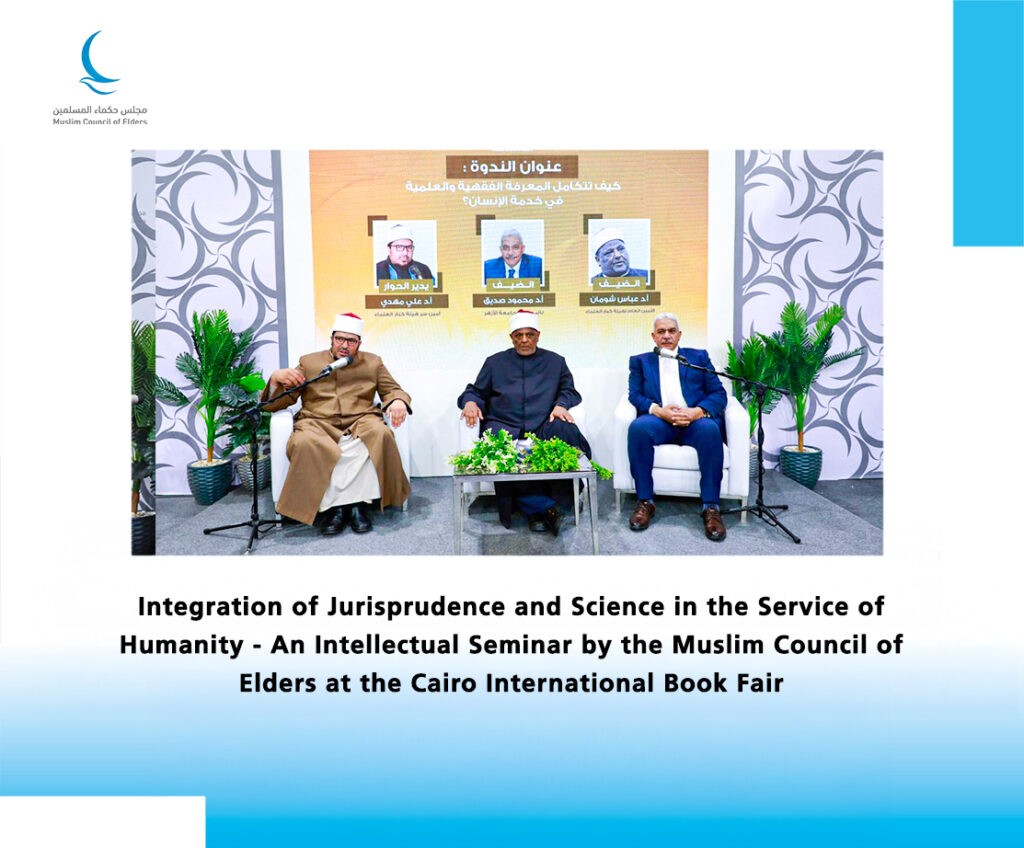
ic jurisprudential sciences with modern scientific knowledge to advance human welfare and to build civilizational awareness grounded in a balance between religious values and contemporary needs. The discussion highlighted how such integration enhances human development and addresses modern challenges with a comprehensive vision.
In his remarks, Dr. Abbas Shoman emphasized the deep connection between Islamic law and all other sciences. He explained that religious and worldly sciences are inseparable and noted that issuing a legal opinion (fatwa) often requires reference to various other disciplines, such as economics and medicine. He added that jurisprudence may at times rely on the determinations of specialists in different scientific fields. Dr. Shoman also pointed to the Islamic Research Academy as a model of knowledge integration due to its diverse membership of experts in both religious and scientific fields, enabling the development of jurisprudence that is attentive to contemporary issues and developments.
For his part, Dr. Mahmoud Seddik stated that the Qur’an and the Prophetic Sunnah call for the integration of different fields of knowledge. He referred to the Prophet Muhammad’s (PBUH) guidance in certain hadiths to prevent mixing between the sick and the healthy—an instruction that modern medical institutions endorse today to limit the spread of disease.
The Vice President of Al‑Azhar University explained that the life sciences, especially medical sciences, complement jurisprudential studies to ensure that human life can continue in a sound manner. He noted that the jurist sometimes sets boundaries for the physician’s decisions, just as the jurist needs the insights of medical and scientific specialists before issuing legal opinions. He explained that jurists at the Islamic Research Academy regularly consult specialists in medicine, genetics, economics, and other modern sciences and engage in extensive discussions with them before issuing fatwas or ruling on contemporary issues. This approach, he added, reflects the authenticity of Islamic thought and its openness to diverse fields of knowledge.
The Muslim Council of Elders is participating at the 57th Cairo International Book Fair, held from 21 January to 3 February 2026 with a large selection of the Council’s distinguished publications, along with a series of seminars, activities, and events focused on promoting the values of peace and peaceful coexistence among all people.
The pavilion of the Muslim Council of Elders is located next to the Al‑Azhar Pavilion in Heritage Hall No. 4 at the Egypt International Exhibition and Convention Center in the Fifth Settlement.