
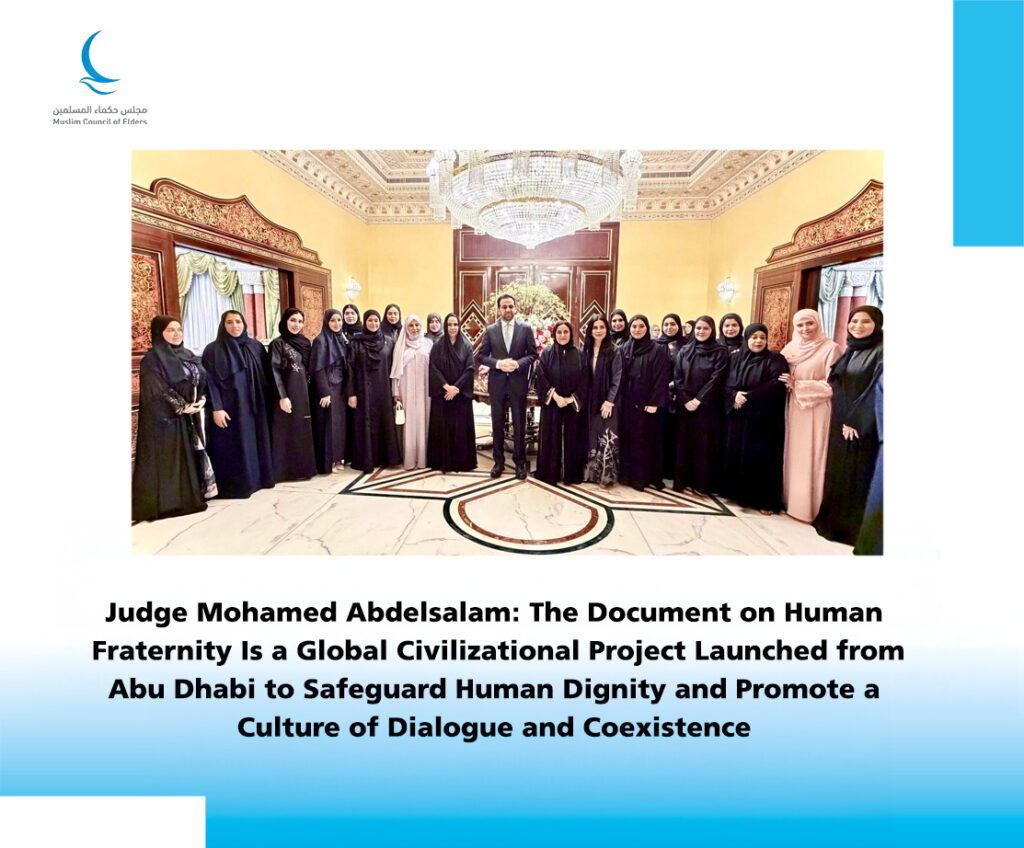
His Excellency Judge Mohamed Abdelsalam, General Advisor of the Muslim Council of Elders, affirmed that the Document on Human Fraternity, launched in Abu Dhabi on February 4, 2019, represents a global civilizational and humanitarian project aimed at safeguarding human dignity, promoting a culture of dialogue and coexistence, and advancing the values of peace and human fraternity among peoples.
The remarks came during an event organized by the Shamma Mohammed Council for Thought and Knowledge under the title “The Journey of Human Fraternity from Abu Dhabi to the World: Towards a Shared Human Future” held under the patronage of H.H. Sheikha Dr. Shamma bint Mohammed bin Khalid Al Nahyan, Chairperson of the Sheikh Mohammed bin Khalid Al Nahyan Cultural and Educational Institutions, and was attended by a distinguished group of intellectuals and individuals interested in humanitarian and cultural affairs.
During the event, moderated by media personality Hind Khalifat, Judge Mohamed Abdelsalam reviewed the process leading to the drafting of the Document on Human Fraternity, including years of consultations and dialogue between His Eminence Dr. Ahmed Al-Tayeb, Grand Imam of Al-Azhar and Chairman of the Muslim Council of Elders, and the late Pope Francis, former Head of the Catholic Church, as well as a number of religious and intellectual leaders. These efforts ultimately culminated in the signing of the historic document in Abu Dhabi, which has since become a global reference for promoting the values of coexistence, fraternity, and peace.
Judge Mohamed Abdelsalam also highlighted his book, “The Pope and the Grand Imam: A Thorny Path,” which chronicles the journey of human dialogue that led to the issuance of the Document on Human Fraternity, as well as the challenges and efforts that accompanied its development. He emphasized that this experience has provided a pioneering global model for dialogue and cooperation among religions and cultures.
He noted that the remarkable success achieved by the Document on Human Fraternity is a reflection of the UAE’s visionary approach under the leadership of His Highness Sheikh Mohamed bin Zayed Al Nahyan, President of the United Arab Emirates, and its firm belief that tolerance, dialogue, and respect for diversity constitute essential pillars for building a more stable and prosperous future for humanity. He added that the UAE’s wise leadership embraced this major humanitarian initiative and provided the supportive environment necessary for it to flourish and expand from Abu Dhabi to the world, further strengthening the UAE’s position as a global capital of tolerance and coexistence and a gathering place for peacebuilders.
Judge Mohamed Abdelsalam explained that the Document on Human Fraternity has evolved beyond a mere declaration of principles to become a comprehensive civilizational and humanitarian project. It calls for rejecting intolerance, extremism, and hatred, while promoting a culture of dialogue and joint action among peoples and cultures, based on the belief in a shared human destiny.
At the conclusion of the event, Judge Mohamed Abdelsalam stressed that investing in human development remains the true foundation for the advancement of societies. He noted that awareness and confidence are the two essential pillars for shaping the future and emphasized that strengthening younger generations’ understanding of their identity and authentic values is crucial to enabling them to engage positively with the world, contribute meaningfully to their countries’ development, and help build a more peaceful and humane future.