
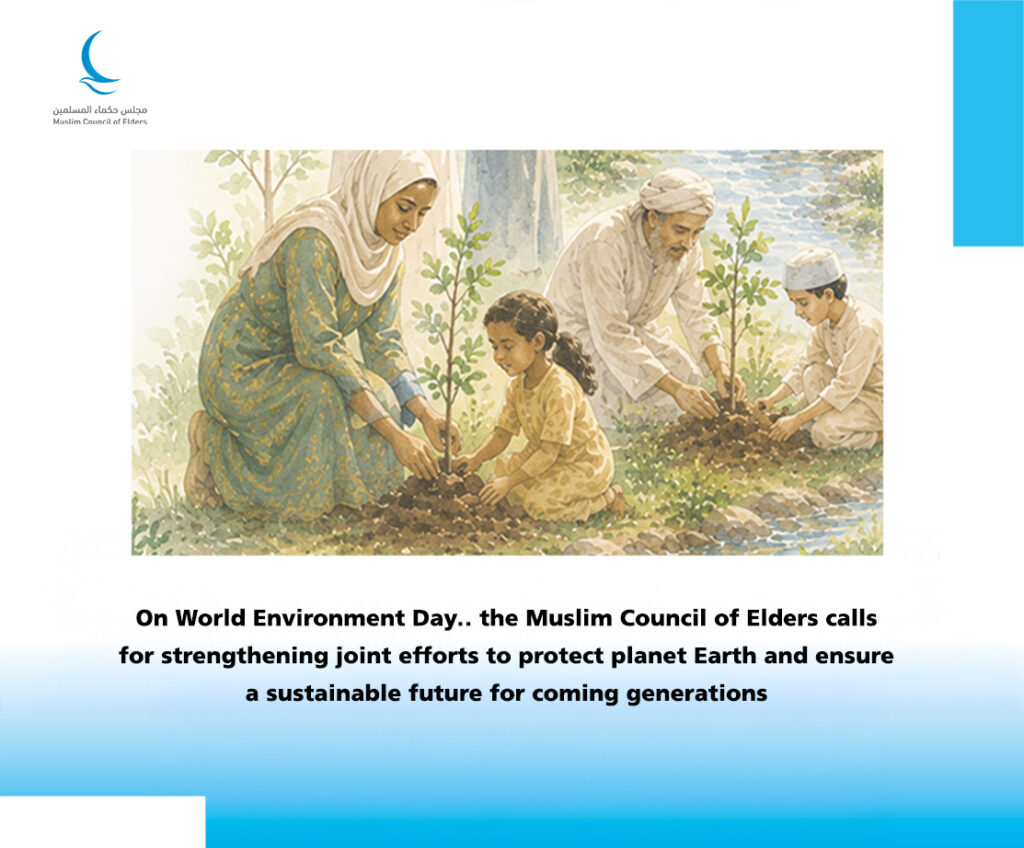
The Muslim Council of Elders, chaired by His Eminence Prof. Ahmed Al-Tayeb, Grand Imam of Al-Azhar, has affirmed that protecting the environment and preserving natural resources are shared moral and humanitarian responsibilities that require concerted international efforts to address growing environmental challenges and secure a more sustainable future for generations to come.
In a statement marking World Environment Day, observed annually on June 5, the Muslim Council of Elders emphasized that Islam, along with all divine laws, calls for the stewardship and flourishing of the Earth and forbids corruption and destruction within it. These teachings promote the values of moderation and responsibility in the use of natural resources, helping to achieve a balance between the demands of development and the preservation of the environment.
The statement highlighted the importance of raising environmental awareness and supporting initiatives aimed at tackling climate change, pollution, and biodiversity loss. It stressed that environmental protection is no longer merely a local or regional concern, but a global responsibility that requires effective international cooperation, sustainable partnerships, and collective action at every level.
The Muslim Council of Elders has made significant efforts to strengthen the role of religious leaders and faith communities in addressing global challenges, particularly environmental and climate-related issues. In this regard, the Council organized the Global Faith Leaders’ Summit on Climate Action. The summit resulted in the issuance of the Confluence of Conscience: Uniting for Planetary Resurgence”, also known as “The Abu Dhabi Interfaith Statement for COP28”. The statement was endorsed by more than 30 prominent religious leaders from around the world, including His Eminence Prof. Ahmed Al-Tayeb, Grand Imam of Al-Azhar, and His Holiness Pope Francis.
The Council also organized the Faith Pavilion during COP28 in the United Arab Emirates and COP29 in the Republic of Azerbaijan—the first initiative of its kind in the history of the UN Climate Change Conferences (COPs). The pavilion helped highlight the vital role of religions and ethical values in supporting international efforts to protect the environment and combat climate change.
The Muslim Council of Elders renews its affirmation that caring for the environment and safeguarding its natural resources are integral to humanity’s responsibility toward itself, its communities, and future generations. The Council calls for continued collective action to protect our planet and preserve the future of humankind.