
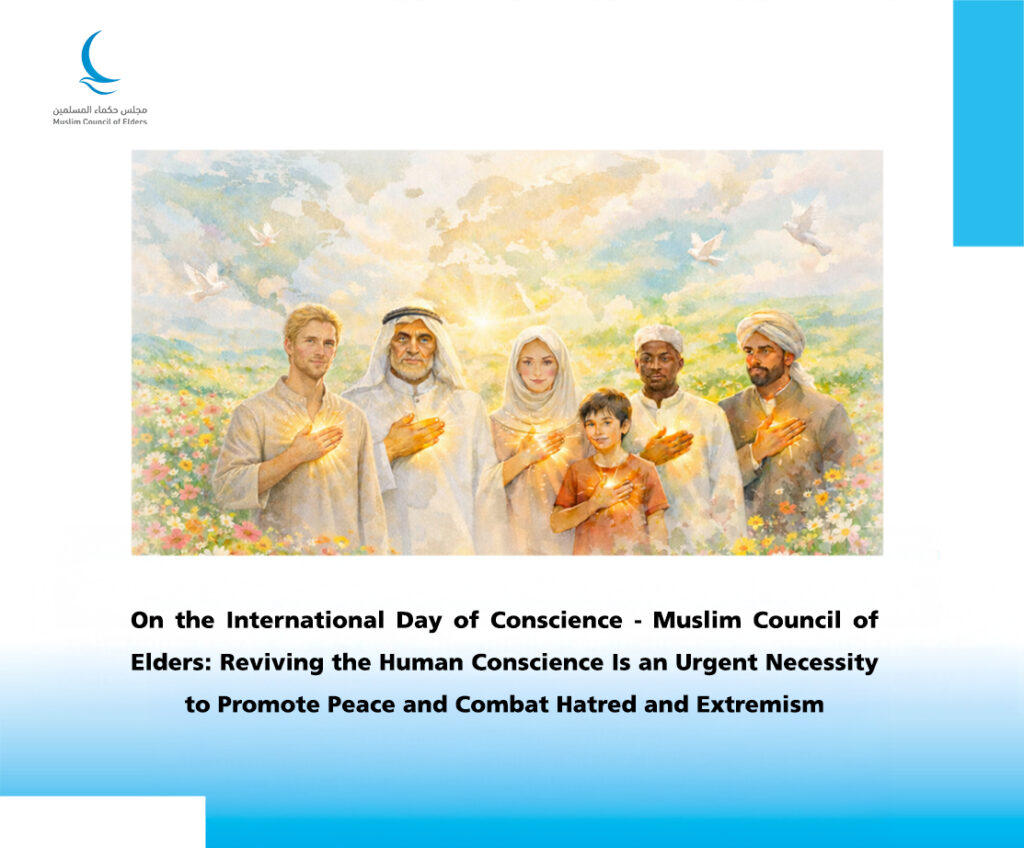
The Muslim Council of Elders, under the chairmanship of His Eminence Dr. Ahmed Al-Tayeb, the Grand Imam of Al-Azhar, affirmed that the International Day of Conscience represents an important opportunity to renew the call to elevate the voice of the human conscience, strengthen the values of compassion, solidarity, and social responsibility, and enhance collective awareness of the importance of working toward a world founded on peace, justice, and mutual respect.
In a statement, the Muslim Council of Elders noted that the observance of this international occasion—marked annually on April 5—reflects the world’s growing need to revive moral and humanitarian values in the face of the successive wars, conflicts, and crises it continues to endure. The Council emphasized that a living and vigilant conscience remains a vital safeguard that protects societies from sliding into hatred, division, and violence.
The Council further stated that an awakened human conscience constitutes the cornerstone of fostering understanding among peoples and of promoting a culture of dialogue, tolerance, and peaceful coexistence. It reaffirmed that all divine religions have called for activating the conscience, safeguarding human dignity, rejecting injustice and aggression, and building bridges of fraternity and cooperation among humankind.
The Muslim Council of Elders renewed its call for coordinated international efforts to promote a culture of peace, strengthen dialogue among religions and cultures, and instill the values of human fraternity in the hearts of younger generations. Such efforts, the Council stressed, contribute to building a world that is more conscious of its shared humanity and better equipped to overcome the causes of hatred, conflict, and division.
The Council also urged religious, educational, cultural, and media institutions to fulfill their essential role in nurturing the human conscience and instilling the values of compassion, respect, and responsibility, recognizing these principles as fundamental pillars for building cohesive societies capable of safeguarding human dignity and protecting every individual’s right to security, peace, and a dignified life.