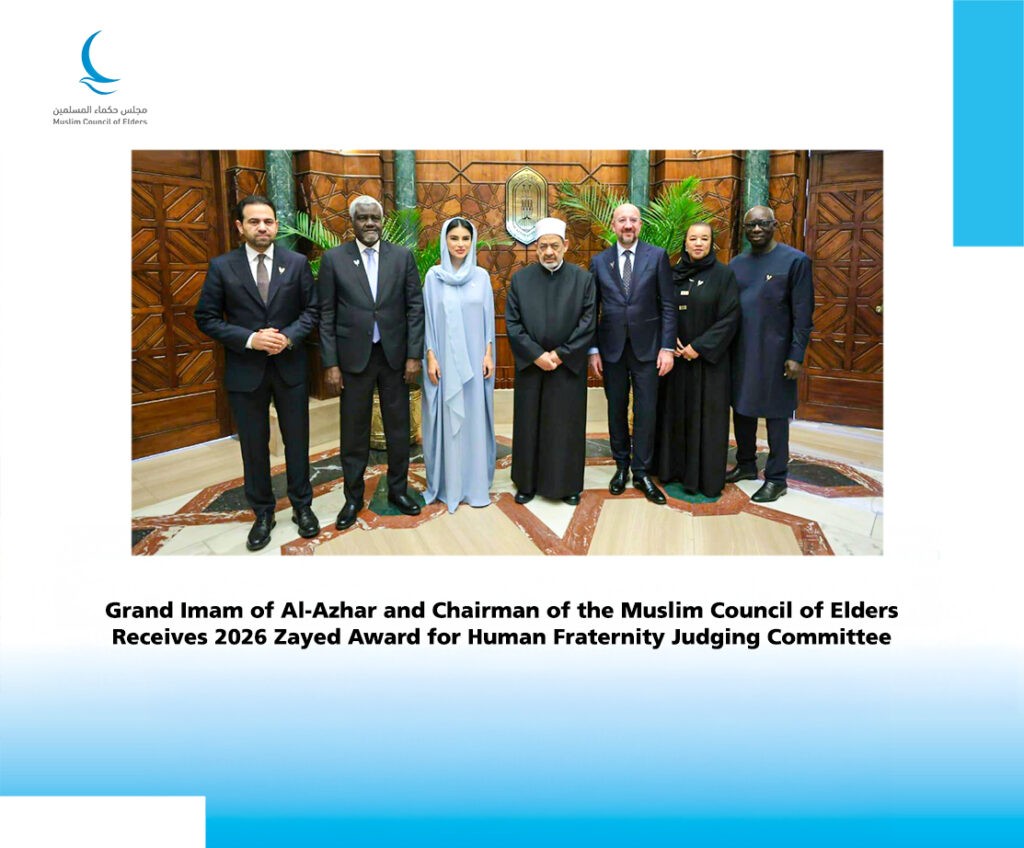
Grand Imam of Al-Azhar and Chairman of the Muslim Council of Elders Receives 2026 Zayed Award for Human Fraternity Judging Committee
His Eminence Ahmed Al-Tayeb, Grand Imam of Al-Azhar and Chairman of the Muslim Council of Elders received members of the Zayed Award for Human Fraternity’s 2026 judging committee at Al-Azhar headquarters in Cairo on Tuesday. The visiting delegation of the independent global award included head of the Administration of the President of the Republic of Uzbekistan Her Excellency Saida Mirziyoyeva; former President of the European Council His Excellency Charles Michel; Zayed Award for Human Fraternity Secretary-General His Excellency Judge Mohamed Abdelsalam; and former Chairperson of the African Union Commission His Excellency Moussa Faki Mahamat.
During the meeting, Grand Imam Al-Tayeb welcomed the jury members and stressed that this first visit of the committee to Egypt represents an extension of the journey of human fraternity that began in Cairo in 2017 and culminated in His Eminence’s signing of the Document on Human Fraternity alongside the late His Holiness Pope Francis, in Abu Dhabi, United Arab Emirates, in 2019.
Grand Imam Al-Tayeb added that the award named after the ‘Wise Man of the Arabs’ – the late Sheikh Zayed bin Sultan Al Nahyan, founder of the United Arab Emirates – stands as a continuation of his noble legacy in serving humanity and supporting the weak and vulnerable and extended his gratitude to His Highness Sheikh Mohamed bin Zayed Al Nahyan, President of the United Arab Emirates, who stands as the foremost supporter of the path of human fraternity
His Eminence said: “You are now sitting in a place [Al-Azhar] that for more than a thousand years has been spreading peace, moderation, and human fraternity in Egypt and across the world. Egypt is the cradle of tolerance and coexistence; it offers the world a unique and unparalleled model in advancing peaceful coexistence, human fraternity, and tolerance.
He added that all religions uphold the values of peace, fraternity, and coexistence — universal human values that humanity is now in utmost need of strengthening in societies, especially as today’s world is plagued by wars and conflicts.
The Grand Imam of Al-Azhar expressed his confidence in the sincere efforts undertaken by the members of the Zayed Award for Human Fraternity judging committee to achieve the goals of the Document on Human Fraternity, for which the award was established. He noted that history is a guide to help lay the foundations of peace and fraternity in the world, stressing that the Zayed Award for Human Fraternity has today become one of the most important independent global platforms honoring genuine humanitarian efforts and initiatives. His Eminence called on the jury members to shoulder their historic responsibility in selecting individuals and initiatives that embody the spirit of human fraternity in its highest form, and that present to the world inspiring models that demonstrate peace and understanding are possible – no matter how great the challenges and how diverse cultures may be.
For their part, the members of the Zayed Award for Human Fraternity judging committee affirmed their commitment to select honorees following in the footsteps of honorary recipients Grand Imam Al-Tayeb and the late Pope Francis, for the award’s seventh edition.
Zayed Award for Human Fraternity Secretary-General His Excellency Judge Mohamed Abdelsalam said: “The judging committee’s inaugural visit to the Arab Republic of Egypt reflects our deep appreciation for this ancient country’s pioneering role in human progress, dialogue, and civilization. Our meeting with His Eminence Grand Imam Al-Tayeb – the foremost moral and spiritual authority in the Islamic world and a founding figure of the human fraternity mission – constitutes a central pillar and a fundamental source of support for the award’s efforts to highlight models and initiatives that embody the values of human fraternity.”
Her Excellency Saida Mirziyoyeva, head of the Administration of the President of the Republic of Uzbekistan and 2026 jury member, said: “It was truly a privilege for us as a jury to meet with His Eminence Al-Tayeb at Al-Azhar – one of humanity’s oldest and most esteemed centers of knowledge and dialogue – and to discuss our collective efforts advancing human fraternity and making the world a better place, with a figure who has committed his life to coexistence and service of others.”
His Excellency Charles Michel, former President of the European Council and 2026 jury member, said: “As an international jury visiting Egypt, a civilizational crossroads, Al-Azhar, a global beacon of learning, and our discussion with the Grand Imam of Al-Azhar, we are reminded of the Zayed Award for Human Fraternity’s core purpose – to strengthen humanity and civilization by promoting human development, dialogue, and education.”
His Excellency Moussa Faki Mahamat, former Chairperson of the African Union Commission and 2026 jury member, said: “This meeting with His Eminence Al-Tayeb has underlined how essential religious and moral leadership is in promoting peaceful coexistence, especially in regions facing conflict. We are encouraged to select this year’s honorees guided by a sense of the importance of reconciliation, protection of vulnerable communities, and empowerment of future generations.”
Advisors to the 2026 judging committee – former Secretary-General of the Commonwealth the Right Honorable Patricia Scotland KC and Adama Dieng, African Union Special Envoy on the Prevention of Genocide and Other Mass Atrocities and former United Nations Special Advisor on the Prevention of Genocide – were also present for the meeting and shared their perspectives.
The meeting with Grand Imam of Al-Azhar Ahmed Al-Tayeb is the first part of the judging committee’s visit to Egypt, which includes a visit to Al-Azhar Mosque, the Grand Egyptian Museum, and several other religious and cultural institutions in Cairo.
Named in honor of the late Sheikh Zayed bin Sultan Al Nahyan, founder of the United Arab Emirates, the Zayed Award for Human Fraternity recognizes individuals and organizations – of all backgrounds, anywhere in the world – working selflessly and tirelessly to advance human fraternity and create breakthroughs towards peaceful coexistence.
The award has so far recognized 16 recipients from 15 countries including the Grand Imam of Al-Azhar and world-renowned cardiac surgeon Professor Sir Magdi Yacoub – since its establishment in 2019, following the historic meeting in Abu Dhabi between the late His Holiness Pope Francis, 266th head of the Catholic Church, and His Eminence Ahmed Al-Tayeb, Grand Imam of Al-Azhar, during which the two religious figures co-signed the Document on Human Fraternity.