
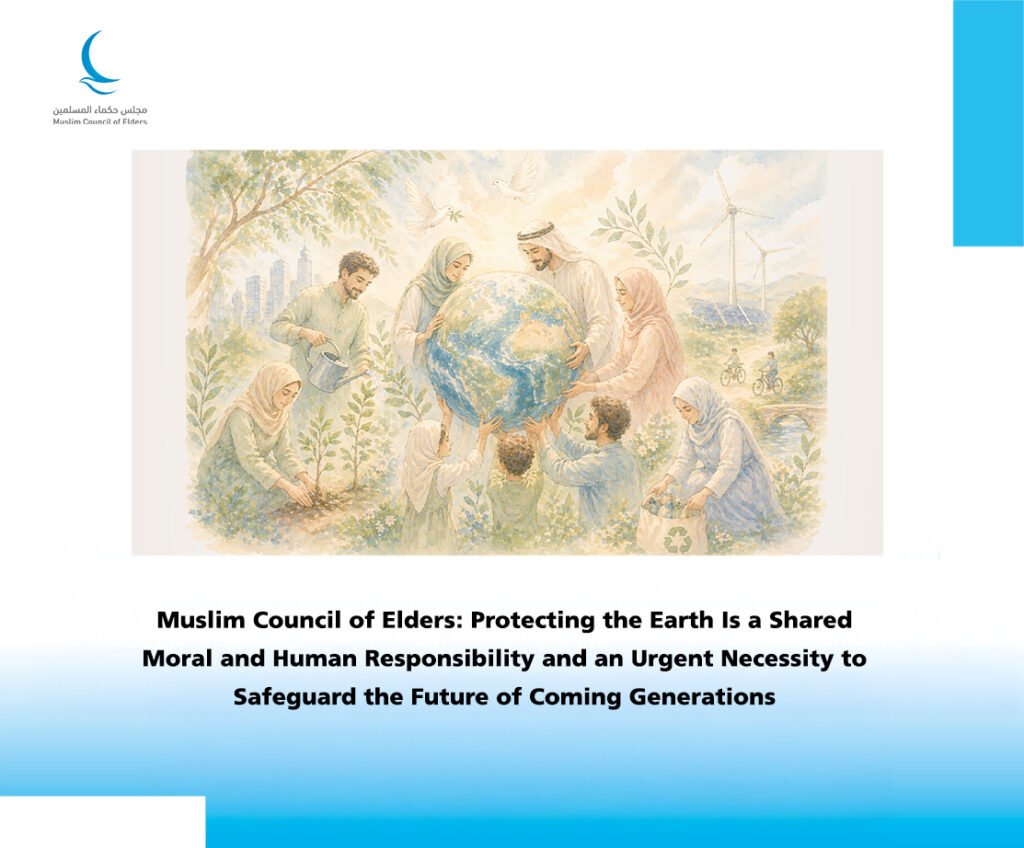
Muslim Council of Elders: Protecting the Earth Is a Shared Moral and Human Responsibility and an Urgent Necessity to Safeguard the Future of Coming Generations
The Muslim Council of Elders, under the chairmanship of His Eminence Professor Dr. Ahmed Al‑Tayeb, the Grand Imam of Al‑Azhar, affirms that World Earth Day, observed annually on 22 April, is an important occasion to renew collective awareness of the necessity of preserving planet Earth, safeguarding its resources, and protecting its environment from degradation and depletion, in a manner that ensures the sustainability of life for present and future generations.
In a statement issued on World Earth Day, the Council emphasized that environmental protection is a shared moral and humanitarian duty and a collective responsibility that requires sincere commitment and a unified will to preserve life on this planet. It also called for the strengthening of joint efforts to confront escalating environmental challenges, foremost among them climate change, pollution, and the loss of biodiversity.
Furthermore, the statement notes that all divine religions have affirmed the importance of cultivating the Earth and refraining from causing corruption upon it, recognizing humanity as stewards entrusted with its care and protection. In this regard, the statement cited the Qur’anic verse: (And do not cause corruption on the Earth after it has been set in order) (Qur’an 7:56), highlighting the ethical and spiritual dimensions of environmental preservation and calling for the adoption of sustainable lifestyles that balance development with the protection of natural resources.
The Muslim Council of Elders further calls for the adoption of effective policies and innovative initiatives that contribute to mitigating the impacts of climate change, advancing the transition toward a green economy, and embedding a culture of environmental responsibility within communities. The Council underscored the importance of investing in environmental education and awareness—particularly among youth—as essential partners in building a more sustainable future.
The Council continues to exert significant efforts to strengthen the role of religious leaders and institutions in addressing global challenges, foremost among them environmental issues, in pursuit of climate justice. These efforts include initiatives such as the “Faith Pavilion,” held during COP28 in Dubai and COP29 in Azerbaijan.
In addition, the Council organized the Global Faith Leaders Summit for Climate Action in Abu Dhabi in 2023, which resulted in the document titled “A Call of Conscience: The Abu Dhabi Joint Statement for Climate” which was co-signed by over 30 religious leaders and figures from around the world, including His Eminence Dr. Ahmed Al‑Tayeb, the Grand Imam of Al‑Azhar and Chairman of the Muslim Council of Elders, and His Holiness the late Pope Francis of the Catholic Church, among other inspiring initiatives and efforts dedicated to preserving our planet.