
خبریں

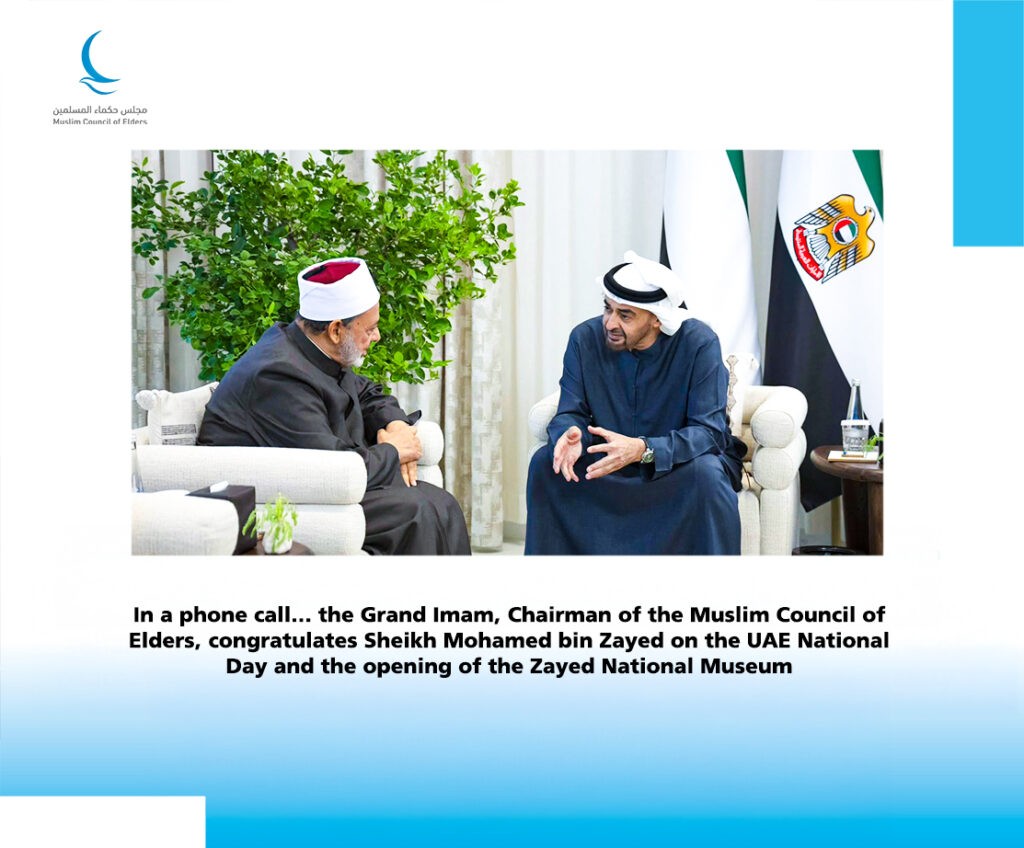
During a Telephone Call – Grand Imam of Al-Azhar and Chairman of the Muslim Council of Elders Congratulates Sheikh Mohamed bin Zayed on the UAE’s 54th National Day and the Opening of the Zayed National Museum

In a telephone call on Thursday, His Eminence Dr. Ahmed Al-Tayeb, Grand Imam of Al-Azhar and Chairman of the Muslim Council of Elders, extended heartfelt congratulations to His Highness Sheikh Mohamed bin Zayed Al Nahyan, President of the United Arab Emirates, on the occasion of the UAE’s 54th National Day, praying to Almighty Allah to perpetuate security, progress, and prosperity upon the nation.

His Eminence also conveyed warm congratulations to the respective Rulers—members of the Supreme Council of the Union—and to the Emirati people on the UAE national occasion. He also praised the UAE’s leadership for advancing its civilizational and humanitarian renaissance in steadfast continuation of the visionary path laid by the nation’s Founding Father, the late Sheikh Zayed bin Sultan Al Nahyan—may Allah rest his soul in eternal peace.

The Grand Imam further lauded the profound significance of the newly inaugurated Zayed National Museum, which opened in conjunction with the National Day celebrations, for immortalizing the founder’s enduring legacy and his exemplary approach to leadership, nation-building, and the cherished values of unity and love upon which the Union of the Emirates was established. He supplicated Almighty Allah to shower Sheikh Zayed with divine mercy in recompense for his monumental contributions.

His Highness Sheikh Mohamed bin Zayed Al Nahyan expressed profound gratitude and appreciation to His Eminence Prof. Dr. Ahmed Al-Tayeb for his sincere sentiments toward the UAE and its people, as well as for his tireless efforts in promoting the values of dialogue, tolerance, peace, and coexistence.

During a Telephone Call – Grand Imam of Al-Azhar and Chairman of the Muslim Council of Elders Congratulates Sheikh Mohamed bin Zayed on the UAE’s 54th National Day and the Opening of the Zayed National Museum Read More »

Muslim Council of Elders to Participate at the Iraq International Book Fair 2025

“Ahlul-Qibla Call” and Strengthening Intra-Islamic Dialogue Take Center Stage

The Muslim Council of Elders is participating at the 6th Iraq International Book Fair, held under the patronage of His Excellency Mohammed Shia al-Sudani, Prime Minister of the Republic of Iraq, from 3 to 13 December 2025 in the capital Baghdad. The pavilion showcases over 250 publications, including scholarly works, books, and treatises addressing key intellectual and cultural topics, correcting misconceptions, promoting enlightened moderate thought, and enhancing intra-Islamic dialogue.

Reflecting the deep affection and immense respect the Iraqi people hold for His Eminence Prof. Dr. Ahmed Al-Tayeb, Grand Imam of Al-Azhar and Chairman of the Muslim Council of Elders, the pavilion features over 20 of his authored works that highlight the tolerance of Islam and the richness of its intellectual and philosophical heritage. Among them are Al-Qawl al-Tayyib, Muqawwimat al-Islam, Ra’y fi Hiwar al-Sharq wa al-Gharb, Al-Awdah ila al-Iman, Kalimah ila al-Shabab and many others.

The pavilion also presents a selection of significant publications, including Love in the Holy Qur’an by Prince Ghazi bin Muhammad, member of the Muslim Council of Elders; The Pope and the Grand Imam: A Thorny Path by Judge Mohamed Abdelsalam; Rules of Understanding and Mutual Comprehension from Thought and Language by Dr. Mustafa Benhamza, member of the Council; and Studies on Similar Structures in the Qur’anic Narratives: Comparison and Analysis by Abdul Ghani Al-Rajihi. In addition, more than 25 new 2025 titles from Al-Hokamaa Publishing are featured, such as Problems of the Ummah’s Division into Sunni and Shi‘a: Roots and Solutions by Dr. Elyas Belka, Managing Conflicts in the Muslim World by Dr. Idriss Qasim, Crafting International Peace: Drawing on Shared Contexts, and International Peace: Shared Values and Institutional Concepts by a group of researchers from the Council’s Center for Peace Research.

As part of the Council’s ongoing efforts to promote intra-Islamic dialogue—and in practical application of the outcomes of the first Intra-Islamic Dialogue Conference held in Bahrain last February, which produced the “Ahlul-Qibla Call” charter aimed at strengthening Muslim unity, reuniting the Ummah, and unifying its ranks—the Council’s pavilion is hosting a series of seminars and lectures featuring prominent thinkers, scholars, and academics. These sessions explore ways to enhance dialogue and understanding among all Islamic sects, the roles of media, women, youth, and the responsibility of scholars in building effective bridges of communication, paving the way for a new era of cooperation and unity across the Ummah’s diverse components.

The pavilion is also organizing a variety of intellectual and cultural events and programs tailored to visitors’ interests and needs, including a dedicated book-sales area and a special children’s corner offering entertaining and educational activities designed specifically for them.

The Muslim Council of Elders’ participation in the Iraq International Book Fair aligns with its mission to promote peace, entrench values of dialogue and tolerance, and build bridges of communication and human coexistence. The Council’s pavilion is located at the Baghdad International Fairground, Pavilion 16 – H6.

Muslim Council of Elders to Participate at the Iraq International Book Fair 2025 Read More »

Grand Imam of Al-Azhar and Chairman of the Muslim Council of Elders Extends Warmest Congratulations to Sheikh Mohamed bin Zayed and the Emirati People on the 54th National Day

His Eminence Dr. Ahmed Al-Tayeb, the Grand Imam of Al-Azhar and Chairman of the Muslim Council of Elders, extends his heartfelt congratulations to His Highness Sheikh Mohamed bin Zayed Al Nahyan, President of the United Arab Emirates, to his brothers the Rulers and Sheikhs of the Emirates, and to the Emirati people on the occasion of the 54th UAE National Day.

His Eminence affirms that this day—the anniversary of the UAE’s union—serves as a powerful reminder of the spirit of unity and solidarity upon which the United Arab Emirates was founded, guided by the wise vision of the late Sheikh Zayed bin Sultan Al Nahyan. He further commends the extraordinary achievements and comprehensive renaissance the UAE has realized for its people, alongside its outstanding global efforts to entrench the values of human fraternity and tolerance.

He prays to Almighty Allah to bless security, peace, progress, and prosperity upon the United Arab Emirates and upon the entire Arab and Islamic worlds.

Grand Imam of Al-Azhar and Chairman of the Muslim Council of Elders Extends Warmest Congratulations to Sheikh Mohamed bin Zayed and the Emirati People on the 54th National Day Read More »

On the International Day of Solidarity with the Palestinian People – Muslim Council of Elders Calls on the International Community to Take Decisive Steps to End the Suffering of the Palestinian People and Affirm Their Legitimate Rights

The Muslim Council of Elders, under the chairmanship of His Eminence Dr. Ahmed Al-Tayeb, Grand Imam of Al-Azhar, renews its unquestioned solidarity with the Palestinian people, who have endured suffering for over seven decades. It calls on the international community to take urgent and decisive steps to support the inalienable rights of the Palestinian people and affirm their legitimate right to establish an independent state with Jerusalem as its capital.

In a statement on the occasion of the International Day of Solidarity with the Palestinian People, observed annually on November 29, the Muslim Council of Elders declared that the Palestinian cause will remain a just and central issue in the Arab, Islamic, and human conscience. It emphasized the importance of mobilizing and strengthening regional and international efforts to revive a path toward just and comprehensive peace that ends the ongoing suffering of the Palestinian people and establishes a future of justice, coexistence, and stability in the region and the world.

The Muslim Council of Elders stresses the necessity for the international community to shoulder its moral, humanitarian, and legal responsibilities toward the Palestinian people in the Gaza Strip, the West Bank, and Jerusalem. This includes working to halt all violations against innocent civilians, completing the phases of a ceasefire in the Gaza Strip, ensuring the delivery of humanitarian and relief aid to those affected by the aggression, and expediting the implementation of reconstruction plans.

The Muslim Council of Elders also affirms that solidarity with the oppressed Palestinian people and support for their legitimate rights represents a religious, moral, and humanitarian duty. It commends all relief initiatives aimed at upholding the rights of the Palestinian people and alleviating their humanitarian suffering, as well as all efforts to enhance global awareness of the Palestinian cause and entrench values of dialogue, peace, and human coexistence.

On the International Day of Solidarity with the Palestinian People – Muslim Council of Elders Calls on the International Community to Take Decisive Steps to End the Suffering of the Palestinian People and Affirm Their Legitimate Rights Read More »

Grand Imam of Al-Azhar and Chairman of the Muslim Council of Elders Receives the European Union Special Representative for Human Rights to Discuss Strengthening Mutual Cooperation

His Eminence Dr. Ahmed Al-Tayeb, Grand Imam of Al-Azhar has received Kaisa Ollongren, the European Union Special Representative for Human Rights, to explore avenues for enhancing mutual cooperation.

The Grand Imam stated, “We are among those who believe that a significant portion of human rights has been agreed upon between East and West, and it is incumbent upon all to cultivate it as the foundational elements of human rights. Yet, certain matters remain that the West regards as rights, but which, for us in the East, are not, as they contradict sound innate disposition and clash with religious and moral values—the primary constituents and approved reference for Eastern peoples.”

He emphasized that human dignity is not a bestowed privilege but an inherent right that must remain inviolable, while underscoring the Eastern peoples’ rejection of attempts to impose the Western human rights framework on Eastern individuals under the guise of freedoms. He stressed the need for the West to recognize that these issues are intricately tied to the Eastern individual’s personality, identity, history, civilization, and, foremost, to the system of values and religious teachings.

For her part, Kaisa Ollongren, the European Union Special Representative for Human Rights, expressed her appreciation for the Grand Imam’s tangible efforts in promoting peace, fraternity, acceptance of others, and equality among all. She expressed her awareness of Al-Azhar’s stature and the vital role it plays in safeguarding human rights and dignity worldwide.

She also affirmed readiness towards enhancingcooperation, stemming from the belief in the role of religious institutions and the shared vision while being acutely aware of the necessity to align human rights with religious, moral, and societal values. She further noted Al-Azhar’s stature and the important, vital role it plays in protecting human rights and dignity globally.

Grand Imam of Al-Azhar and Chairman of the Muslim Council of Elders Receives the European Union Special Representative for Human Rights to Discuss Strengthening Mutual Cooperation Read More »

Muslim Council of Elders Commends the UAE’s Initiative to Provide 10 Million Meals in Solidarity with People in Gaza

The Muslim Council of Elders, under the chairmanship of His Eminence Dr. Ahmed Al-Tayeb, Grand Imam of Al-Azhar, extends its profound admiration to the United Arab Emirates for its compassionate endeavor to prepare 10 million meals in support of the people in Gaza—a gesture poised to significantly alleviate the humanitarian anguish endured by civilians amid the unrelenting aggression.

The Council affirms that this exemplary humanitarian undertaking in collaboration with the “Gallant Knight 3” campaign, exemplifies the UAE’s visionary leadership in extending aid to those in distress. It also embodies an enduring legacy of chivalry in succoring the oppressed and the afflicted, reflecting an unwavering ethical and humanitarian resolve toward the resilient Palestinian people of Gaza.

The Muslim Council of Elders urges all—individuals and institutions alike—to join this vital campaign, which resonates deeply with the timeless principles enshrined in the Document on Human Fraternity, which was co-signed by His Eminence Dr. Ahmed Al-Tayeb and the late Pope Francis: values that champion solidarity with the vulnerable and unwavering support for those in need.

Furthermore, the Council lauds continued Arab and international endeavors to mitigate the profound suffering in Gaza, underscoring the imperative of sustaining such noble efforts and delivering urgent humanitarian assistance to ease the plight of the Palestinian people.

Muslim Council of Elders Commends the UAE’s Initiative to Provide 10 Million Meals in Solidarity with People in Gaza Read More »

On the International Day for the Elimination of Violence against Women – Muslim Council of Elders Calls for Heightened Awareness of Women’s Rights and Comprehensive Protection from Violence

The Muslim Council of Elders, under the chairmanship of His Eminence Dr. Ahmed Al-Tayeb, Grand Imam of Al-Azhar, affirms that protecting women from every form of violence—physical, psychological, verbal, and digital—is a sacred religious, moral, and humanitarian imperative. The Council emphasizes the urgent need to raise global awareness of women’s rights and eradicate all gender-based violence, thereby strengthening social peace, reinforcing family stability, and upholding the noble values of mercy and justice.

In a statement marking the International Day for the Elimination of Violence against Women, observed annually on 25 November, the Council declared that the tolerant teachings of Islam have always honored women as mothers, sisters, daughters, and wives, safeguarding their dignity, elevating their status, and making respect for their rights a shared responsibility. It stressed the critical importance of providing special protection for women and girls in conflict zones and war-torn regions, as well as disaster-stricken areas, where the risks of violence, exploitation, and assault are dramatically heightened.

The statement further highlighted that the historic Document on Human Fraternity, co-signed in Abu Dhabi in 2019 by His Eminence Dr. Ahmed Al-Tayeb and the late Pope Francis, unequivocally affirms the protection of women, rejects all forms of violence and discrimination against them, condemns practices that degrade their dignity, guarantees their full rights, and opposes the imposition of cultural practices that conflict with their faith, values, culture, or ethics.

Through its programs, initiatives, and international dialogue platforms, the Muslim Council of Elders places paramount importance on advancing the empowerment of women, seeking to entrench the values of human fraternity and peaceful coexistence while cultivating a global culture of compassion, cooperation, and mutual respect. The Council also renews its urgent call for unified religious, intellectual, and institutional efforts to create a world free from violence against women—a world governed by justice, dignity, and equity for every member of society.

On the International Day for the Elimination of Violence against Women – Muslim Council of Elders Calls for Heightened Awareness of Women’s Rights and Comprehensive Protection from Violence Read More »

Grand Imam of Al-Azhar and Chairman of the Muslim Council of Elders Receives Professor Volker Kauder of the Free Theological University of Giessen

His Eminence Dr. Ahmed Al-Tayeb, the Grand Imam of Al-Azhar and Chairman of the Muslim Council of Elders, received Dr. Volker Kauder, Professor of Ethics, Politics, and Religious Freedom at the Free Theological University of Giessen, Germany, to discuss strengthening interfaith dialogue and consolidating the values of human fraternity.

During the meeting, His Eminence emphasized that the Document on Human Fraternity was written first and foremost in the voice of humanity before it was written in the voice of religions. He highlighted the openness of Al-Azhar and the Muslim Council of Elders to religious institutions worldwide in order to establish a just peace that preserves human dignity.

For his part, Professor Kauder praised the tireless efforts of His Eminence in promoting tolerance and positive coexistence and entrenching the values of global peace.

Grand Imam of Al-Azhar and Chairman of the Muslim Council of Elders Receives Professor Volker Kauder of the Free Theological University of Giessen Read More »

Muslim Council of Elders Congratulates Egypt’s Dar al-Iftaa on the 130th Anniversary of Its Establishment

The Muslim Council of Elders, under the chairmanship of His Eminence Prof. Dr. Ahmed Al-Tayeb, the Grand Imam of Al-Azhar, extends congratulations to Egypt’s Dar al-Iftaa on the occasion of its 130th anniversary. Dar al-Iftaa remains one of the most venerable religious institutions in the Islamic world, having played a pivotal role for over a century in consolidating Al-Azhar’s enlightened, moderate methodology and enhancing societal awareness through responsible and principled fatwa issuance.

The Council commends Dar al-Iftaa’s pioneering contributions to the disciplined practice of iftāʾ, the promotion of moderate Islamic thought, the reinforcement of social stability, and the entrenchment of values of compassion and coexistence. It also affirms that Dar al-Iftaa stands as an outstanding model of rigorous, institutional religious scholarship both within Egypt and across the Muslim world.

Muslim Council of Elders Congratulates Egypt’s Dar al-Iftaa on the 130th Anniversary of Its Establishment Read More »

Muslim Council of Elders Participates in International Panel Discussion on Artificial Intelligence and Cultural Diversity in Kazakhstan

The Muslim Council of Elders took part in a panel discussion titled “Artificial Intelligence and Cultural Diversity: In Search of Universal Ethics”, held virtually and organized by the International Center for Interreligious Dialogue in Kazakhstan in partnership with the Baku International Center for Intercultural Dialogue. The session brought together prominent religious and intellectual leaders as well as AI experts from leading global universities.

During the discussion, Mohamed Al-Amin, Director-General of the Muslim Council of Elders’ Regional Office in Central Asia, emphasized that artificial intelligence is no longer merely a technological advancement but has become a profound ethical and human test. Societies and decision-makers must ensure that technology is harnessed to serve human dignity, foster mutual understanding, and promote peace among peoples. He noted that AI has the potential to address major humanitarian challenges—such as eradicating poverty, combating diseases, and enhancing cross-cultural communication—yet the absence of ethical frameworks could turn it into a source of inequality and social risk.

He highlighted the Council’s strong focus on technology and ethics, citing the regional workshop it organized in Central Asia in collaboration with L.N. Gumilyov Eurasian National University and the Kazakh Senate, titled “Artificial Intelligence and Ethics – A Sustainable Future” in Astana. The workshop concluded that AI is as much an ethical revolution as a technological one and requires international cooperation to ensure its responsible and equitable use.

Al-Amin also announced upcoming events organized by the Council’s Regional Office in Turkistan and Almaty during November and December, focusing on media and peace journalism in the age of artificial intelligence, with the aim of raising societal awareness and promoting the use of AI technologies to support civil peace and intercultural communication.

The session saw broad participation from government officials, representatives of diverse religious institutions, and AI experts from global universities. Speakers explored mechanisms for ensuring the ethical responsibility of intelligent systems, the role of religious and cultural traditions in enriching AI ethics frameworks, and the importance of developing legal and policy frameworks that promote the responsible use of modern technologies.

The discussion concluded with a strong call to formulate universal ethics for artificial intelligence drawn from shared human values, reflecting cultural diversity while safeguarding justice and human dignity in the digital age.

Muslim Council of Elders Participates in International Panel Discussion on Artificial Intelligence and Cultural Diversity in Kazakhstan Read More »