خبریں

During a seminar at the International Book Fair in Rabat, the Secretary-General of the Islamic Research Academy at Al-Azhar: The Search for Understanding and Comprehension is an Inevitable Necessity and a Religious Duty

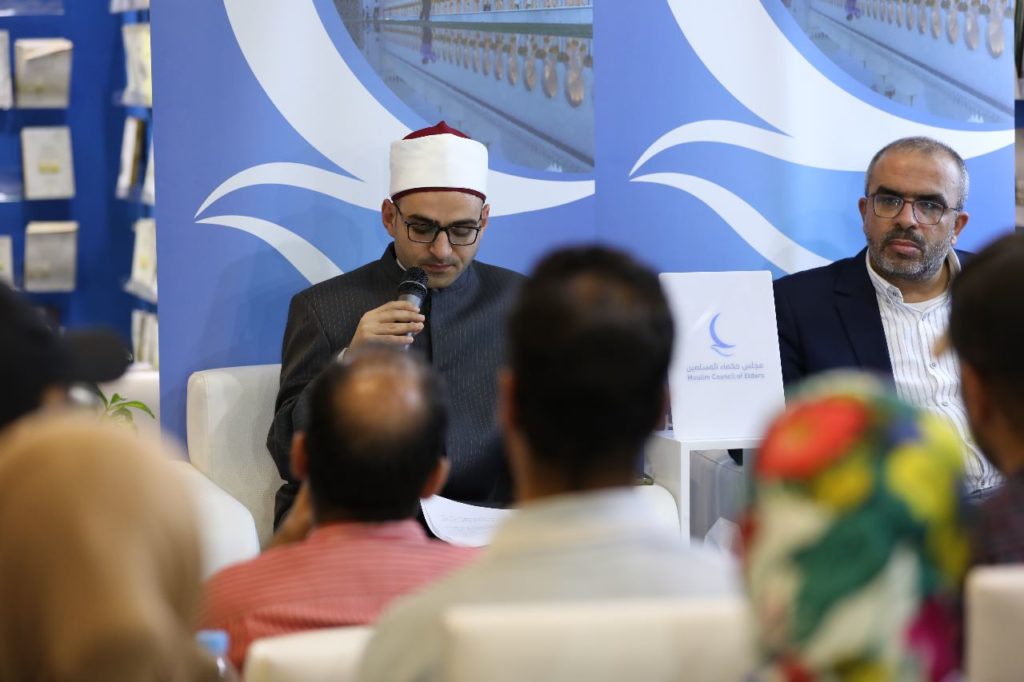
The Muslim Council of Elders organized a seminar titled ‘Principles of Understanding and Comprehension from Thought and Language’ in the Al-Oudaya Hall at the International Publishing and Book Fair in Rabat. The seminar was presented by Dr. Nazir Ayad, Secretary-General of the Islamic Research Academy at Al-Azhar.

Dr. Samir Boudinar, the Executive Director of the Al-Hokama Center for Peace and Research, opened the seminar by referring to the book “Understanding and Comprehension from Thought and Language” by His Eminence Dr. Mustapha Benhamza, member of the Muslim Council of Elders, President of the Ulema Council of Oujda, and President of the Regional Scientific Council in the Oriental Region.

For his part, Dr. Nazir Ayad addressed important issues related to the reality of Muslims and the proper understanding of Islam, as well as attempts to achieve communication and understanding in the Muslim world. He explained that there are many challenges of the modern era that affect the proper understanding of Islam, such as rapid changes in society, multiple ideologies, and conflicting theories. He emphasized that in light of these challenges, the search for understanding and comprehension becomes an inevitable necessity and a religious duty.

Dr. Ayad highlighted the importance of language in achieving proper understanding, pointing that the misuse of language can hinder communication and lead to misunderstandings. He called for the preservation of the Arabic language, which is the language of the Quran, and its development to align with modern advancements. He emphasized the issue of ijtihad (independent reasoning) in Islam, stating that it is the essence of religion, and proper interpretation of Sharia requires familiarity with the Arabic language and its arts. He called for the necessity of flexibility that interacts with the nature of Sharia and the changes of the era.

The Secretary-General of the Islamic Research Academy emphasized that Almighty Allah has bestowed in religion what enables Muslims to achieve righteousness in this world and the hereafter. He pointed out that selective readings have led to a misunderstanding of religious texts and that language goes beyond the role of expression to become a complex structure of analyses, words, and expressions, necessitating familiarity with all these aspects to overcome their misuse, while avoiding the dominance of emotion and readings based on personal inclinations, which do not align with the nature of understanding.

In conclusion, Dr. Nazir Ayad praised the scientific and research efforts of His Eminence Dr. Mustapha Benhamza, stating that proper understanding can only be achieved by adhering to the principles, with the necessity of distinguishing between the absolute and the limited in this regard. He explained that diversity is a universal reality that allows for exploration, development, and adaptation of life.

The seminar witnessed a significant attendance by visitors of the International Publishing and Book Fair who were eager to listen to the seminar and participate through various questions and diverse interventions. The event concluded with a book signing ceremony.

The Muslim Council of Elders’ stand at the International Publishing and Book Fair in Rabat is set to host several seminars and activities aimed at rectifying misconceptions, promoting dialogue and tolerance, and building bridges of communication and coexistence. These efforts align with the Council’s message, under the Chairmanship of His Eminence Dr. Ahmed Al-Tayeb, the Grand Imam of Al-Azhar, which aims to enhance peace in Muslim and non-Muslim societies.

During a seminar at the International Book Fair in Rabat, the Secretary-General of the Islamic Research Academy at Al-Azhar: The Search for Understanding and Comprehension is an Inevitable Necessity and a Religious Duty Read More »

Seminar at the Muslim Council of Elders’ stand at the 2023 International Publishing and Book Fair in Rabat calls on young people to spread the values of the Document on Human Fraternity

The Muslim Council of Elders’ stand at the International Publishing and Book Fair in the Moroccan capital Rabat has held a seminar titled ‘’Religious Pluralism, Identities, and the Paths to Peace’ by Dr. Said Kafaiti, Professor at the Faculty of Arts and Humanities at Sidi Mohamed Ben Abdellah University in Fez and Dr. Karima Norah Al-Issaoui, Professor of the History of Religions and Dialogue of Civilizations at the Faculty of Theology at Abdelmalek Essaadi University in Tetouan.  

At the seminar’s beginning, Dr. Karima Norah Al-Issaoui discussed the history of the relationship between Islam and the West. She pointed out that this relationship has not always been good, as misunderstandings and religious conflicts have prevailed over the past centuries. She also highlighted the presence of misconceptions and negative attitudes towards Islam in the West, which affect the integration of Muslims in those countries and increase identity tensions. She also called for promoting mutual dialogue and cultural understanding between different cultures and working towards overcoming religious differences and focusing on common values.

For his part, Dr. Said Kafaiti shed light on important data regarding religious pluralism and identities in European countries. He pointed out that the challenges related to pluralism are not limited to the increase in the number of immigrants and refugees, but also involve unprecedented religious and cultural diversity in those countries in recent decades.

Professor Kafaiti also emphasized the importance of the Document on Human Fraternity which was co-signed by His Eminence Dr. Ahmed El-Tayeb, the Grand Imam of Al-Azhar and Chairman of the Muslim Council of Elders, and His Holiness Pope Francis, Pontiff of the Catholic Church, in Abu Dhabi in 2019. He explained that the document promotes the language of dialogue among followers of religions and contributes to enhancing tolerance and peaceful coexistence.

Dr. Kafaiti called on youth and new media outlets to widely disseminate the principles of the document to combat misunderstandings of religious texts and electronic fatwas that reflect misconceptions, impede dialogue, and reject differences. He stressed the need to include a definition of religions and enhance the values of dialogue and tolerance in educational curricula, with a focus on religious and human commonalities.

In conclusion, the interventions and discussions raised important issues about religious and identity pluralism in the West. The participants emphasized the necessity of working towards enhancing communication and mutual understanding between cultures and religions, and building bridges of dialogue and cooperation to achieve peaceful coexistence in diverse societies.

The Muslim Council of Elders’ stand at the International Publishing and Book Fair in Rabat is set to host several seminars and activities aimed at rectifying misconceptions, promoting dialogue and tolerance, and building bridges of communication and coexistence. These efforts align with the Council’s message, under the Chairmanship of His Eminence Dr. Ahmed Al-Tayeb, the Grand Imam of Al-Azhar, which aims to enhance peace in Muslim and non-Muslim societies.

Seminar at the Muslim Council of Elders’ stand at the 2023 International Publishing and Book Fair in Rabat calls on young people to spread the values of the Document on Human Fraternity Read More »

Eurasian National University in Kazakhstan awards honorary professorship to the Secretary-General of the Muslim Council of Elders

The Secretary-General of the Muslim Council of Elders, Judge Mohamed Abdelsalam, was awarded an honorary professorship by the Eurasian National University in the Republic of Kazakhstan, in recognition of his efforts in promoting and enhancing the values of dialogue, tolerance, fraternity and coexistence. The university held a special ceremony in the presence of Dr. Yerlan Sydykov, the Chancellor of the Eurasian National University, along with several professors and students. 

At the beginning of the ceremony, Dr. Yerlan Sydykov expressed the university’s appreciation to Judge Mohamed Abdelsalam, the Secretary-General of the Muslim Council of Elders, and to the message of the Council, led by His Eminence Dr. Ahmed Al-Tayeb, the Grand Imam of Al-Azhar, for their efforts in promoting and strengthening peace in Muslim and non-Muslim societies, as well as disseminating the values of dialogue, tolerance, and acceptance of others.

In his speech, Judge Mohamed Abdelsalam said, “I have come to you from the United Arab Emirates, a nation that has managed to export tolerance and human fraternity to the entire world, whilst becoming a role model for promoting the values of dialogue, coexistence, and human fraternity.” 

He also expressed his immense joy to be present in Kazakhstan, a country known for its rich civilization, diversity, progress, and development in various fields. He praised Kazakhstan’s efforts in promoting dialogue and coexistence among followers of different religions and cultures.

The Secretary-General of the Muslim Council of Elders further praised the Republic of Kazakhstan for promoting dialogue and coexistence among followers of different religions and cultures, exemplified by its organization of the World and Traditional Religious Leaders Conference. The seventh edition of the summit took place last year and was attended by His Eminence Dr. Ahmed Al-Tayeb, the Grand Imam of Al-Azhar and Chairman of the Muslim Council of Elders, as well as His Holiness Pope Francis, Pontiff of the Catholic Church, along with various leaders and representatives of global and traditional religions from around the world. This unique event, hosted by Kazakhstan every three years, reflects the nation’s belief in the significant role of religious leaders in promoting and enhancing the values of dialogue, coexistence, and peace.

Judge Abdelsalam dedicated his honor to Al-Azhar, the fortress of knowledge and scholars, where he learned and grew up embracing moderation, diversity, pluralism, and accepting others. He also dedicated it to his mentor, the Grand Imam, His Eminence Dr. Ahmed Al-Tayeb, Chairman of the Muslim Council of Elders, who instilled in him the love of goodness and the promotion of dialogue, coexistence, and helped him down the path of peace and human fraternity.

During a meeting with the university’s students, the Secretary-General emphasized that dialogue is the only means through which visions and ideas can be exchanged. He stressed the importance of comprehensive dialogue in managing human relationships at all levels, from the most personal to international relations between nations and communities. He pointed out that diversity is a characteristic of the universe and a law of human society, and its impact lies not only in preserving the balance of human civilization with its diverse components but also in enriching and highlighting its strongest and most beautiful aspects, contributing to human advancement and well-being.

Judge Abdelsalam further highlighted that in today’s world, with its diverse civilizations and identities, the paths of communication between societies and the dialogue among cultures and nations cannot achieve their goals without a strong presence of universities with their visions, projects, and students with knowledge, questioning, dialogue, and creativity. They are the repository of our aspirations for the future and the questions that should be posed and discussed in order to find answers that make our world a better place.

The Secretary-General clarified that the Muslim Council of Elders works to derive wisdom in all societies as a source of independent and purposeful will for those societies. He emphasized its crucial role in managing diversity through the roles of the council’s members, who all strive to address common global challenges. These challenges can only be overcome by choosing constructive convergence within diversity or by avoiding fragmentation that threaten not only constructive diversity but also our shared human existence.

In conclusion, Abdelsalam also addressed a message to the participating youth, emphasizing the importance of embracing hope and perseverance in pursuing the path of knowledge with determination and confidence in human capabilities to face challenges. He highlighted the abilities and capacities that Allah bestowed upon humans, along with the guidance and enlightenment, as the most valuable asset and the most precious trust that we bear for the sake of a better future.

The Eurasian National University is one of the most important universities in Kazakhstan and the largest educational institution in Astana. The university has previously honored several influential figures for promoting peace and coexistence, including His Eminence Dr. Ahmed Al-Tayeb, the Grand Imam of Al-Azhar, who was awarded an honorary doctorate in 2018.

Eurasian National University in Kazakhstan awards honorary professorship to the Secretary-General of the Muslim Council of Elders Read More »

Secretary-General of the Muslim Council of Elders meets Chairman of the Nazarbayev Centre for Inter-Civilizational Dialogue in Kazakhstan and discusses ways to enhance mutual cooperation

The Secretary-General of the Muslim Council of Elders, Judge Mohamed Abdelsalam, has met the Chairman of the Nazarbayev Centre for the Development of Interfaith and Intercivilizational Dialogue, Mr. Bulat Sarsenbayev, with the aim of enhancing cooperation in the field of interfaith and intercultural dialogue and its role in addressing global challenges, including climate change.

During the meeting, the Secretary-General expressed his appreciation for the efforts of the Nazarbayev Centre for the Development of Interfaith and Intercivilizational Dialogue in promoting dialogue, particularly the efforts that followed the recent meeting of the World and Traditional Religious Leaders Conference. He emphasized that Kazakhstan plays an important role in promoting a culture of dialogue and convergence while shedding light on the important role that religious leaders and relevant institutions can play in raising awareness about climate change. This is particularly relevant in light of the international challenges and the UAE’s upcoming hosting of COP28 confernece at the end of this year.

For his part, the Chairman of the Nazarbayev Centre for the Development of Interfaith and Intercivilizational Dialogue praised the efforts of the Muslim Council of Elders under the chairmanship of His Eminence Dr. Ahmed Al-Tayeb, the Grand Imam of Al-Azhar, in seeking to unify the efforts of religious leaders in addressing global challenges, including climate issues, promoting peace, and spreading the values of dialogue, tolerance, and coexistence. Sarsenbayev also praised the Abu Dhabi Document on Human Fraternity which was signed in 2019 by His Eminence Dr. Ahmed Al-Tayeb, the Grand Imam of Al-Azhar and Chairman of the Muslim Council of Elders alongside His Holiness Pope Francis, Pontiff of the Catholic Church under the patronage of His Highness Sheikh Mohamed bin Zayed Al Nahyan, President of the United Arab Emirates, for the noble values it represents in terms of promoting dialogue and coexistence. 

At the end of the meeting, both parties agreed to enhance their cooperation through various efforts and initiatives that contribute to correcting misconceptions, supporting the values of coexistence, and benefiting from interfaith dialogue efforts in formulating an effective vision for the role of religions in addressing climate change. This would be based on the Memorandum of Cooperation signed between the Muslim Council of Elders and the Nazarbayev Centre for the Development of Interfaith and Intercivilizational Dialogue in November of last year.

Secretary-General of the Muslim Council of Elders meets Chairman of the Nazarbayev Centre for Inter-Civilizational Dialogue in Kazakhstan and discusses ways to enhance mutual cooperation Read More »

Seminar at the Muslim Council of Elders’ stand at the 2023 International Publishing and Book Fair in Rabat praises role of the Council in seeking to achieve peace in Africa

The Muslim Council of Elders’ stand at the International Publishing and Book Fair in the Moroccan capital Rabat has held a seminar titled ‘Efforts of Conflict Resolution Groups in Africa’ by Dr. Adel Mousawi, Professor of International Relations at Mohammed V University in Rabat.  

Dr. Samir Boudinar, the Executive Director of the Al-Hokama Center for Peace and Research opened the seminar by emphasizing the importance that the Muslim Council of Elders, under the Chairmanship of His Eminence Dr. Ahmed Al-Tayeb, the Grand Imam of Al-Azhar, places on conflict resolution and peace promotion, particularly in the African continent.

Dr. Adel Mousawi, for his part, expressed his appreciation for the efforts of the Muslim Council of Elders in seeking to resolve conflicts in Africa. He highlighted that the Council has successfully mediated several disputes on the continent, contributing significantly to achieving internal peace and reconciliation among conflicting parties. He also noted the council’s efforts in promoting values of coexistence, intercultural and interreligious dialogue within the framework of civil peace, and their dedicated work towards enhancing stability and development in Africa.

Mousawi further elaborated on the concept of factions in African nationalist political thought. He discussed various pillars, including the sense of African identity and the rejection of foreign interference, that underpin the concept of factions. He pointed out that while the concept of factions is necessary, it is insufficient to prove African uniqueness. He raised an important question about the availability of the necessary willpower to achieve integration and unity in the African continent.

As a professor of international relations and international law at Mohammed V University in Rabat, Dr. Adel Mousawi emphasized the importance of continued communication and cooperation between the international community and the Muslim Council of Elders in strengthening peace and stability efforts in Africa. He emphasized that African solutions should be based on consultation and cooperation among African nations, including utilizing the expertise and knowledge possessed by the Muslim Council of Elders.

Dr. Mousawi concluded by affirming that regional cooperation and solidarity are the keys to success in achieving peace and stability in Africa. He called for the continued joint efforts to confront challenges and build a prosperous future for the African continent.

The Muslim Council of Elders’ stand at the International Publishing and Book Fair in Rabat is set to host several seminars and activities aimed at rectifying misconceptions, promoting dialogue and tolerance, and building bridges of communication and coexistence. These efforts align with the Council’s message, under the Chairmanship of His Eminence Dr. Ahmed Al-Tayeb, the Grand Imam of Al-Azhar, which aims to enhance peace in Muslim and non-Muslim societies.

Seminar at the Muslim Council of Elders’ stand at the 2023 International Publishing and Book Fair in Rabat praises role of the Council in seeking to achieve peace in Africa Read More »

Secretary-General of the Muslim Council of Elders participates in the Astana International Forum ‘Tackling Challenges through Dialogue: Towards Cooperation, Prosperity, and Progress’

Secretary-General of the Muslim Council of Elders: Diversity is a divine approach that calls on us to be open towards others and unify our efforts in confronting global challenges

The Secretary-General of the Muslim Council of Elders, Judge Mohamed Abdelsalam, participated in the Astana International Forum held in the Kazakh capital, Astana, on Thursday. The forum carried the mission statement ‘Tackling Challenges through Dialogue: Towards Cooperation, Prosperity and Progress’ and brought together over 1,000 participants from 70 countries, including leaders, heads of state, government officials, international organization directors, and representatives. The event consists of over 40 panel discussions and activities covering topics related to peace promotion, diversity, the global order, climate challenges, and more.

In his speech during the panel discussion titled ‘Coming Together or Moving Apart: The Future of Multilateralism’ the Secretary-General emphasized that humanity faces two options: either convergence or fragmentation while stressing the importance of managing diversity, establishing its values, building awareness within societies, and developing institutional and legal mechanisms. Alternatively, Abdelsalam added that if we move towards further fragmentation, we should be prepared for the high cost of division, conflict, and the tragic consequences it entails.

Judge Abdelsalam highlighted that diversity, in its various manifestations—religious, cultural, and social—represents human diversity in origin and cultural components. and that it also reflects divine wisdom. Abdelsalam also posed questions, such as how can humans, as creations, allow themselves to hate others contrary to the Creator’s will? How can human will diverge from what God’s wisdom and human nature necessitate?

The Secretary-General also emphasized that our responsibility to establish a serious and constructive dialogue about the future of diversity and its options requires us to be open to diverse social and cultural experiences within our world. He urged the need to examine paths of diversity in our era as expressions of these experiences with the goal of establishing a positive relationship between Islam and the Western world, especially Europe, in strategic fields of identity, culture, and society. He also affirmed the importance of achieving positive integration and confronting all forms of bigotry, hatred, and Islamophobia.

Judge Abdelsalam stated that the Muslim Council of Elders, under the chairmanship of His Eminence Dr. Ahmed Al-Tayeb, the Grand Imam of Al-Azhar is making concerted efforts to promote the values of peace, coexistence, and respect for others. He mentioned that the historic Abu Dhabi Document on Human Fraternity has laid down several guidelines, principles, and foundations governing coexistence among all people, despite their differences and diversity. Additionally, the friendship between the Grand Imam and Pope Francis, the Pontiff of the Catholic Church, has established an inspiring model for the relationship between religious leaders and paved the way for a constructive dialogue that focuses on human commonalities.

The Secretary-General expressed his gratitude to the government of Kazakhstan for organizing the Astana International Forum and for turning it into a global project for generating ideas to address urgent global problems and advancing dialogue among international actors with different specialties, perspectives, interests, and orientations.

The Astana International Forum was attended by figures from 70 countries, including leaders, heads of state, government officials, and directors of international organizations. Among them were President Kassym-Jomart Tokayev of Kazakhstan, His Highness Sheikh Tamim bin Hamad Al Thani, the Emir of Qatar, President Sadyr Japarov of Kyrgyzstan, and various other leaders, heads of state, and officials from around the world.

Secretary-General of the Muslim Council of Elders participates in the Astana International Forum ‘Tackling Challenges through Dialogue: Towards Cooperation, Prosperity, and Progress’ Read More »

Muslim Council of Elders strongly condemns stabbing attack in the French city of Annecy

Muslim Council of Elders strongly condemns stabbing attack in the French city of Annecy

Under the Chairmanship of His Eminence Dr. Ahmed Al-Tayeb, the Grand Imam of Al-Azhar, the Muslim Council of Elders strongly condemns the stabbing attack that targeted several individuals, including children, in a park in the city of Annecy in the French Alps, resulting in a number of injuries.

The Muslim Council of Elders affirms its absolute rejection of such criminal acts that contradict all divine and international laws as well as basic human values. May Almighty Allah afford the injured a swift recovery.

Muslim Council of Elders strongly condemns stabbing attack in the French city of Annecy Read More »

Seminar at the Muslim Council of Elders’ stand at the 2023 International Publishing and Book Fair in Rabat sheds light on pluralism, and coexistence within ‘Dawn of Andalusia’

As part of the activities of the International Publishing and Book Fair in the Moroccan capital Rabat, the Muslim Council of Elders organized a seminar titled ‘A Reading of the Book ‘Dawn of Andalusia’ by Dr. Hassan Oureid, Professor of Political Science at Mohammed V University in Rabat.

At the beginning of the seminar, Dr. Samir Boudinar, the Executive Director of the Al-Hokama Center for Peace and Research introduced the seminar while pointing out that the book ‘Dawn of Andalusia’ serves as a model and reference for managing diversity and coexistence within societies.

Meanwhile, Dr. Hassan Oureid expressed his gratitude to the Muslim Council of Elders, under the Chairmanship of His Eminence Dr. Ahmed Al-Tayeb, the Grand Imam of Al-Azhar, for their great efforts in promoting the values of coexistence among people.

The Moroccan scholar also praised the importance of the book ‘Dawn of Andalusia’ for its widespread dissemination and impact on society. He discussed his journey in search of the book and the challenges he faced before meeting the late Moroccan scholar and thinker, Mohammed Ben Cherifa, who gave him the only available copy of the book. He noted that he discovered that ‘Dawn of Andalusia’ was one of the books that did not receive sufficient attention in Arabic Andalusian studies.

Dr. Oureid also discussed the book’s author, Hussein Moenis, who held the position of Professor of Literature at Cairo University in the 1950s. He highlighted Moenis’ pioneering proposal to establish an Institute for Andalusian Studies in Madrid, which was accepted by the late Minister of Education, Taha Hussein. He further explained, “Dr. Moenis spent ten years as the director of this institute and made frequent visits to Morocco, which he considered an extension of Andalusia.”

Dr. Oureid emphasized that ‘Dawn of Andalusia’ is a book about Andalusia in the Arabic language which covers a time period from the Islamic conquest to the establishment of the first emirate by Abd al-Rahman al-Dakhil. It also sheds light on the components of Andalusia and its various tribes associated with the Arabic language.

He pointed out that Arabs were not the dominant element in Andalusia, which was home to many other tribes and nationalities. He explained that the writer, Hussein Moenis, reviewed each tribe and the homogeneity and coexistence that resulted from it, emphasizing that Muslims relied on Sharia as a reference for administrative affairs in that era and built laws based on interests. He also highlighted the important relationship between the Maliki school of thought and Roman law, emphasizing that a researcher in Andalusian studies cannot succeed in their study without reading this book due to its enjoyable and simple language.

The seminar was attended by a large audience, and there was intense interaction from the visitors of the exhibition, who also sought to explore the publications of the Muslim Council of Elders exhibited at the International Publishing and Book Fair. 

The Muslim Council of Elders’ stand at the International Publishing and Book Fair in Rabat is set to host several seminars and activities aimed at rectifying misconceptions, promoting dialogue and tolerance, and building bridges of communication and coexistence. These efforts align with the Council’s message, under the Chairmanship of His Eminence Dr. Ahmed Al-Tayeb, the Grand Imam of Al-Azhar, which aims to enhance peace in Muslim and non-Muslim societies.

Seminar at the Muslim Council of Elders’ stand at the 2023 International Publishing and Book Fair in Rabat sheds light on pluralism, and coexistence within ‘Dawn of Andalusia’ Read More »

Seminar at the Muslim Council of Elders’ stand at the 2023 International Publishing and Book Fair in Rabat praises role of the Council in maintaining and developing Islamic heritage

The Muslim Council of Elders’ stand at the International Publishing and Book Fair in the Moroccan capital Rabat has held a seminar titled ‘The Role of the Muslim Council of Elders in Serving and Disseminating Islamic Heritage’ by Dr. Mohammed Jamal, researcher at the Heritage Revival Office of Al-Azhar.  

Dr. Samir Boudinar, the Executive Director of the Al-Hokama Center for Peace and Research opened the seminar by shedding light on the efforts of the Muslim Council of Elders in promoting peace, dialogue, and communication. He emphasized that Islamic heritage is an endless source of knowledge and an important reservoir of culture and wisdom.

Dr. Mohammed Jamal, a researcher at the Heritage Revival Office of Al-Azhar, expressed his heartfelt gratitude to the Muslim Council of Elders for organizing such great gatherings at international exhibitions. He considered the issue of heritage as a significant challenge in our contemporary reality, stating that Islamic heritage requires continuous renewal and development that aligns with modern advancements while preserving its authentic values and rich legacy.

Dr. Jamal also pointed out that despite the fact that Islamic heritage traces back to a great civilization, it is crucial to ensure the selection of what is suitable for our time and current circumstances. He commended the efforts of scholars who served heritage and carried the torch of civilization, emphasizing that heritage is one of the main pillars of the Islamic nation.

Jamal also noted the guidance of His Eminence Dr. Ahmed Al-Tayeb, the Grand Imam of Al-Azhar and Chairman of the Muslim Council of Elders, who calls for promoting and disseminating moderate heritage among people in order to combat extremism, sectarianism, and division. He stressed the importance of maintaining a balance between reason and revelation while affirming that Al-Azhar’s ideology is most suitable for fulfilling this role, given its committed message based on the teachings of Islam and its balanced approach.

In this context, Dr. Mohammed Jamal also praised the efforts of the Muslim Council of Elders in serving Islamic heritage while also enhancing its care and development. He explained that preserving and sustaining heritage requires continuous efforts and unwavering attention.

The Muslim Council of Elders’ stand at the International Publishing and Book Fair in Rabat is set to host several seminars and activities aimed at rectifying misconceptions, promoting dialogue and tolerance, and building bridges of communication and coexistence. These efforts align with the Council’s message, under the Chairmanship of His Eminence Dr. Ahmed Al-Tayeb, the Grand Imam of Al-Azhar, which aims to enhance peace in Muslim and non-Muslim societies.

Seminar at the Muslim Council of Elders’ stand at the 2023 International Publishing and Book Fair in Rabat praises role of the Council in maintaining and developing Islamic heritage Read More »

His Eminence Dr. Ahmed Al-Tayeb, the Grand Imam of Al-Azhar and Chairman of the Muslim Council of Elders has today met His Excellency Dato Dr. Koutoub Sano, member of the Muslim Council of Elders and Secretary-General of the International Islamic Fiqh Academy to discuss potential joint cooperation. 

During the meeting, His Eminence affirmed the openness of Al-Azhar and the Muslim Council of Elders to cooperate with various religious and cultural institutions around the world, and to support all scientific endeavours that contribute to enhancing Islamic cooperation while promoting the values of fraternity, coexistence, and positive engagement with others. The Grand Imam also emphasized the important role of Islamic scholars and jurisprudential assemblies in confronting extremist ideologies and deviant behaviors that threaten societal security and stability.

For his part, the member of the Muslim Council of Elders and Secretary-General of the International Islamic Fiqh Academy expressed his pleasure at meeting with the Grand Imam of Al-Azhar and Chairman of the Muslim Council of Elders, as well as the deep-rooted appreciation of the Islamic Fiqh Academy for His Eminence’s significant scientific and cultural achievements. Sano also acknowledged His Eminence’s efforts in establishing of human fraternity and peace whilst working to promote the correct image of Islam and confronting all forms of extremism and radicalism. He confirmed the International Islamic Fiqh Academy’s keenness to collaborate with scholars of jurisprudence and Sharia at Al-Azhar on various issues of mutual interest.

His Eminence Dr. Ahmed Al-Tayeb, the Grand Imam of Al-Azhar and Chairman of the Muslim Council of Elders has today met His Excellency Dato Dr. Koutoub Sano, member of the Muslim Council of Elders and Secretary-General of the International Islamic Fiqh Academy to discuss potential joint cooperation.  Read More »