خبریں

Muslim Council of Elders Set to Participate in the Inaugural Edition of the America International Arabic Book Fair 2025

The Muslim Council of Elders is set to take part in the inaugural edition of the America International Arabic Book Fair in Dearborn, Michigan, from May 1 to May 4, 2025, at the Ford Community & Performing Arts Center. The Council’s participation aims to strengthen engagement with Arab and Muslim communities, as well as with the broader American public, by promoting the values of moderation, tolerance, and coexistence, and fostering constructive dialogue around key issues facing local communities.

Throughout the fair, the Muslim Council of Elders’ pavilion will showcase over 250 diverse intellectual and cultural publications, including several of the latest releases from Al-Hokama Publishing for 2025. The pavilion will also feature more than 20 works by His Eminence Prof. Dr. Ahmed Al-Tayeb, the Grand Imam of Al-Azhar and Chairman of the Muslim Council of Elders. These works aim to highlight the tolerance of Islam and the richness of its intellectual and philosophical heritage. Titles include “Al-Qawl al-Tayyib,” “From My Old Notebooks,” “A Perspective on East-West Dialogue,” “Tradition and Renewal,” “For the Sake of Peace,” “Insights into the Thought of Imam Al-Ash‘ari,” “Etiquette and Values,” and “Toward a Contemporary Jurisprudential Renewal,” among others.

In the same context, the Council’s pavilion offers several important publications, including “Love in the Holy Quran” by HRH Prince Ghazi Bin Muhammad, a member of the Muslim Council of Elders; “The Pope and the Grand Imam: A Thorny Path – A Testimony to the Birth of the Document on Human Fraternity” by Judge Mohamed Abdelsalam, Secretary-General of the Muslim Council of Elders; “Rules of Understanding and Mutual Understanding in Thought and Language” by Dr. Mustafa Benhamza, a member of the Muslim Council of Elders; “Muslims at a Crossroads” by the late Dr. Mahmoud Hamdy Zaqzouq; “Confronting Islamophobia in Europe” by various researchers; and “Islam, the West, and Tolerance: Conceiving Coexistence” by Aaron Tyler, among others.

As part of its seminar program, the Council will host a seminar titled “Countering Islamophobia: Building Bridges Through Dialogue and Understanding,” on Friday, May 2, 2025. The seminar will feature Dr. Muqtedar Khan, Professor of Political Science at the University of Delaware and author of “Islam and Good Governance: A Political Philosophy on Ihsan”; Dr. Mohammad Hassan Khalil, Professor of Religious Studies and Director of the Muslim Studies Program at Michigan State University; and Dr. Morgan Shipley, Foglio Endowed Chair of Spirituality at Michigan State University. The seminar will tackle the pressing issue of Islamophobia, a significant concern for Arab and Muslim-Americans, while also shedding light on the Council’s efforts in combatting this issue. Furthermore, it aims to explore how dialogue and cultural exchange can reshape perceptions, as well as the crucial role of the media and cinema in propagating and countering this phenomenon.

The second seminar will take place on Saturday, May 3, and will be titled “Intra-Islamic Dialogue: A Reading of the Ahlul Qiblah Call,” and will feature Imam Mohamad Mardini, esteemed leader of the American Muslim Center in Dearborn, as well as Imam Ahmad Sobhy Mustafa from Kansas City, a member of the Al-Azhar Observatory for Combating Extremism. The seminar will discuss the “Ahlul Qiblah Call,” a charter for unity among Islamic traditions which was launched by the Council at the Intra-Islamic Dialogue Conference which took place in the Kingdom of Bahrain in February 2025.

The Muslim Council of Elders’ pavilion at the America International Arabic Book Fair can be found at the Ford Community & Performing Arts Center in Dearborn, Michigan, from May 1 until May 4, 2025.

Muslim Council of Elders Set to Participate in the Inaugural Edition of the America International Arabic Book Fair 2025 Read More »

Muslim Council of Elders Participates in the International Conference “Maturidism – A Doctrine of Tolerance, Moderation, and Enlightenment” in Samarkand

Muslim Council of Elders Secretary-General: Upholding the School of Ahl al-Sunnah wal-Jama‘ah and the legacy of its great scholars throughout the ages is the key to countering extremist and takfiri discourse

Muslim Council of Elders Secretary-General: The legacy of our distinguished scholars requires ongoing, insightful reflection and comprehensive research that draws on both inherited knowledge and the tools of our time to serve Muslims and the wider world

Muslim Council of Elders Secretary-General: The scholarly institutions of Al-Azhar have embraced the Islamic heritage worldwide, serving it with sincerity, honoring its sciences, and preserving the legacy of its noble scholars


His Excellency Judge Mohamed Abdelsalam, Secretary-General of the Muslim Council of Elders, took part in the international conference titled “Maturidism – A Doctrine of Tolerance, Moderation, and Enlightenment,” held in the city of Samarkand, Uzbekistan, from April 29–30. The event brought together a distinguished group of scholars and religious leaders from around the world. It aimed to explore the intellectual legacy of Imam Al-Maturidi and his followers, while highlighting the contemporary relevance of Maturidi principles.

Speaking during the opening session, His Excellency Judge Abdelsalam emphasized that adherence to the School of Ahl al-Sunnah wal-Jama‘ah—which represents the mainstream of the Muslim Ummah, including Ash‘aris, Maturidis, and scholars of hadith from the Hanafi, Maliki, Shafi‘i, and Hanbali schools, along with the imams of spiritual refinement and discipline, and the enduring legacy of their great scholars throughout the ages—is the key to confronting extremist and takfiri rhetoric. This school of thought does not excommunicate anyone among the People of Qiblah, nor does it expel Muslims from the fold of Islam on the basis of sin, error, or doubt. Rather, it establishes the principles of moderation, balance, and coexistence—both within the Muslim community and with all of humanity.

The Secretary-General noted that in a world facing growing challenges, it is essential to recognize the noble attributes of the Maturidi tradition and the broader heritage of Ahl al-Sunnah wal-Jama‘ah. These enduring schools prevailed not because they favored reason over revelation, or vice versa, but because they upheld the balanced path of the Prophet’s Companions—one rooted in sound belief, intellectual clarity, and harmony between scripture and reasoned reflection. This rich legacy must be continually revisited with insight, and studied comprehensively using both inherited knowledge and modern methodologies to serve Muslims—and indeed all people.

His Excellency Judge Abdelsalam also highlighted Imam Al-Maturidi’s distinguished status in the history of Islamic theology (‘ilm al-tawḥīd) and scholastic theology (‘ilm al-kalām), not only in his birthplace and homeland but throughout the regions of Transoxiana and the wider Muslim world. He quoted His Eminence Prof. Dr. Ahmed Al-Tayeb, Grand Imam of Al-Azhar and Chairman of the Muslim Council of Elders, who described Imam Al-Maturidi as “Imam al-Huda (the Imam of Guidance), may Allah be pleased with him,” a title recognized by scholars past and present. He further emphasized that the centers of Al-Azhar have long embraced Islamic scholarship from every corner of the Muslim world, serving it with sincerity, preserving its sciences, and honoring the memory of its righteous imams. In this spirit, the Muslim Council of Elders has published several works on the School of Ahl al-Sunnah wal-Jama‘ah, encompassing its diverse traditions and contributions to theology and foundational Islamic thought.

The Secretary-General concluded by expressing his gratitude to the Republic of Uzbekistan and its President, Shavkat Mirziyoyev, for their continued commitment to reviving the legacy of Islamic scholars. He expressed his hope that this conference would serve as a blessed step toward restoring the Muslim Ummah to its rightful place—as a just and balanced nation, a witness over humanity, and a bearer of goodness to the world.

Muslim Council of Elders Participates in the International Conference “Maturidism – A Doctrine of Tolerance, Moderation, and Enlightenment” in Samarkand Read More »

Muslim Council of Elders Hosts Seminar Titled “The Message of Religions for Coexistence and Peace” at Abu Dhabi International Book Fair

Dr. Maria Mohammed Al Hatali, Secretary-General of the UAE Council for Fatwa: We must work to renew religious discourse in a modern and balanced way to reach youth through the platforms they use.
 
Dr. Mahmoud Najah, Imam of Imam Al-Tayeb Mosque in Abu Dhabi: The values of monotheism and human dignity are a shared foundation among religions.
 
Rev. Bishoy Fakhri, Pastor of the Coptic Orthodox Church of St. Anthony in Abu Dhabi: Peace is the essence of faith, not a secondary option.
 
S.P. Singh, Chief Sikh Priest and Director General of the Sikh Temple in the UAE: The unity of humanity lies at the heart of the message of religions.
 
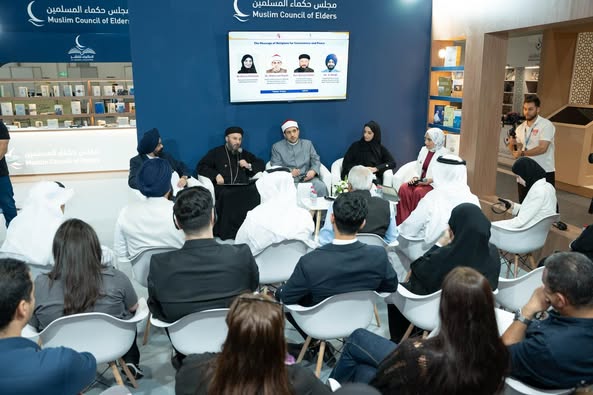
As part of its cultural and intellectual program at the 34th edition of the Abu Dhabi International Book Fair, the Muslim Council of Elders hosted a seminar titled “The Message of Religions for Coexistence and Peace.” The seminar featured a distinguished panel including Dr. Maria Mohammed Al Hatali, Secretary-General of the UAE Council for Fatwa; Dr. Mahmoud Najah, Imam and preacher of Imam Al-Tayeb Mosque at the Abrahamic Family House in Abu Dhabi; Rev. Bishoy Fakhri, Pastor of the Coptic Orthodox Church of St. Anthony in Abu Dhabi; and Mr. S.P. Singh, Chief Sikh Priest and Director General of the Sikh Temple in the UAE.
 
Opening the seminar, Dr. Maria Al Hatali expressed her appreciation for the Muslim Council of Elders’ efforts to amplify the voice of religions in addressing global challenges and countering hate speech and violence. She emphasized the importance of shared religious values—such as belief in human dignity, freedom of belief, citizenship, and justice—noting that these values are common to Islam and other divine traditions.
 
She further explained that extremist groups have distorted religious texts to manipulate and recruit youth, pointing out that 80% of recruitment and radicalization takes place through social media platforms. Dr. Al Hatali stressed the urgent need to renew religious discourse so that it is balanced, relevant, and capable of engaging young people through the digital platforms they use.
 
Dr. Mahmoud Najah expressed thanks to the United Arab Emirates for its pioneering efforts in promoting human fraternity and fostering a culture of coexistence and mutual respect. He praised the mission of the Muslim Council of Elders, under the chairmanship of His Eminence Professor Dr. Ahmed Al-Tayeb, the Grand Imam of Al-Azhar, for its commitment to peacebuilding and the promotion of dialogue, tolerance, and human coexistence.
 
He affirmed that the core values shared across all heavenly religions are rooted in the belief in the oneness of God, pointing out that the Torah, the Gospel, and the Quran all converge on this central principle. He added that all divine laws have consistently emphasized the dignity of the human being, equality among people, and the idea of mutual understanding as a basis for peaceful relations rather than conflict.
 
Rev. Bishoy Fakhri underscored that peace is the essence of faith, not a secondary option. He stated: “We live in a world overwhelmed by the noise of division, yet as followers of divine religions, we carry the light of peace and love.” He expressed his regret that religion is at times misused as a tool for violence and hatred, and he called for the dissemination of religious messages through modern digital platforms to reach younger generations in a language they understand.
 
Mr. S.P. Singh, Chief Sikh Priest and Director General of the Sikh Temple in the UAE, praised the Muslim Council of Elders for its message of human fraternity, interfaith dialogue, and global peace. He affirmed that the teachings of religions emphasize the unity of humanity, despite cultural and linguistic differences.
 
The Muslim Council of Elders’ pavilion at the 2025 Abu Dhabi International Book Fair presents more than 250 diverse intellectual and cultural publications, including a number of the latest releases from Al-Hokama Publishing in 2025. These publications address the most prominent intellectual and cultural issues, stemming from the Council’s mission aimed at promoting peace and instilling the values of dialogue, tolerance, and human coexistence. The Council’s pavilion is located at Booth 10C35, Hall 10.

Muslim Council of Elders Hosts Seminar Titled “The Message of Religions for Coexistence and Peace” at Abu Dhabi International Book Fair Read More »

“Environmental Protection is a Human Responsibility” — Seminar at the Muslim Council of Elders’ Pavilion at the Abu Dhabi International Book Fair

Sheikh Dr. Abdulaziz bin Ali bin Rashid Al Nuaimi: Sustainability embodies the vision of the United Arab Emirates and its wise leadership in preserving the planet and its natural resources

Sheikh Al Nuaimi praises the Muslim Council of Elders’ efforts in promoting the role of religions in environmental conservation

During a seminar held at the Muslim Council of Elders’ pavilion at the Abu Dhabi International Book Fair, Sheikh Dr. Abdulaziz bin Ali Al Nuaimi: Protecting nature begins with human beings recognizing their responsibility toward the Earth 


As part of its cultural and intellectual program at the 34th Abu Dhabi International Book Fair, the Muslim Council of Elders organized a seminar titled “Environmental Protection is a Human Responsibility,” presented by Sheikh Dr. Abdulaziz bin Ali Al Nuaimi, Environmental Advisor to the Government of Ajman and fondly known around the world as “The Green Sheikh.”

At the beginning of the seminar, Sheikh Dr. Al Nuaimi affirmed that sustainability reflects the vision of the United Arab Emirates and its wise leadership in safeguarding the planet and its natural resources, aligning with the vision of the late Sheikh Zayed bin Sultan Al Nahyan — may Allah rest his soul — who famously said: “Give me agriculture, and I shall guarantee you civilization.”

Sheikh Dr. Abdulaziz Al Nuaimi emphasized that integrity is the foundation of sustainability, calling for the adoption of high human values such as honesty, integrity, and justice — values deeply rooted in Emirati society, which he described as a “rare diamond” in its leadership, people, and land. He also praised the efforts of the Muslim Council of Elders, chaired by His Eminence Prof. Dr. Ahmed Al-Tayeb, Grand Imam of Al-Azhar, in strengthening the role of religious leaders in addressing global challenges, foremost among them climate change. He also highlighted the Council’s organization of the Global Summit of Religious Leaders, which resulted in the issuance of “The Call of Conscience: The Abu Dhabi Joint Declaration on Climate,” as well as the historic establishment of the Faith Pavilion — the first of its kind — at COP28 and COP29.

The Green Sheikh further explained that true reading and responsible writing form the pillars of intellectual and cultural sustainability. He stated: “When you open a book, you open a window to a new world and plant seeds of wisdom in your heart. Every act of reading builds the self, and every act of writing is a legacy for future generations.” He urged the audience: “Be readers who build, writers who sow, and humans who cultivate and flourish.” He emphasized that book fairs serve as vibrant spaces for reading, writing, and nurturing minds, citing the Quranic verse: “Nūn. By the pen and what everyone writes!” [The Qur’an, 68:1] to illustrate the sacredness of the word and its role in the making of civilizations.

The Environmental Advisor to the Government of Ajman also called for reviving the lifeblood of rivers and rescuing endangered animals from the threat of extinction. He stressed that protecting nature begins with human awareness of responsibility toward the Earth, sharing his personal experiences, such as his visit to the kingdom of the rare gorillas in Rwanda, noting that these creatures offer a living lesson in behavior and harmony with nature.
 
It is worth mentioning that the Muslim Council of Elders’ pavilion at the 2025 Abu Dhabi International Book Fair is showcasing over 250 diverse intellectual and cultural publications, including several new releases from Al Hokama Publishing for 2025, addressing major contemporary intellectual and cultural issues. This is part of the Council’s broader vision and mission to promote peace, foster dialogue, and reinforce the values of tolerance and human coexistence. The Council’s pavilion is located at the Abu Dhabi National Exhibition Centre (ADNEC), Stand No. 10C35, Hall 10.

“Environmental Protection is a Human Responsibility” — Seminar at the Muslim Council of Elders’ Pavilion at the Abu Dhabi International Book Fair Read More »

Between Two Humanities: A Dream and Wisdom Between Decline and Emergence” — Seminar Concludes Muslim Council of Elders’ Participation at the Rabat International Book Fair

Dr. Samir Boudinar: There is an urgent need for visionary thinkers who can open new horizons for inquiry and reflection

Dr. Mustafa Hijazi: Humanity is a “pure” concept in Islam, and we are now living in the “Age of Wisdom”


The Muslim Council of Elders concluded its participation in the 30th Rabat International Book Fair with a cultural seminar titled “Between Two Humanities: A Dream and Wisdom Between Decline and Emergence.” The session was moderated by Dr. Samir Boudinar, Director of Al Hokama Center for Peace Research, and presented by renowned Egyptian academic and thinker Dr. Mustafa Hijazi.

Opening the seminar, Dr. Samir Boudinar emphasized Dr. Mustafa Hijazi’s profound intellectual vision and research expertise, noting the pressing need for thinkers who can chart bold new paths for questioning and understanding. He stressed the importance of strategic thinkers who can help navigate the complex realities of our societies through both critical and constructive engagement with philosophical and social issues.

In his remarks, Dr. Mustafa Hijazi highlighted the necessity of asking the “right and fundamental questions,” which he referred to as “questions of truth.” He observed that humanity has moved beyond the phase of “rehumanizing humanity” and now stands “at the threshold of an exchange between two humanities.” Dr. Hijazi pointed out that all of humanity traces its origins to a single source, and that the essence of creation is rooted in unity (Tawhid). He described historical divisions — between science and religion, between philosophy, science, and faith — as manifestations of a “non-human” condition marked by conflict and antagonism.
 
Dr. Hijazi further underscored the importance of considering higher moral objectives (maqasid) when developing strategies aimed at serving humanity. He emphasized the clarity and purity of the concept of humanity in Islam and noted that the post-information era has ushered in what he called the “Age of Wisdom.” In this new era, he argued, it is not enough to ask “how” — rather, we must ask the deeper “why” questions, focusing on causality.

The Muslim Council of Elders’ pavilion at the Rabat International Book Fair showcased over 250 diverse intellectual and cultural publications, including a number of its latest 2025 releases from Al-Hokama Publishing, addressing key contemporary intellectual and cultural issues. The Pavilion also hosted a series of cultural and scholarly events featuring prominent scholars, thinkers, authors, academics, and university professors, all in line with the Council’s vision and mission to promote peace and uphold the values of dialogue, tolerance, and human coexistence.

Between Two Humanities: A Dream and Wisdom Between Decline and Emergence” — Seminar Concludes Muslim Council of Elders’ Participation at the Rabat International Book Fair Read More »

Allusive Interpretation: Principles, Guidelines, and Fruits — A Seminar at the Muslim Council of Elders’ Pavilion, Rabat International Book Fair

Dr. Samir Boudinar: Allusive interpretation offers a fresh approach to Qur’anic exegesis, going beyond the apparent meanings to uncover subtle insights revealed through deep reflection on the Holy Qur’an

Dr. Ali Shams Al-Din: Among the fruits of allusive interpretation are sincere devotion to Allah, pure-hearted monotheism, refinement of the soul, and advancement in faith


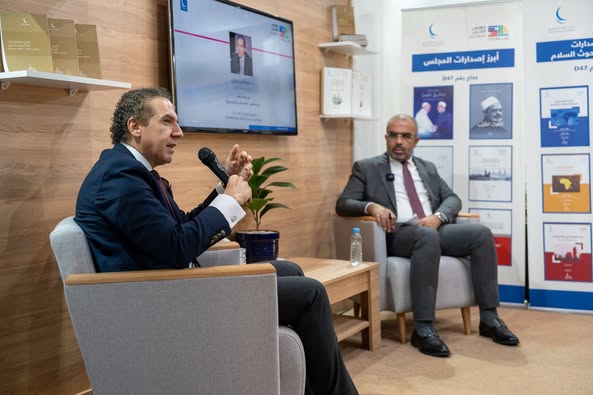
As part of its cultural program at the 30th Rabat International Book Fair, the Muslim Council of Elders’ pavilion hosted a seminar titled “Allusive Interpretation: Principles, Guidelines, and Fruits.” The seminar was moderated by Dr. Samir Boudinar, Director of Al Hokama Center for Peace Research, and presented by Dr. Ali Shams Al-Din, a specialist in Qur’anic studies at the General Secretariat of the Council of Senior Scholars at Al-Azhar.

Opening the session, Dr. Samir Boudinar emphasized that the topic of allusive interpretation has long served as a bridge between scholars of the East and West, captivating generations of scholars and specialists. He explained that allusive interpretation intersects with various fields, including the disciplines of hermeneutics, Qur’anic studies, Arabic language sciences, and the fields of Sufism. Dr. Boudinar described it as a revitalization of Qur’anic interpretation — one that moves beyond surface meanings to the deeper indications that become accessible through profound contemplation of the Holy Qur’an. 

For his part, Dr. Ali Shams Al-Din explained that “allusive interpretation” derives its name from the concept of isharāt (subtle indications). Those who follow this approach are known as the “People of Indications” because they express the meanings they discern during their reading and meditation on the Qur’an through these insights. He noted that the term “allusive interpretation” is deliberately cautious, used by its proponents to acknowledge that true interpretation must adhere to proper foundations — drawing on authentic textual transmission, sound reasoning, and established linguistic norms.

Dr. Ali Shams Al-Din also outlined key aspects of the allusive interpretation of the Holy Qur’an, including its conditions, origins, major works, distinguishing features, and spiritual dimensions. He highlighted that Imam Al-Qushayri was the first scholar to author a major work dedicated specifically to allusive interpretation. He further noted that this method became particularly prominent among the Tabi‘un (the generation of Muslims who followed the Companions [Sahaba] of the Prophet Muhammad, peace be upon him) and their successors during the third and fourth centuries of the Hijri calendar.

Dr. Shams Al-Din emphasized that the fruits of allusive interpretation include cultivating sincere devotion to Allah, achieving pure and heartfelt monotheism, refining the soul, progressing in faith toward the station of Ihsan (spiritual excellence), elevating the spirit to the levels of mystical knowledge (‘irfan), and developing a deep, intuitive perception of hidden meanings while remaining firmly grounded in the recognized outward meanings based on the principles of Arabic linguistic tradition.

The Muslim Council of Elders’ Pavilion at the Rabat International Book Fair showcases over 250 diverse intellectual and cultural publications, including a number of its latest 2025 releases from Al-Hokama Publishing, addressing key contemporary intellectual and cultural issues. The Pavilion also hosts a series of cultural and scholarly events featuring prominent scholars, thinkers, authors, academics, and university professors, all in line with the Council’s vision and mission to promote peace and uphold the values of dialogue, tolerance, and human coexistence. The Council’s Pavilion is located in the Souissi District of Morocco’s capital, Rabat, at Stand D47.

Allusive Interpretation: Principles, Guidelines, and Fruits — A Seminar at the Muslim Council of Elders’ Pavilion, Rabat International Book Fair Read More »

Intra-Islamic Dialogue: A Seminar at the Muslim Council of Elders’ Pavilion at the Abu Dhabi International Book Fair

Dr. Ahmed Al-Haddad, Member of the Muslim Council of Elders: The Unity of the Muslim Ummah is a Religious Necessity to Address Contemporary Challenges
 
Dr. Ahmed Al-Haddad: The Muslim Council of Elders is Making Diligent Efforts to Unify the Ranks of the Muslim Ummah
 
Dr. Ahmed Al-Haddad: The Intra-Islamic Dialogue Conference Represented a Qualitative Leap Towards Unifying the Word of Muslims Under the ‘Call for the People of Qiblah’
 
As part of its cultural and intellectual activities at the 34th edition of the Abu Dhabi International Book Fair, the Muslim Council of Elders organized a seminar titled “Intra-Islamic Dialogue: One Nation and One Shared Destiny.” The seminar was presented by His Eminence Dr. Ahmed bin Abdulaziz Al-Haddad, member of the Muslim Council of Elders, Senior Mufti and Director of the Fatwa Department in Dubai, and member of the UAE Fatwa Council.
 
At the outset of the seminar, Dr. Al-Haddad emphasized that the unity of the Muslim Ummah is a fundamental pillar for achieving peace and stability. He pointed out that division and fragmentation open the doors to destruction, strife, and intellectual invasion. He clarified that the unity of the Muslim Ummah is a divine mandate outlined in the Glorious Quran and advocated by the Prophet Muhammad (peace be upon him), where Allah Almighty commands the believers to hold fast to His rope and not be divided, as stated in the verse: “And hold firmly to the rope of Allah all together and do not become divided.” (The Quran, 3:103).
 
Dr. Al-Haddad added that since its establishment, the Muslim Council of Elders has been keen on building bridges of dialogue among various religions and cultures. One of its most prominent milestones was the signing of the “Document on Human Fraternity,” in Abu Dhabi, in 2019 by His Eminence Professor Dr. Ahmed Al-Tayeb, the Grand Imam of Al-Azhar, and His Holiness Pope Francis, under the patronage of His Highness Sheikh Mohamed bin Zayed Al Nahyan, President of the United Arab Emirates. This event represented a historic moment that advanced the concept of coexistence and global peace.
 
He explained that after the Council’s success in extending bridges of dialogue with followers of other religions, it found an urgent need to focus on intra-Islamic dialogue due to the sectarian differences and divisions that have weakened the Ummah and led to its fragmentation. He confirmed that the call for internal unity has become a religious duty and a collective responsibility. He noted that the Bahrain Conference on Intra-Islamic Dialogue represented a qualitative leap in this direction, as it called for the unity of Muslims under the “Call for the People of Qiblah,” a charter launched by the Grand Imam of Al-Azhar, advocating for it to be a cornerstone for Islamic constants and joint collective action.
 
Dr. Al-Haddad concluded by affirming that the current challenges facing the Ummah, whether sectarian strife, intellectual or moral invasion, require the Ummah to be united. He pointed out that its strength can only be achieved through its unity and solidarity. He directed several important messages to all Muslims, emphasizing the necessity of realizing that Islamic unity is a religious obligation, not an option; adhering to ethical values derived from the Glorious Quran and the Sunnah of the Prophet; being aware of the dangers of division and what it causes in terms of fragmentation, weakness, and disintegration; enhancing cooperation and joint action among the members of the Ummah away from conflict; and prioritizing the interest of the Ummah over narrow interests. He further called for the cooperation of religious, scientific, and media authorities to instill the values of understanding and human fraternity.
 
The Muslim Council of Elders’ pavilion at the 2025 Abu Dhabi International Book Fair presents more than 250 diverse intellectual and cultural publications, including a number of the latest releases from Al-Hokama Publishing in 2025. These publications address the most prominent intellectual and cultural issues, stemming from the Council’s mission aimed at promoting peace and instilling the values of dialogue, tolerance, and human coexistence. The Council’s pavilion is located at Booth 10C35, Hall 10.

Intra-Islamic Dialogue: A Seminar at the Muslim Council of Elders’ Pavilion at the Abu Dhabi International Book Fair Read More »

“The Potential for Renewing Islamic Theology through Personal Experience” — A Seminar by the Muslim Council of Elders at the Rabat International Book Fair

Dr. Samir Boudinar: The Distinguished Scholar Dr. El-Shafei Represents a Renewed Link Between the Scholars of the East and Their Counterparts in the West

Dr. Hasan El-Shafei: Renewal Has Its Conditions, and Among Muslims, It Means Demonstrating the Firm Beliefs Through the Quran and the Sunnah

As part of its cultural program at the 30th edition of the Rabat International Book Fair, the Muslim Council of Elders hosted a seminar titled: “The Potential for Renewing Islamic Theology through Personal Experience.” The seminar was moderated by Dr. Samir Boudinar, Director of the Al-Hokama Center for Peace Research, and featured a keynote address by His Eminence Professor Dr. Hasan Abdullatif El-Shafei, member of the Muslim Council of Elders, member of Al-Azhar’s Council of Senior Scholars, Chairman of the Union of Arabic Language and Science Academies, and former President of the Academy of the Arabic Language in Cairo.

At the beginning of the seminar, Dr. Boudinar emphasized that the presence of His Eminence Sheikh El-Shafei at the Muslim Council of Elders’ pavilion at the Rabat International Book Fair, and his visit to Morocco as a distinguished guest, held “special significance.” He described him as a renewed link between the venerable scholars of the East and their counterparts in the West, particularly between Al-Azhar Al-Sharif in Egypt and Al-Qarawiyyin University in Fez. Dr. Boudinar noted that Dr. El-Shafei is one of the most prominent specialists in Islamic theology, a distinguished scholar whose reputation has spread across the Islamic world, known among scholars and researchers alike for his profound scholarship and meticulous research, both in the East and the West.

For his part, His Eminence Professor Dr. El-Shafei highlighted that there are numerous commonalities in the field of Islamic theology between the scholars of Cairo and Rabat, most notably a “tendency toward institutional renewal” through “scientific bodies” — an approach found uniquely in Morocco and at Al-Azhar headquarters in Egypt. He explained that in the Western world, renewal generally meant reviving Roman legal traditions and Greek philosophy, while in the Islamic context, it involved reviving the “experimental spirit” within Islamic heritage. In the West, renewal concerned fundamentals, beliefs, issues, and proofs, whereas “for the East, renewal focuses on issues, methodological rules, and proofs alone,” noting that “we do not have ecumenical councils that introduce new doctrines into the core of our faith.” He stressed that “renewal among Muslims means demonstrating the established articles of faith through the Quran and the Sunnah.”

His Eminence further explained that renewal has specific conditions, as understood by jurists, hadith scholars, and theologians — including the renowned thinker Ibn Rushd (Averroes), as stated in the early pages of his work “The Decisive Treatise on the Connection Between Islamic Religious Law and Philosophy.” The first condition, he said, is mastery of the Arabic language; the second, not relying on a single proof for a given issue; and the third, profound expertise in the field targeted for renewal. Additionally, he emphasized the necessity of familiarity with contemporary human knowledge and thought, engagement with the intellectual traditions of previous civilizations and Muslim scholars through critical discussion rather than blind acceptance, and a deep understanding of the history and development of Islamic theology.

The Muslim Council of Elders’ pavilion at the Rabat International Book Fair showcases more than 250 diverse intellectual and cultural publications, including several of the latest 2025 releases from Al-Hokama Publishing. These works address some of the most pressing contemporary intellectual and cultural issues. In addition to its publications, the Council is hosting a series of cultural and intellectual activities featuring an elite group of scholars, thinkers, writers, cultural figures, academics, and university professors. This comes in line with the Council’s mission to promote peace and foster the values of dialogue, tolerance, and human coexistence.
The Muslim Council of Elders’ pavilion is located in the Souissi district of Rabat, at Booth D47.

“The Potential for Renewing Islamic Theology through Personal Experience” — A Seminar by the Muslim Council of Elders at the Rabat International Book Fair Read More »

Tunisian President Kais Saied Visits Muslim Council of Elders’ Pavilion at Tunis International Book Fair and Praises Al Hokama Publishing’s Releases

His Excellency Kais Saied, President of the Republic of Tunisia, visited the pavilion of the Muslim Council of Elders at the 39th edition of the Tunis International Book Fair. During his tour of the pavilion, he reviewed the Council’s diverse collection of more than 250 publications available in five languages, addressing prominent intellectual and cultural issues.

President Saied expressed particular interest in several key publications, including “The Call for the People of Qiblah: One Nation and a Shared Destiny” and “The Problems Behind the Division of the Ummah into Sunnis and Shia.” His Excellency emphasized the importance of the unity of the Muslim Ummah, adherence to the fundamental principles of Islam, and the rejection of division, citing the verse from the Quran: “Surely this religion of yours is only one, and I am your Lord, so fear Me alone.” (Quran 23:52).

His Excellency also reviewed “100 Questions on Doctrine, Creed, and Sharia,” with its sections covering issues related to Islamic theology, takfir, jihad, Islamic governance, and other contemporary matters. He underlined the necessity of correcting misconceptions and the importance of properly understanding Islamic heritage, commending the efforts of the Muslim Council of Elders, under the chairmanship of His Eminence Professor Dr. Ahmed Al-Tayeb, Grand Imam of Al-Azhar, in promoting peace, fostering the values of dialogue, tolerance, and coexistence, and striving for the unity of the Muslim Ummah.

The Muslim Council of Elders is participating for the second consecutive year with a dedicated pavilion at the Tunis International Book Fair, held from April 25 to May 4, 2025. The Council is showcasing more than 250 diverse intellectual and cultural titles by Al Hokama Publishing, in line with its mission to promote peace, foster the values of dialogue and tolerance, and build bridges of cooperation and human coexistence.

Tunisian President Kais Saied Visits Muslim Council of Elders’ Pavilion at Tunis International Book Fair and Praises Al Hokama Publishing’s Releases Read More »

Secretary-General of the Muslim Council of Elders Attends Pope Francis’ Funeral and Extends Condolences to Catholic Church Leaders

On Saturday, His Excellency Judge Mohamed Abdelsalam, Secretary-General of the Muslim Council of Elders, attended the funeral of His Holiness Pope Francis of the Catholic Church, who passed away on Monday at the age of 88.

His Excellency conveyed heartfelt condolences to the leaders of the Catholic Church, expressing profound sorrow for the loss of Pope Francis, with whom he shared a deep personal and familial bond spanning nearly a decade.

Representing His Eminence Dr. Ahmed Al-Tayeb, the Grand Imam of Al-Azhar and Chairman of the Muslim Council of Elders, along with the Council’s distinguished members, Judge Abdelsalam reaffirmed the commitment to advancing the path of human fraternity championed by Pope Francis and the Grand Imam. Their enduring partnership yielded transformative global initiatives, including the historic Document on Human Fraternity, which was co-signed in Abu Dhabi in 2019, the inaugural World Conference on Peace Among Religious Leaders in Cairo in 2017, and the East-West Dialogue Forum in the Kingdom of Bahrain in 2022.

Secretary-General of the Muslim Council of Elders Attends Pope Francis’ Funeral and Extends Condolences to Catholic Church Leaders Read More »