
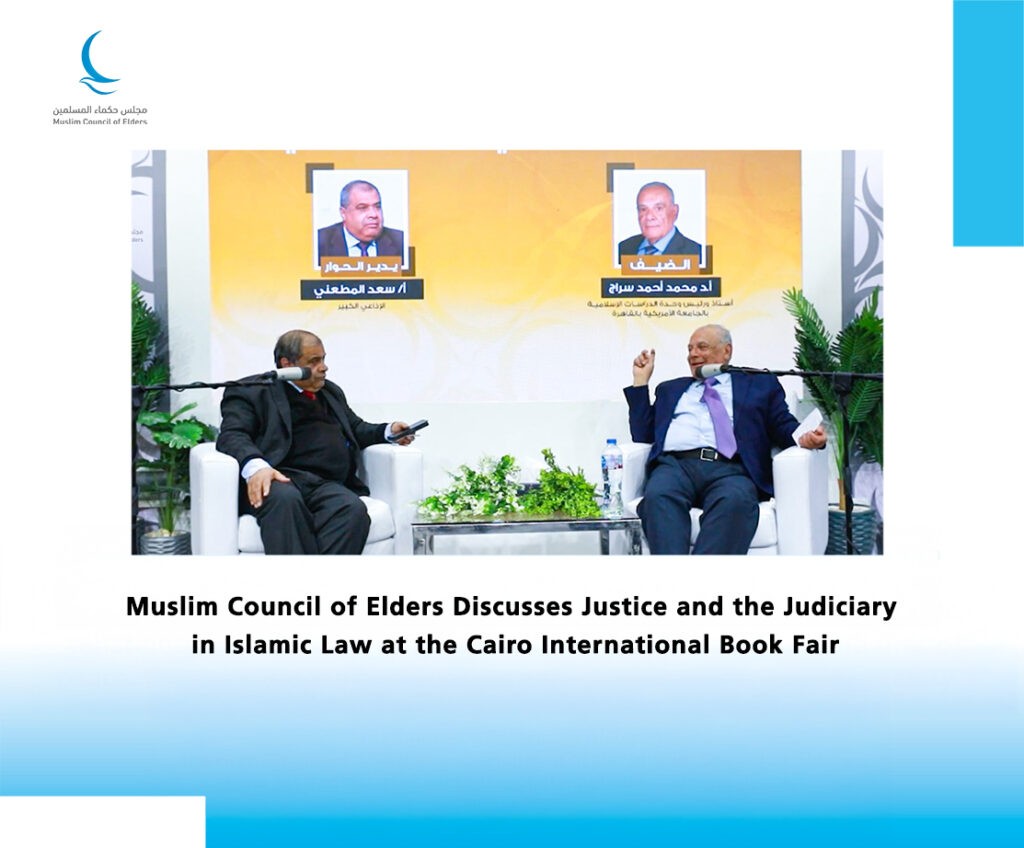
The pavilion of the Muslim Council of Elders held its fourth seminar at the 57th Cairo International Book Fair, titled “Justice and the Judiciary in Islamic Law,” with the participation of Prof. Dr. Mohamed Ahmed Siraj, Professor and Head of the Islamic Studies Unit at the American University in Cairo.
The seminar, moderated by journalist Saad Al‑Matani, examined the ethical and jurisprudential foundations of the concept of justice in Islamic law, the role of the judiciary in upholding human values, safeguarding rights, and achieving balance between legal texts and higher objectives, within a scholarly framework that enhances legal awareness.
During the seminar, Dr. Mohamed Siraj affirmed that the Holy Qur’an sought to establish a legal and legislative system within societies by laying down the governing principles of that system, while leaving it to society to develop the mechanisms necessary to implement those principles. Foremost among these principles, he noted, is justice, which represents the primary axis from which many other principles emerge, such as equality and freedom of belief.
The Head of the Islamic Studies Unit at the American University in Cairo explained that throughout its history, the Islamic world developed a legal system rooted in the authority of the Qur’an. He emphasized that no society can function without a legislative framework that preserves rights and regulates relationships, noting that such a system contributed to the protection of the Islamic state and the realization of justice among people.
Dr. Siraj also pointed out that judges throughout the history of Islamic legislation played a key role in developing high‑level legal principles and establishing judicial precedents that reflected remarkable legal maturity, from which Western legal thought later benefited. He noted that judges in the history of Islamic law enjoyed full independence in carrying out their judicial responsibilities.
The seminar concluded with Dr. Mohamed Siraj calling on researchers and academic institutions to give greater attention to the Islamic legal system, as well as to the curricula and history of judges in Islam, rather than limiting study to abstract legal texts alone. He expressed regret that the volume of academic research published on this heritage in English far exceeds that available in Arabic, and called for addressing this research gap in order to strengthen legal awareness of the treasures of Islamic heritage.
The Muslim Council of Elders is participating at the 57th Cairo International Book Fair, held from 21 January to 3 February 2026. The pavilion features a wide range of the Council’s publications, in addition to organizing a series of seminars, activities, and events focused on promoting the values of peace, and peaceful coexistence among all people.
The Muslim Council of Elders’ pavilion is located next to the Al‑Azhar Pavilion in Heritage Hall No. 4 at the Egypt International Exhibition and Convention Center in the Fifth Settlement.